
What Is Expected Utility?
Expected utility is a cornerstone of decision theory and economics. It measures the average "satisfaction" or value a person can expect from a risky choice, where each possible outcome carries a probability and a utility (a numeric value representing how desirable that outcome is). Rather than averaging raw dollar amounts, expected utility lets you weight outcomes by personal preference, which is why two people facing the same gamble may rationally choose differently.
How to Use This Calculator
Enter a probability and a utility for each possible outcome (up to four). Probabilities are typically decimals between 0 and 1 that should sum to 1, though the calculator also reports the running total so you can check this. Utilities can be any number — positive, negative, or zero. Leave a row blank to skip it. The calculator returns the expected utility, the probability-weighted sum across all outcomes you entered.
The Formula Explained
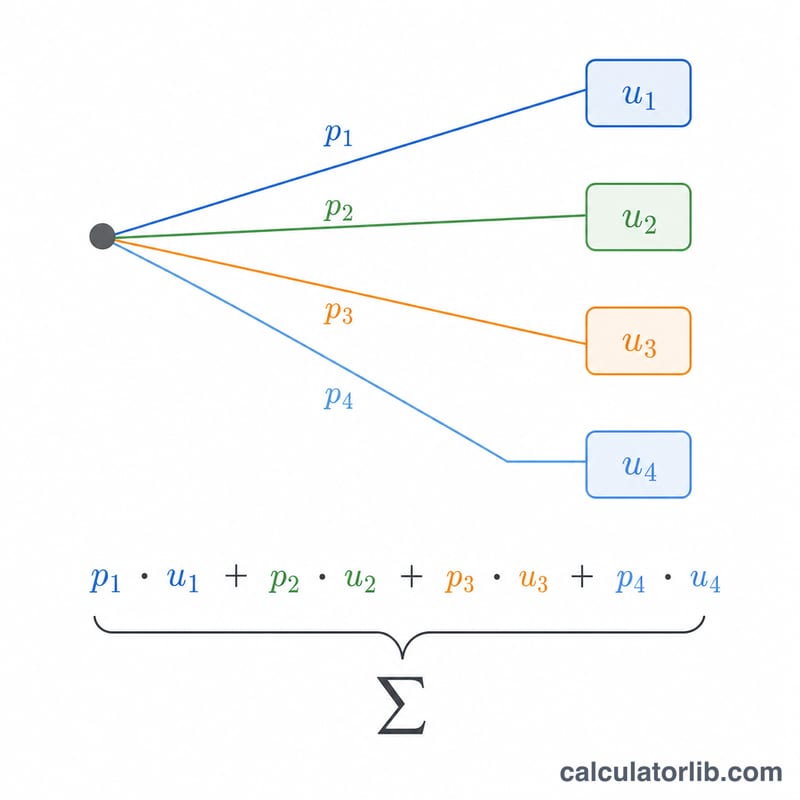
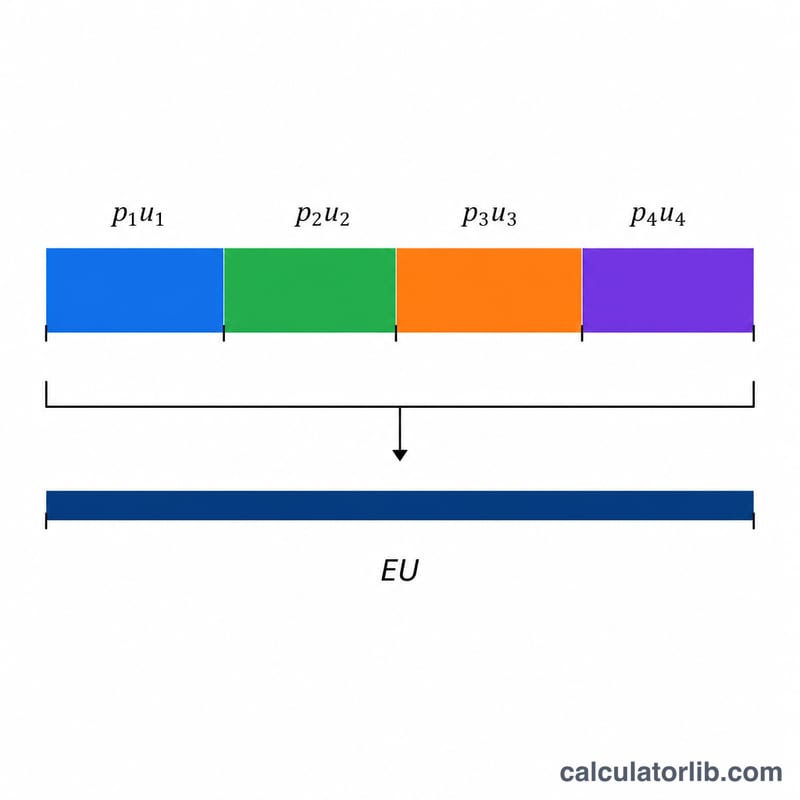
The expected utility formula is $$EU = \sum_{i=1}^{4} p_i \cdot u_i = \text{p}_1 \cdot \text{u}_1 + \text{p}_2 \cdot \text{u}_2 + \text{p}_3 \cdot \text{u}_3 + \text{p}_4 \cdot \text{u}_4.$$ For each outcome i, you multiply its probability \(p_i\) by its utility \(u_i\), then add up all those products. This gives a single number you can compare across competing decisions — the option with the highest expected utility is, in theory, the rational choice.
Worked Example
Suppose a lottery gives a 60% chance of a utility of 50 and a 40% chance of a utility of 10. The expected utility is $$(0.6 \times 50) + (0.4 \times 10) = 30 + 4 = 34.$$ So this gamble has an expected utility of 34, which you would compare to the certain utility of any safe alternative.
FAQ
Should probabilities add to 1? Yes — for a complete set of mutually exclusive outcomes the probabilities should sum to 1. The calculator shows the total so you can verify.
Can utilities be negative? Absolutely. Losses or undesirable outcomes are often given negative utility values, which then reduce the expected utility.
How is this different from expected value? Expected value uses raw monetary outcomes; expected utility uses utility scores that capture risk attitudes, so a risk-averse person assigns diminishing utility to larger gains.