
What Is Lottery Expected Value?
Expected value (EV) is the average amount you would win or lose per ticket if you played the same lottery an enormous number of times. It is the cornerstone of probability theory applied to gambling. For nearly every lottery the expected value is negative, which is exactly how the game funds prizes and profit. This calculator estimates the EV of a single ticket using the jackpot, the odds, and the ticket price.
How to Use It
Enter the jackpot prize, the odds expressed as "1 in N" (for example a 6/49 lottery has odds of 1 in 13,983,816), the cost of one ticket, and how many tickets you plan to buy. The calculator returns the expected value per ticket, your probability of winning, the expected winnings, and the EV across all tickets purchased.
The Formula Explained
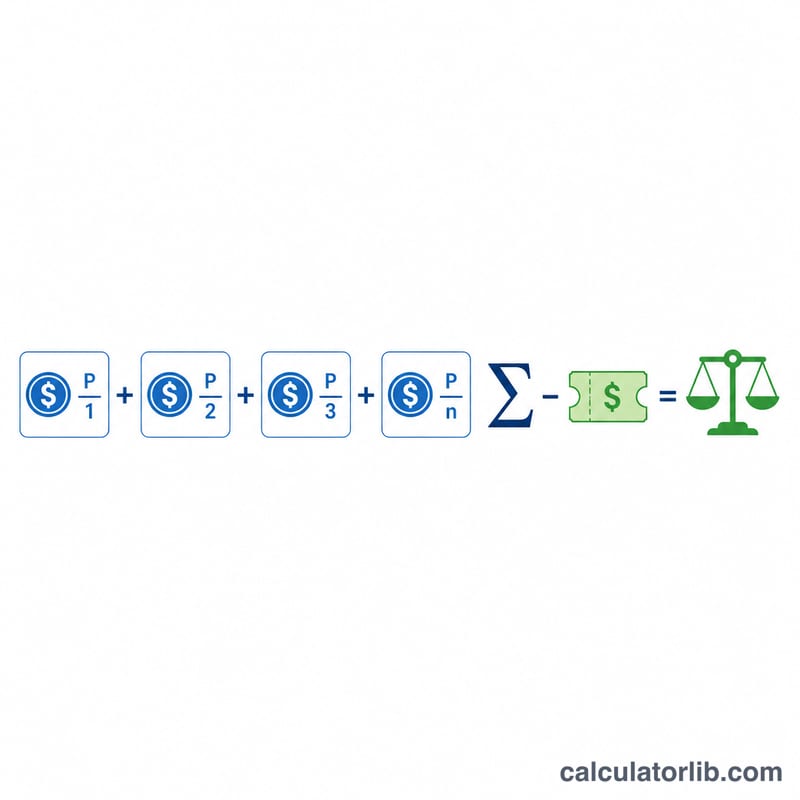
The general rule is \( \text{EV} = \sum \text{prize} \cdot P(\text{prize}) - \text{ticket cost} \). For a simplified single-prize model this becomes
$$\text{EV} = J \times \frac{1}{N} - C,$$where \(J\) is the jackpot, \(N\) is the number of equally likely combinations, and \(C\) is the ticket cost. Multiplying the jackpot by the tiny win probability gives your expected winnings; subtracting the guaranteed cost gives the net expected value.
Worked Example
Suppose the jackpot is $10,000,000, the odds are 1 in 13,983,816, and a ticket costs $2. The probability of winning is
$$\frac{1}{13{,}983{,}816} \approx 0.0000000715.$$Expected winnings:
$$10{,}000{,}000 \times 0.0000000715 \approx \$0.715.$$Subtracting the $2 cost gives an expected value of about \(-\$1.285\) per ticket — meaning you lose roughly $1.29 on average per ticket.
FAQ
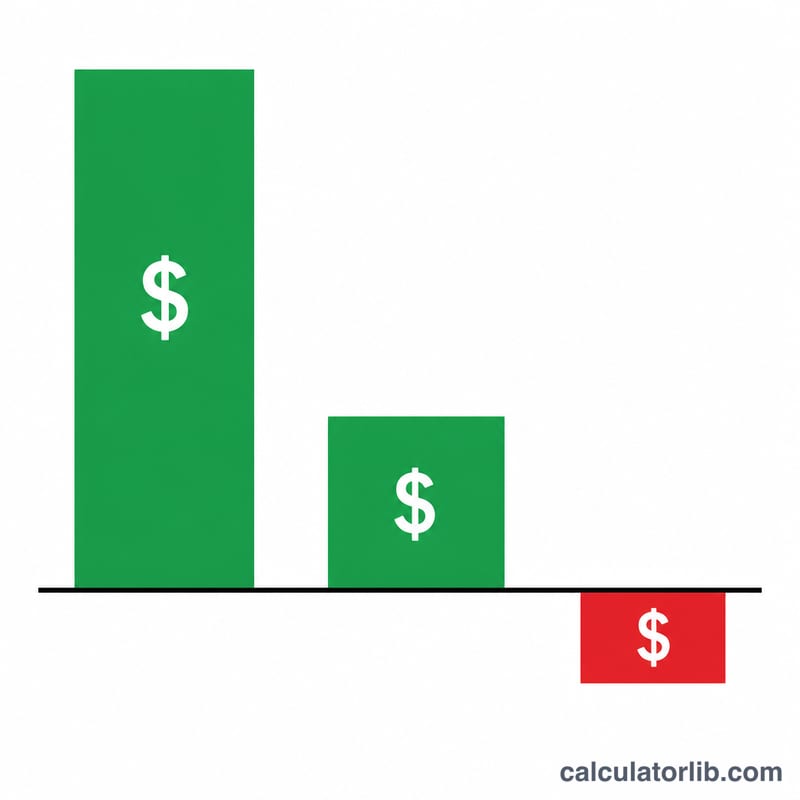
Why is the EV almost always negative? Lotteries are designed so the total prize pool is less than total ticket sales, guaranteeing a long-run loss for players.
Does buying more tickets help? It increases your chance proportionally but multiplies the negative EV too — total expected loss grows with the number of tickets.
Does this account for taxes or smaller prizes? This simplified model uses one main prize. Real lotteries have multiple prize tiers and taxes that typically make the true EV even lower.