
What Is Percent Efficiency?
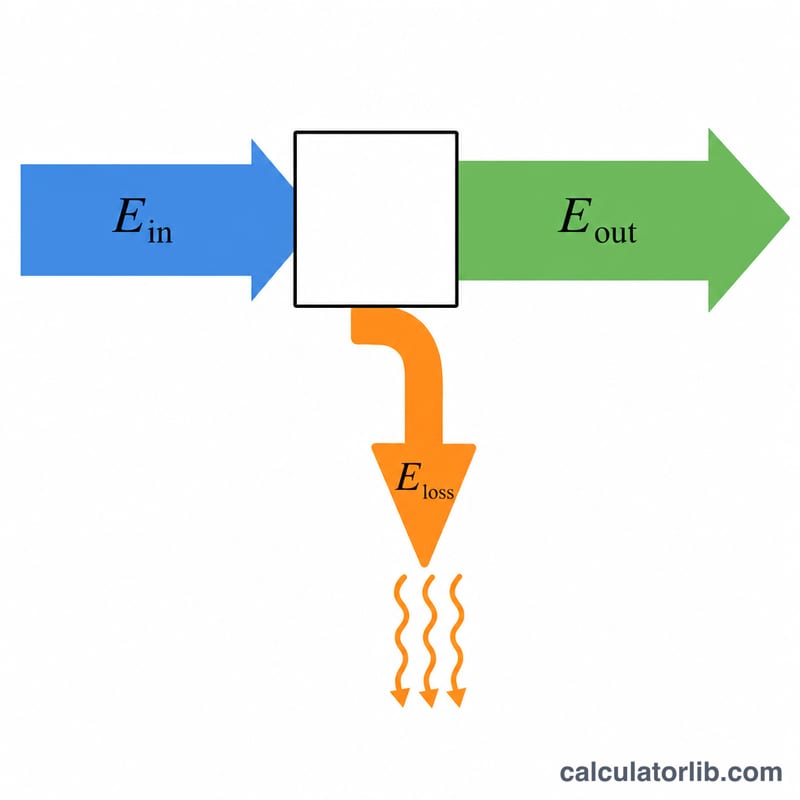
Efficiency measures how much of the energy (or work, power, or resources) you put into a system actually comes out as useful output. A machine, engine, motor, or process is never perfect — some input is always lost to heat, friction, sound, or resistance. Percent efficiency expresses the useful fraction as a number between 0 and 100%, making it easy to compare devices and spot waste.
How to Use This Calculator
Enter the useful output (the energy or work the system delivers) and the total input (the energy or work supplied), using any consistent unit — joules, watts, kWh, or even dollars. The calculator divides output by input, multiplies by 100, and returns the percent efficiency along with the percentage of energy lost.
The Formula Explained
The core equation is:
$$\text{Efficiency} = \frac{\text{Useful Output Energy}}{\text{Total Input Energy}} \times 100\%$$
Because output can never exceed input in a real system, efficiency stays at or below 100%. The remaining share, \(100 - \text{efficiency}\), is the energy lost or wasted.
Worked Example
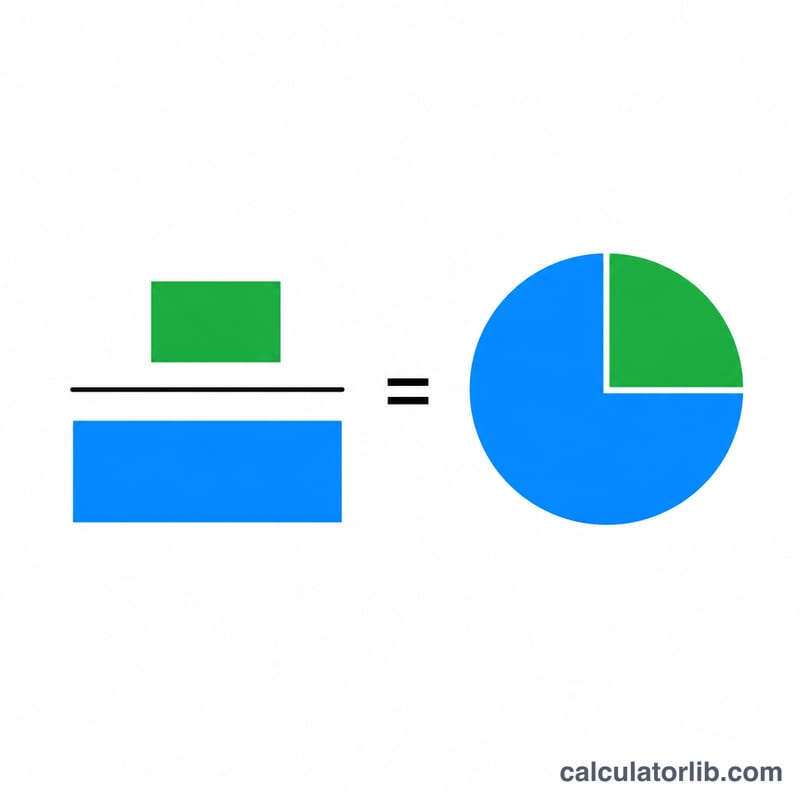
A motor consumes 1,000 J of electrical energy and produces 750 J of mechanical work. Its efficiency is $$\frac{750}{1000} \times 100 = 75\%$$ meaning 25% (250 J) is lost — typically as heat in the windings.
FAQ
Can efficiency exceed 100%? No. For real energy-conserving systems output can never beat input, so anything above 100% signals a measurement error.
What units should I use? Any units work, as long as output and input use the same unit so they cancel out.
Does this apply to power, not just energy? Yes. The same ratio works for power (watts), work (joules), or any matched input/output quantities.