
What is a vertical asymptote?
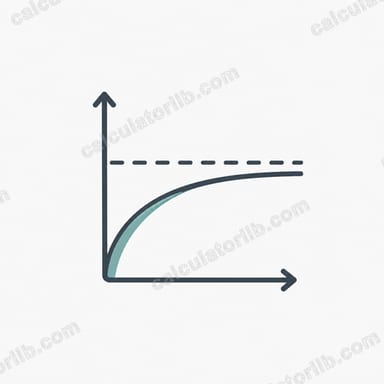
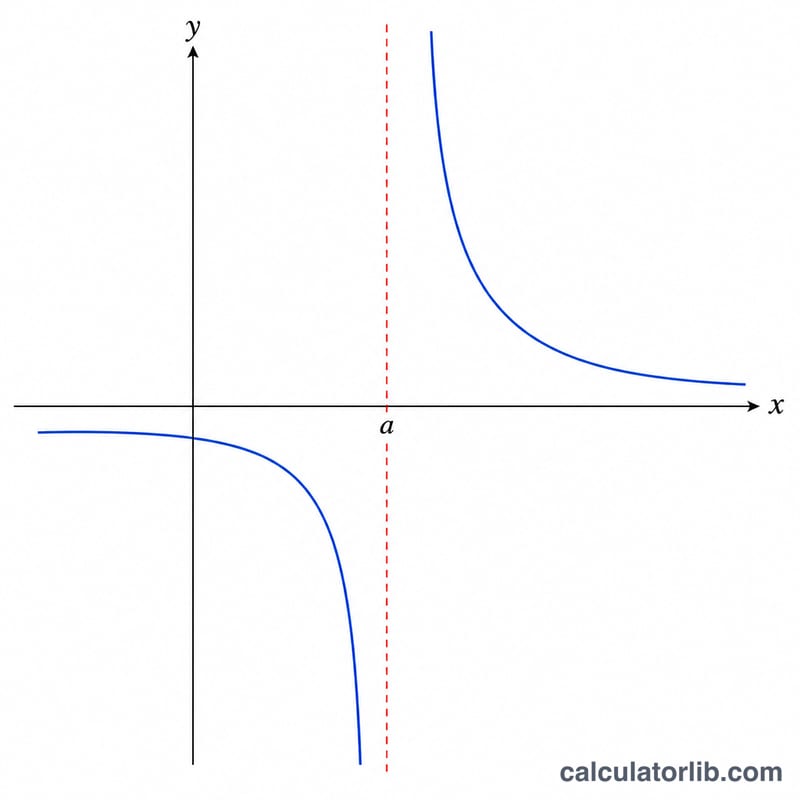
A vertical asymptote is a vertical line \(x = a\) that the graph of a function approaches but never touches, where the function value shoots off toward positive or negative infinity. For a rational function \(f(x) = N(x) / D(x)\), vertical asymptotes occur at the x-values that make the denominator zero — provided the numerator is not also zero there (otherwise you may have a removable hole instead). This calculator focuses on the denominator, treating it as a linear or quadratic polynomial \(a\cdot x^{2} + b\cdot x + c\).
How to use this calculator
Write your function as a fraction and identify the denominator. Enter its coefficients: \(a\) for the x² term, \(b\) for the x term, and \(c\) for the constant. For a linear denominator such as \(x - 3\), set \(a = 0\), \(b = 1\), \(c = -3\). The calculator solves \(a\cdot x^{2} + b\cdot x + c = 0\) and reports each real solution as a vertical asymptote \(x = \text{value}\).
The formula explained
Setting the denominator to zero gives the candidate asymptotes. When \(a = 0\) the equation is linear, with the single solution \(x = -c / b\). When \(a \neq 0\) we use the quadratic formula $$x = \frac{-b \pm \sqrt{b^{2} - 4ac}}{2a}.$$ The discriminant \(b^{2} - 4ac\) decides how many real roots exist: positive gives two asymptotes, zero gives one, and negative gives none.
Worked example
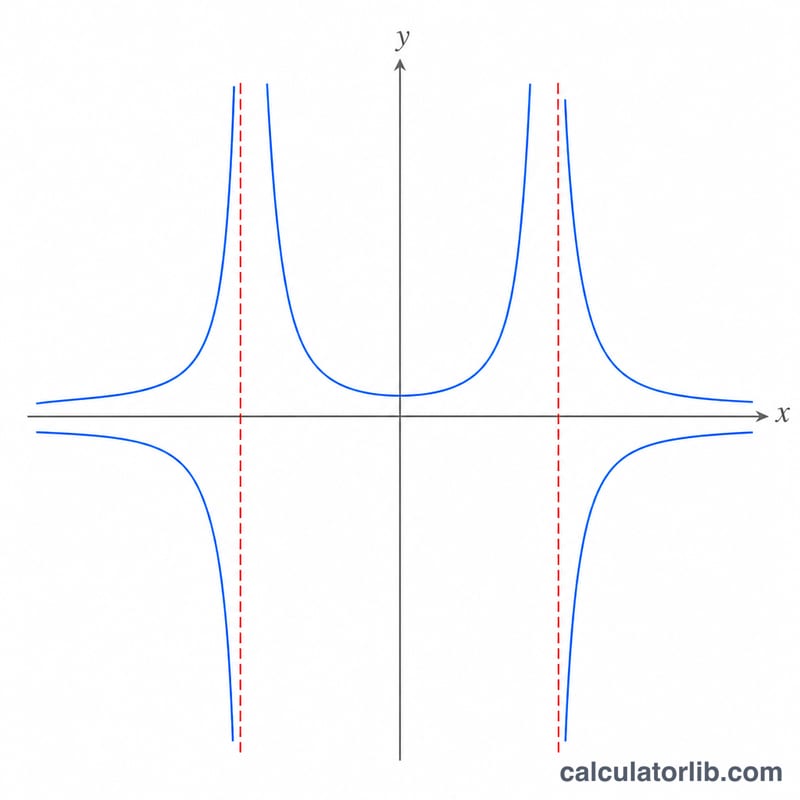
Consider \(f(x) = 1 / (x^{2} - 4)\). Here \(a = 1\), \(b = 0\), \(c = -4\). The discriminant is $$0 - 4(1)(-4) = 16,$$ so \(\sqrt{16} = 4\). The roots are $$\frac{0 \pm 4}{2} = \pm 2.$$ Therefore the function has two vertical asymptotes: \(x = -2\) and \(x = 2\).
FAQ
What if the numerator is zero at the same point? Then that x-value may be a removable discontinuity (hole) rather than an asymptote. This tool assumes the numerator is nonzero at the roots; always check.
Why are there no asymptotes sometimes? If the denominator has no real roots (negative discriminant), it is never zero for real x, so there are no vertical asymptotes.
Can a function have more than two? Yes — higher-degree denominators can have more roots. This calculator handles up to a quadratic denominator (at most two).