
What this calculator does
This tool simplifies a rational expression — a fraction whose numerator and denominator are polynomials. It accepts two quadratics in the form \(a\cdot x^{2} + b\cdot x + c\), finds the roots of each, factors them into \((x - r)\) terms, and cancels any factor that appears on both the top and the bottom. The result is the original ratio reduced to its lowest terms, just as you would do by hand in an algebra class.
How to use it
Enter the three coefficients of the numerator and the three of the denominator. For a linear polynomial like \(x + 2\), set \(a = 0\), \(b = 1\), \(c = 2\). For a pure constant, set \(a = 0\) and \(b = 0\). Click calculate and the tool returns the simplified fraction, the number of common factors cancelled, and the leading coefficient that multiplies the result.
The formula explained
Every quadratic \(ax^{2} + bx + c\) can be written as \(a(x - r_1)(x - r_2)\), where \(r_1\) and \(r_2\) are its roots found with the quadratic formula. Once both polynomials are in factored form, any matching \((x - r)\) factor on top and bottom equals 1 and is removed. The leftover leading numbers combine into a single constant coefficient (the ratio of the two leading coefficients).
$$\frac{\text{na}\,x^{2} + \text{nb}\,x + \text{nc}}{\text{da}\,x^{2} + \text{db}\,x + \text{dc}} = \frac{a_N(x-r_1)(x-r_2)}{a_D(x-s_1)(x-s_2)} \;\xrightarrow{\text{cancel}}\; \frac{\text{numerator}}{\text{denominator}}$$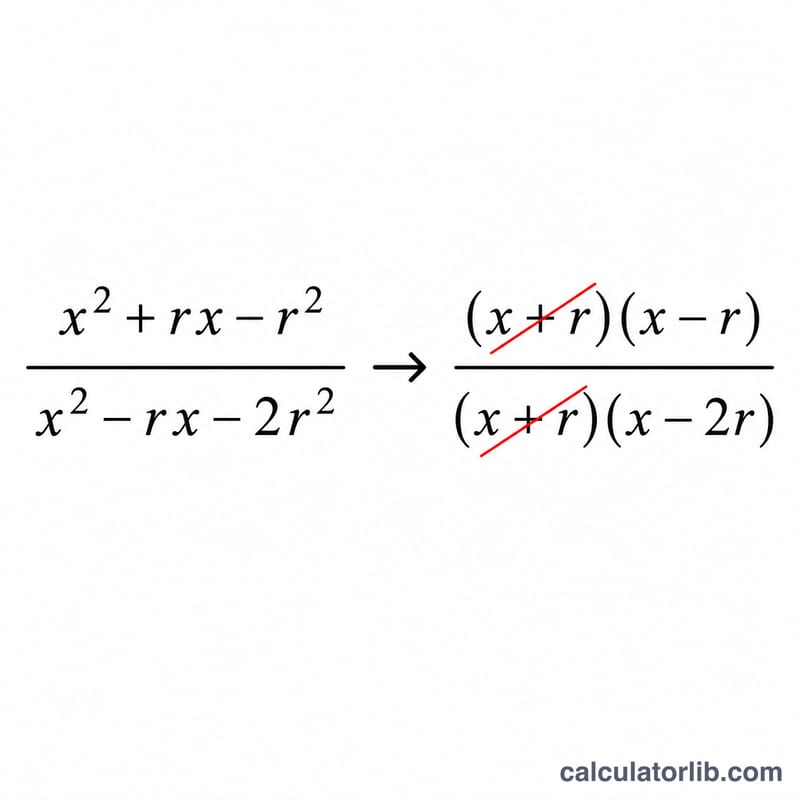
Worked example
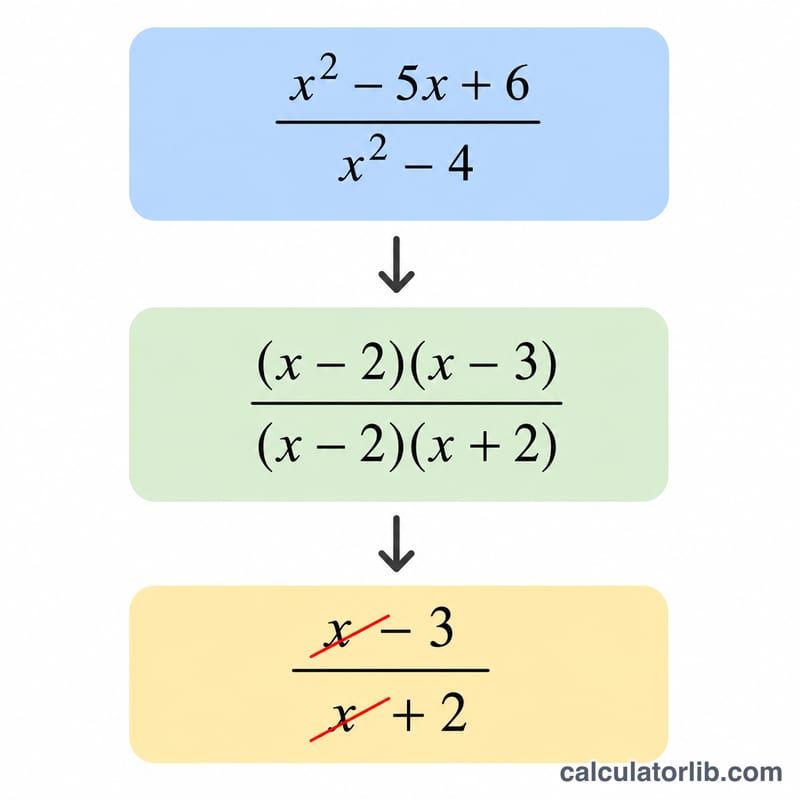
Take \(\dfrac{x^{2} - x - 6}{x^{2} - 6x + 9}\). The numerator factors as \((x - 3)(x + 2)\) and the denominator as \((x - 3)(x - 3)\). The shared \((x - 3)\) cancels, leaving:
$$\frac{x^{2} - x - 6}{x^{2} - 6x + 9} = \frac{(x-3)(x+2)}{(x-3)(x-3)} = \frac{x+2}{x-3}$$One factor was cancelled and the leading coefficient is 1.
FAQ
Can it handle expressions that fully cancel? Yes — if every denominator factor cancels, the result becomes a polynomial or constant with no fraction shown.
What about irrational or repeated roots? Repeated roots cancel one-for-one; irrational roots are matched numerically, so factors that are truly equal still cancel.
Does the answer note domain restrictions? Algebraically the cancelled factor still excludes its root from the domain, but this calculator focuses on the simplified form.