What is the Powerball Odds Calculator?
This tool computes your probability of winning the US Powerball lottery for any prize tier. Powerball draws 5 white balls from a pool of 69 and 1 red Powerball from a pool of 26. The grand jackpot requires matching all five white balls plus the Powerball. These figures reflect the current US game matrix (69/26).
How to use it
Choose the prize tier you want to evaluate — from the jackpot down to a lone Powerball match, or "Any prize" to total all winning combinations. Enter how many distinct tickets (lines) you plan to play, and the calculator shows the odds expressed as "1 in N", the exact probability, and your combined chance across all tickets.
The formula explained
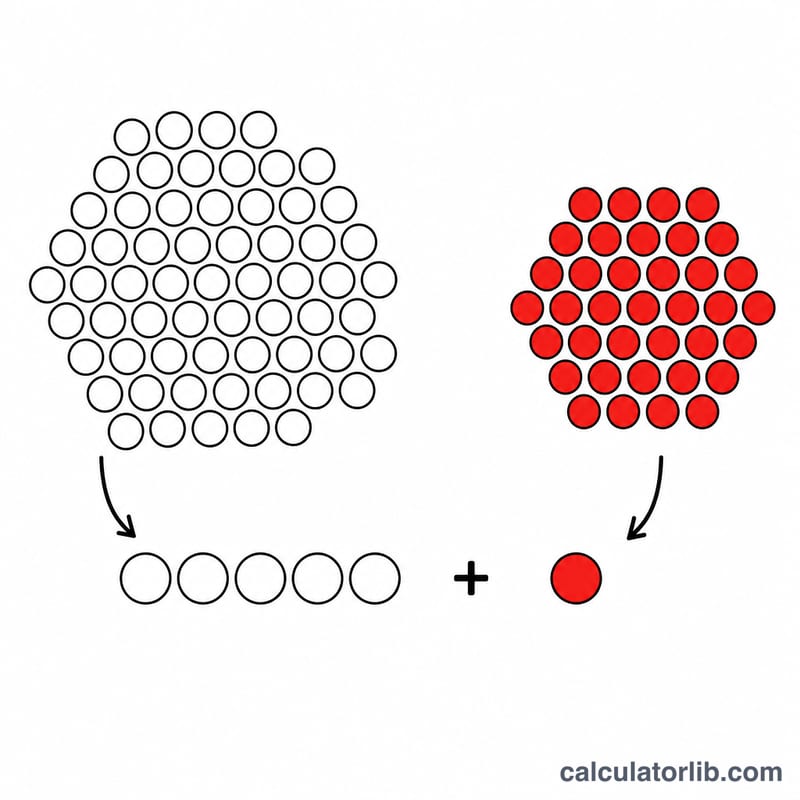
The number of ways to choose 5 white balls from 69 is the binomial coefficient \(C(69,5) = 11{,}238{,}513\). Multiplying by the 26 possible Powerballs gives 292,201,338 equally likely tickets — so the jackpot probability is \(1 / 292{,}201{,}338\). For a tier matching exactly k white balls, the favorable white combinations equal \(C(5,k)\cdot C(64,5-k)\); multiply by \(\frac{1}{26}\) if the Powerball must match, or \(\frac{25}{26}\) if it must not.
Worked example
Match 4 + Powerball: white ways = \(C(5,4)\cdot C(64,1) = 5\cdot 64 = 320\). Probability:
$$P = \frac{320}{11{,}238{,}513}\cdot\frac{1}{26} = \frac{320}{292{,}201{,}338} \approx \frac{1}{913{,}129}$$Across 50 tickets the chance becomes
$$P = 1 - (1-p)^{50} \approx \frac{1}{18{,}263}$$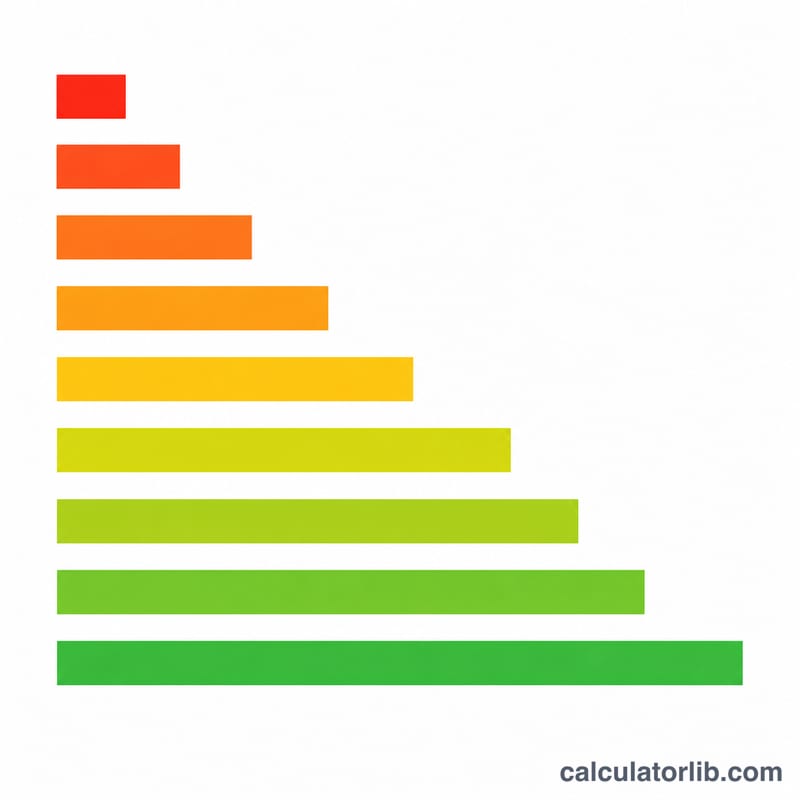
Powerball Prize Tier Odds (69/26 Matrix)
These figures apply to the US Powerball game, where 5 white balls are drawn from 69 and 1 red Powerball from 26. The total number of possible combinations is \(\binom{69}{5} \times 26 = 11{,}238{,}513 \times 26 = 292{,}201{,}338\). Each tier's odds are the total combinations divided by the number of combinations that produce exactly that outcome.
| Tier | White balls matched | Powerball matched | Winning combinations (of 292,201,338) | Odds (1 in N) | Standard base prize (US, without Power Play) |
|---|---|---|---|---|---|
| Jackpot | 5 | Yes | 1 | 1 in 292,201,338 | Jackpot (varies) |
| 2nd | 5 | No | 25 | 1 in 11,688,053.52 | $1,000,000 |
| 3rd | 4 | Yes | 320 | 1 in 913,129.18 | $50,000 |
| 4th | 4 | No | 8,000 | 1 in 36,525.17 | $100 |
| 5th | 3 | Yes | 20,160 | 1 in 14,494.11 | $100 |
| 6th | 3 | No | 504,000 | 1 in 579.76 | $7 |
| 7th | 2 | Yes | 416,640 | 1 in 701.33 | $7 |
| 8th | 1 | Yes | 3,176,880 | 1 in 91.98 | $4 |
| 9th | 0 | Yes | 7,624,512 | 1 in 38.32 | $4 |
Any prize: the nine tiers together cover 11,750,538 winning combinations, so the overall chance of winning something is \(292{,}201{,}338 \div 11{,}750{,}538 \approx\) 1 in 24.87.
The last column lists the standard fixed base prizes and is not part of the odds. Prize amounts can be multiplied by the optional Power Play feature, and the jackpot changes from draw to draw.
FAQ
Why are the jackpot odds 1 in 292 million? Because there are exactly 292,201,338 distinct ticket combinations and only one wins the jackpot.
Do more tickets really help? Yes, but only linearly — doubling tickets roughly doubles a tiny probability. The combined chance is \(1 - (1-p)^{n}\).
Does this account for prize amounts? No. It calculates odds only, not payouts, which vary by draw and ticket sales.