
What this calculator does
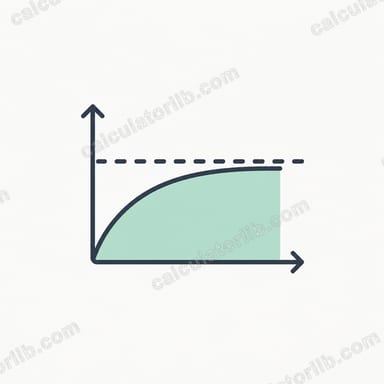
This tool identifies the asymptotes of a rational function, a quotient of two polynomials of the form \(f(x) = \frac{a\,x^{n} + \cdots}{b\,x^{m} + \cdots}\). It returns the horizontal asymptote using the standard degree-comparison rule and helps you locate vertical asymptotes by setting the denominator equal to zero.
How to use it
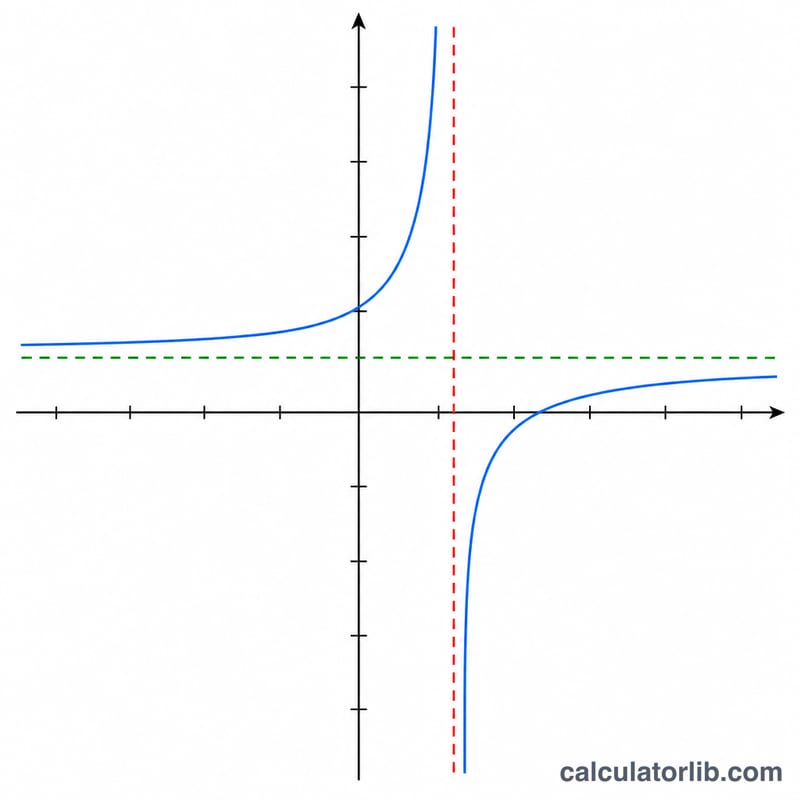
Enter the leading coefficient and degree of the numerator (\(a\) and \(n\)) and of the denominator (\(b\) and \(m\)). The calculator compares the two degrees to determine the horizontal asymptote. If you already know a real value where the denominator is zero, type it into the optional root field to confirm a vertical asymptote \(x = \text{value}\).
The formula explained
The horizontal behaviour of a rational function depends only on the highest-power terms. The general form is
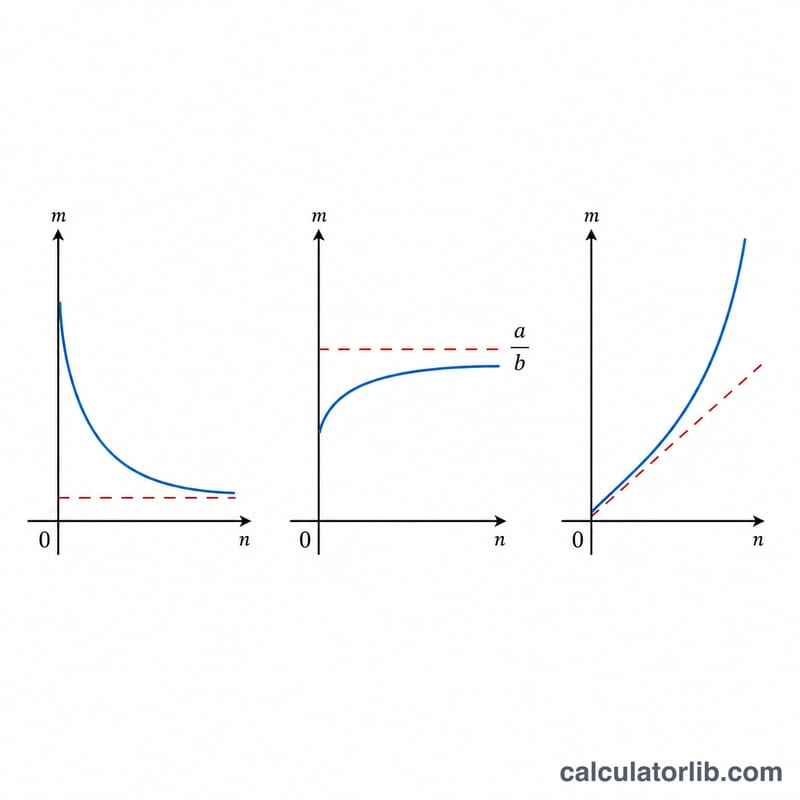
$$y = \frac{a\,x^{n} + \cdots}{b\,x^{m} + \cdots}$$When the numerator degree is smaller than the denominator degree, the function shrinks toward zero, so the horizontal asymptote is
$$\text{HA: } y = 0 \qquad\left(n < m\right);\quad \text{VA: } x = \text{root}$$When the degrees are equal, the function levels off at the ratio of the leading coefficients,
$$\text{HA: } y = \frac{a}{b} \qquad\left(n = m\right);\quad \text{VA: } x = \text{root}$$When the numerator degree is larger, the function grows without bound, so there is no horizontal asymptote (there may instead be an oblique or polynomial asymptote).
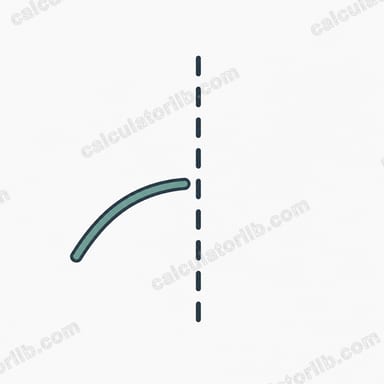
$$\text{No HA} \qquad\left(n > m\right);\quad \text{VA: } x = \text{root}$$Vertical asymptotes appear at \(x\)-values that make the denominator zero while the numerator stays nonzero.
Worked example
Consider \(f(x) = \frac{2x + 3}{x^2 - 1}\). The numerator degree is 1 and the denominator degree is 2, so \(n < m\) and the horizontal asymptote is \(y = 0\). The denominator factors as \((x - 1)(x + 1)\), giving vertical asymptotes at \(x = 1\) and \(x = -1\). Entering \(a = 2\), \(n = 1\), \(b = 1\), \(m = 2\) and \(\text{root} = 1\) confirms \(y = 0\) with a vertical asymptote at \(x = 1\).
FAQ
Can a rational function cross its horizontal asymptote? Yes. A horizontal asymptote describes end behaviour as \(x\) approaches \(\pm\infty\); the graph may cross it for finite \(x\).
What if degrees differ by exactly one? There is no horizontal asymptote, but an oblique (slant) asymptote exists, found by polynomial long division.
Why enter a root for the vertical asymptote? Finding denominator roots requires solving a polynomial equation, which this lightweight tool does not do automatically; supplying a known root lets it report the vertical asymptote directly.