What is a scale factor?
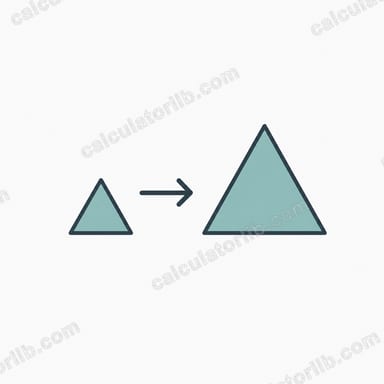
A scale factor (often written k) is the number you multiply every length of a figure by to produce a similar, larger or smaller figure. It describes a dilation: when \(k > 1\) the figure is enlarged, when \(0 < k < 1\) it is reduced, and when \(k = 1\) the figure is unchanged. Scale factors appear in geometry, maps, blueprints, model building, and image resizing.

How to use this calculator
Enter the original dimension (a length on the starting figure) and the matching new dimension (the corresponding length on the scaled figure). The calculator divides the new value by the original value to give the linear scale factor k, then squares it for the area ratio and cubes it for the volume ratio.
The formula explained
The core relationship is $$k = \dfrac{\text{New dimension}}{\text{Original dimension}}$$ Because area is a two-dimensional measure, it scales by \(k^{2}\); volume is three-dimensional, so it scales by \(k^{3}\). For example, doubling every length (\(k = 2\)) makes the area four times larger and the volume eight times larger.

Worked example
Suppose a model is built from an original length of 4 cm and the corresponding new length is 10 cm. Then $$k = 10 \div 4 = 2.5$$ The area ratio is $$2.5^{2} = 6.25$$ meaning the new figure has 6.25 times the surface area. The volume ratio is $$2.5^{3} = 15.625$$ so it holds about 15.6 times the volume.
Interpreting Your Scale Factor
The scale factor \(k\) compares a new (image) length with the matching original length: $$k = \frac{ {\text{new dimension}}}{ {\text{original dimension}}}$$ The sign and size of \(k\) tell you what kind of dilation has taken place.
- \(k > 1\): enlargement. The image is larger than the original. For example, \(k = 2.5\) makes every length 2.5 times as long.
- \(0 < k < 1\): reduction. The image is smaller than the original. For example, \(k = 0.4\) shrinks every length to 40% of its original size.
- \(k = 1\): congruent figure. The image is the same size and shape as the original, so nothing is stretched or shrunk.
- \(k < 0\): negative scale factor. The size changes by \(|k|\), so \(|k| > 1\) is an enlargement and \(0 < |k| < 1\) is a reduction. The image is also rotated 180° about the center of dilation and lies on the opposite side of that center. For example, \(k = -2\) doubles the size and flips the figure through the center.
Going the other way
The scale factor from the new figure back to the original is the reciprocal, \(1/k\). If the original-to-new factor is 4, the new-to-original factor is \(1/4 = 0.25\). If you swap the two dimensions in the calculator, you get this reciprocal.
Reading the area and volume ratios
- Area ratio = \(k^2\). Areas scale with the square of the linear factor. If \(k = 3\), every area is \(3^2 = 9\) times as large.
- Volume ratio = \(k^3\). Volumes scale with the cube. If \(k = 3\), every volume is \(3^3 = 27\) times as large.
- For a reduction these ratios shrink faster than the lengths do. With \(k = \tfrac{1}{2}\), the area ratio is \(\tfrac{1}{4}\) and the volume ratio is \(\tfrac{1}{8}\).
- Angles do not change under a dilation, and neither do ratios between lengths within the same figure.
Converting a map or model scale
A scale written as \(1:n\) means 1 unit on the drawing or model represents \(n\) units in reality. Going from the real object to the model, \(k = \tfrac{1}{n}\). For example, a 1:50 scale gives \(k = \tfrac{1}{50} = 0.02\), so a 10 m wall is drawn as \(10 \times 0.02 = 0.2\) m (20 cm). Going from the model to the real object, the factor is \(n\), which is 50 here. A scale such as 2:1 is an enlargement with \(k = 2\). Make sure both lengths use the same units before you divide.
When the result is valid
A single scale factor describes a whole figure only if the original and the new figure are similar, meaning corresponding angles are equal and all corresponding lengths are in the same ratio. If a rectangle is stretched more in width than in height, there is no single \(k\), and applying \(k^2\) or \(k^3\) to areas or volumes will give wrong answers. Always compare corresponding sides, such as the longest side with the longest side, before trusting the result.
FAQ
What does a scale factor less than 1 mean? It means the figure shrinks. For example \(k = 0.5\) halves every length.
Why does area use k² and not k? Area depends on two dimensions multiplied together, so each is scaled by k, giving \(k \times k = k^{2}\).
Can I use any unit? Yes, as long as the original and new dimensions use the same unit, the scale factor is unitless.