
What Is a Quarter-Wave Antenna?
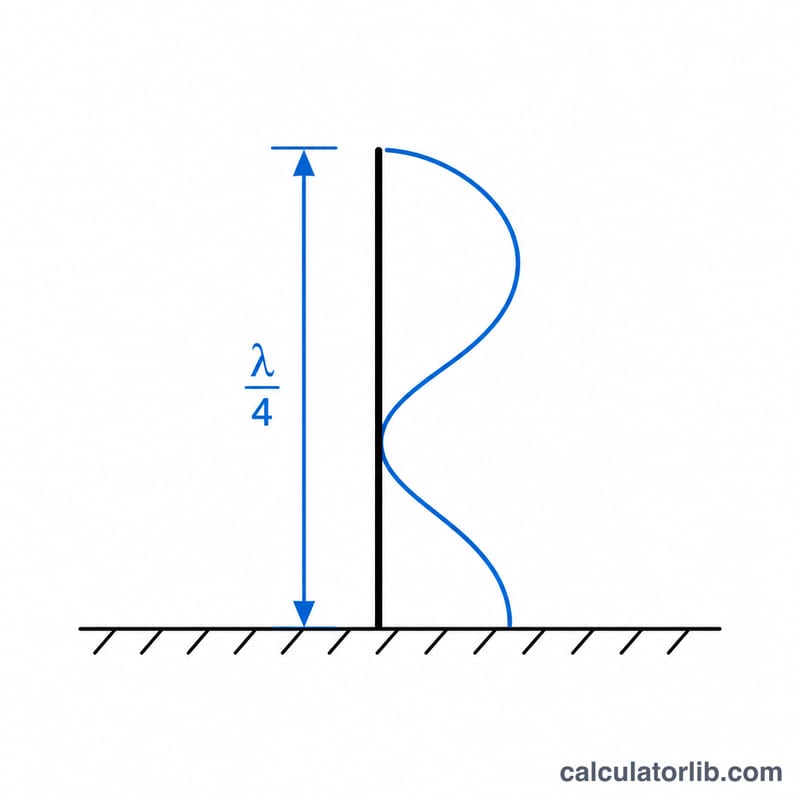
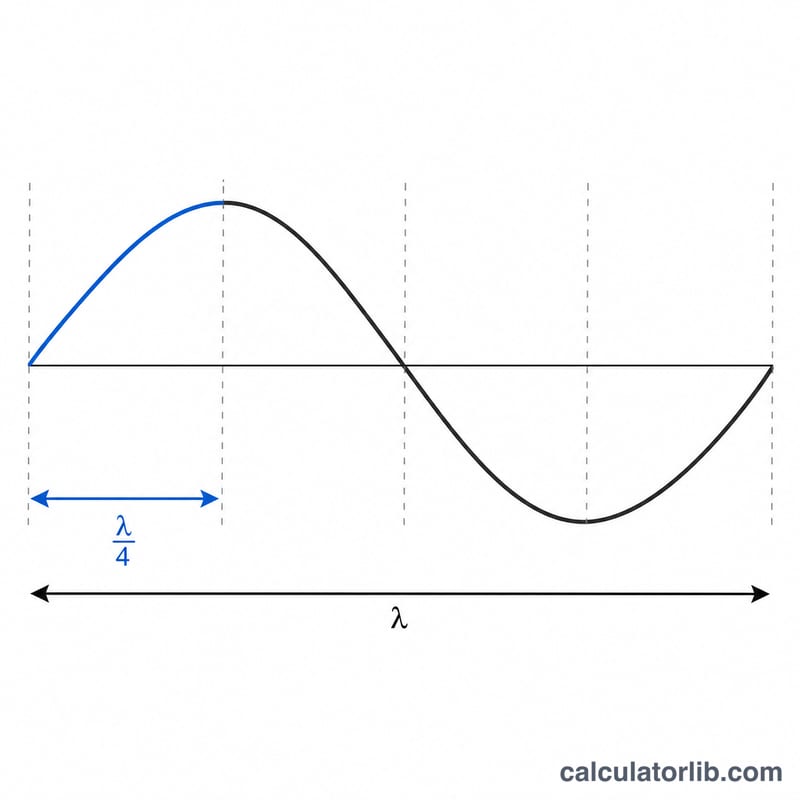
A quarter-wave antenna (such as a quarter-wave monopole or one element of a dipole) has a physical length equal to one quarter of the operating wavelength. Because it resonates naturally at the design frequency, it offers an efficient, easy-to-build option for ham radio, CB, Wi-Fi, FM, and many other RF projects. This calculator converts a target frequency into the length you should cut your wire or rod.
How to Use It
Enter the operating frequency in megahertz (MHz) and the velocity factor of your conductor. The velocity factor accounts for the fact that signals travel slightly slower in a real wire than in free space. A typical bare wire is around 0.95–0.97, while insulated wire or coax can be lower. If you are unsure, 0.95 is a reasonable starting point. The calculator returns the quarter-wave length in meters, centimeters and inches, plus the full free-space wavelength.
The Formula Explained
The speed of light gives a handy shortcut: wavelength (m) = 300 / frequency (MHz). A quarter of that is multiplied by 0.25, then by the velocity factor:
$$L = \frac{300}{f_{\text{MHz}}} \times 0.25 \times \text{VF}$$
The 300 comes from the speed of light (≈300,000,000 m/s) expressed conveniently against MHz.
Worked Example
For a 100 MHz signal with a velocity factor of 0.95: the full wavelength is \(300 / 100 = 3\) m. A quarter of that is 0.75 m, and applying the velocity factor gives $$0.75 \times 0.95 = 0.7125 \text{ m}$$ or about 71.25 cm (28.05 in).
FAQ
Why include a velocity factor? Radio waves move slightly slower in a physical conductor, so the resonant length is a bit shorter than the free-space quarter wave.
What VF should I use? Bare copper wire is commonly modeled around 0.95–0.97. End effects on thicker elements can lower this further; trim and tune for best SWR.
Is this exact? It gives a strong starting point. Real-world factors like wire diameter, insulation, and nearby objects mean you should fine-tune with an SWR or antenna analyzer.