
What Is the Length Contraction Calculator?
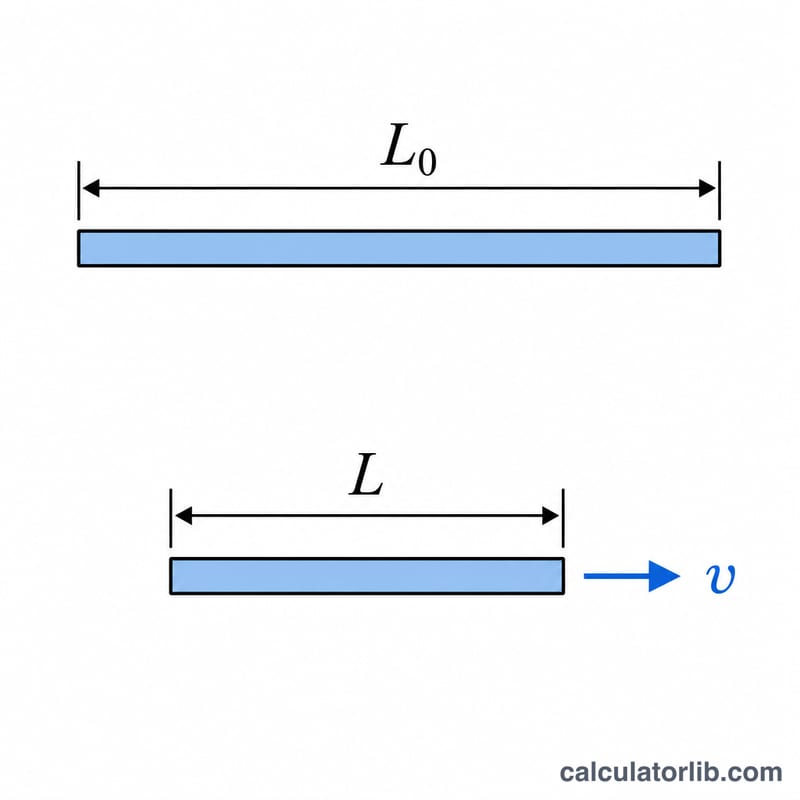
This calculator applies Einstein's special relativity to work out how the length of a moving object appears to shrink when measured by a stationary observer. The effect, called length contraction, only becomes noticeable at speeds approaching the speed of light (c = 299,792,458 m/s). The tool takes the object's true ("proper") length and its velocity, then returns its contracted length along with related figures.
The Inputs You Provide
- Proper Length (L₀) in meters — the length of the object measured in its own rest frame, i.e. when it is not moving relative to you.
- Velocity (v) in m/s — how fast the object is travelling. This must be less than the speed of light (299,792,458 m/s), otherwise the maths breaks down.
The Formula Explained
The calculator uses the standard length contraction equation:
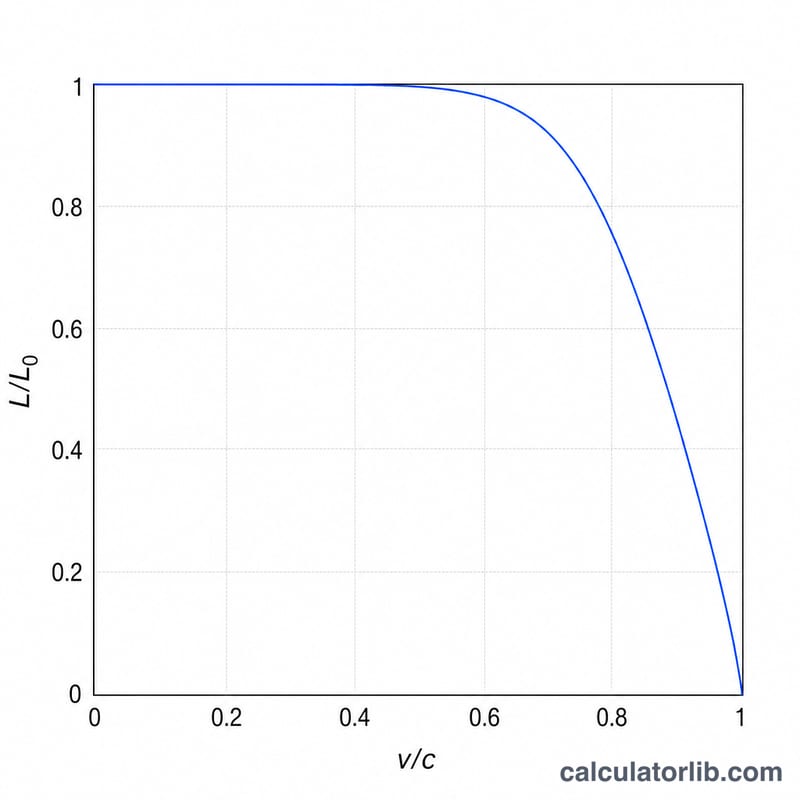
L = L₀ √(1 − v²/c²)
Internally it computes the Lorentz factor γ = 1 / √(1 − v²/c²) and then divides the proper length by it, since L = L₀ / γ — mathematically identical to the formula above. The term √(1 − v²/c²) is always between 0 and 1, so the contracted length is always shorter than the proper length. It also reports velocity as a percentage of light speed and the percentage of contraction.
Worked Example
Suppose a spaceship has a proper length of 100 meters and travels at 150,000,000 m/s (roughly half the speed of light).
- v/c = 150,000,000 / 299,792,458 ≈ 0.5003, so velocity is about 50% of light speed.
- √(1 − 0.5003²) ≈ √(0.7497) ≈ 0.8659
- Contracted length L = 100 × 0.8659 ≈ 86.59 meters
- Contraction percentage ≈ 13.4%
So a stationary observer would measure the 100-meter ship as roughly 86.6 meters long.
Frequently Asked Questions
Does the object actually get shorter? No physical squashing occurs. The contraction is a real measurement effect of relativity for an observer in a different reference frame; in the object's own frame it keeps its proper length.
Why must velocity be below the speed of light? At exactly c, the term inside the square root becomes zero and γ becomes infinite; above c it turns negative, giving an imaginary result. Massive objects cannot reach or exceed light speed.
Why is contraction tiny at everyday speeds? Even a jet at 300 m/s gives v/c so small that √(1 − v²/c²) is essentially 1, making the change far too small to notice. The effect only matters near relativistic speeds.