
What This Wing Loading Calculator Does
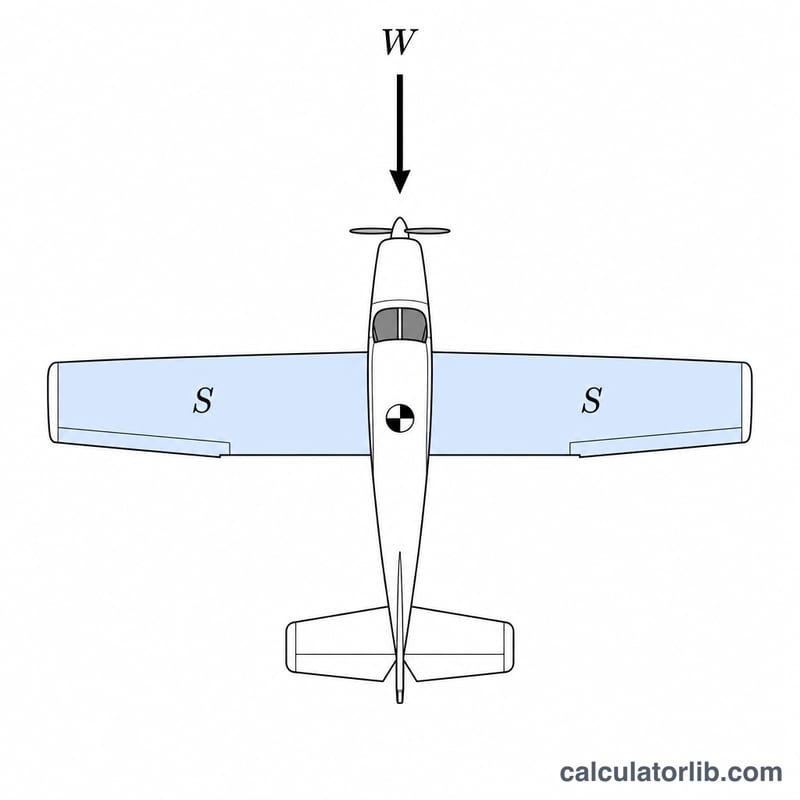
Wing loading is one of the most telling numbers in aircraft design. It tells you how much weight each square foot of wing has to support. This calculator takes two simple inputs—Aircraft Weight (lbs) and Wing Area (sq ft)—and returns the wing loading in pounds per square foot (lb/ft²). It also derives two related figures from those inputs: an estimated stall speed and a lift coefficient, so you get a quick performance snapshot rather than a single number. Units here are US customary (pounds and square feet), the convention common in general aviation in the United States.
The Formula
The core calculation is straightforward division:
- Wing Loading = Aircraft Weight ÷ Wing Area
From that result, the tool estimates a stall-related speed as the square root of (wing loading × 1.2), and then a lift coefficient as (2 × Weight) ÷ (1.225 × Wing Area × speed²), where 1.225 kg/m³ is standard sea-level air density. These secondary values are simplified indicators for comparison, not certified flight figures.
How to Use It
- Enter the total aircraft weight in pounds (use gross or loaded weight depending on the comparison you want).
- Enter the wing area in square feet—the projected planform area of the wing.
- Read the wing loading instantly, along with the derived stall speed and lift coefficient.
Worked Example
Suppose a light aircraft weighs 1,500 lbs with a wing area of 150 sq ft.
- Wing Loading = 1,500 ÷ 150 = 10 lb/ft²
- Stall speed estimate = √(10 × 1.2) = √12 ≈ 3.46
- Lift coefficient = (2 × 1,500) ÷ (1.225 × 150 × 3.46²) ≈ 1.36
A loading of 10 lb/ft² is typical of a docile trainer, while sailplanes sit much lower and jets far higher.
FAQ
Why does wing loading matter? Lower wing loading generally means gentler stall behaviour, shorter takeoff/landing runs and better low-speed maneuverability. Higher wing loading gives a smoother ride in turbulence and higher cruise speeds.
What's a typical wing loading value? Gliders may be 5–8 lb/ft², light single-engine aircraft around 10–20 lb/ft², and airliners well over 100 lb/ft².
Should I use empty or gross weight? Use gross (loaded) weight for worst-case performance estimates; use empty weight only when comparing structural design baselines.