
What is the Debye Length?
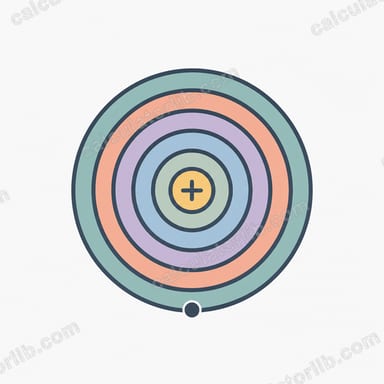
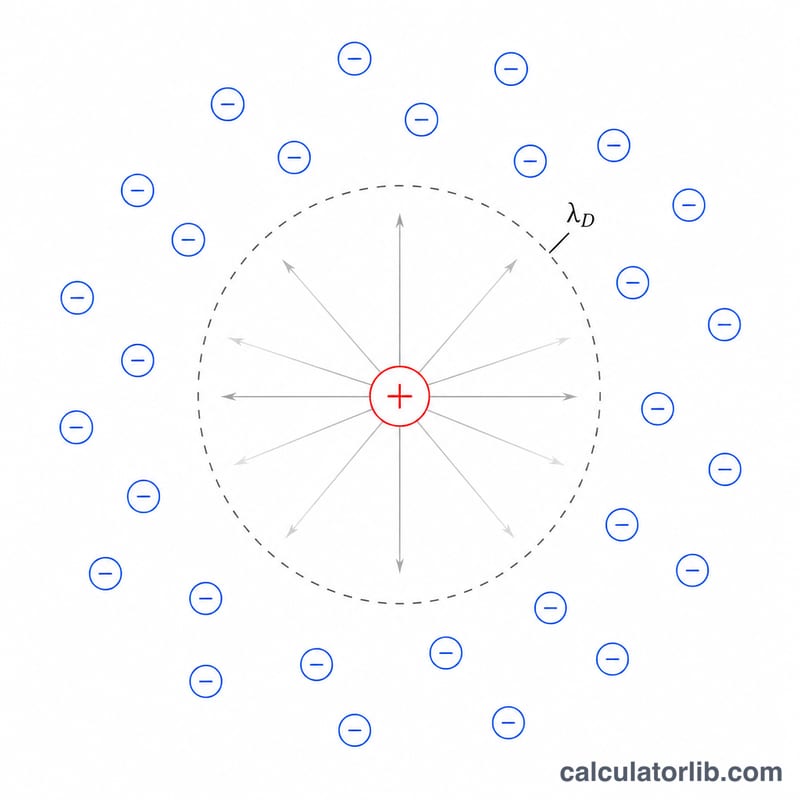
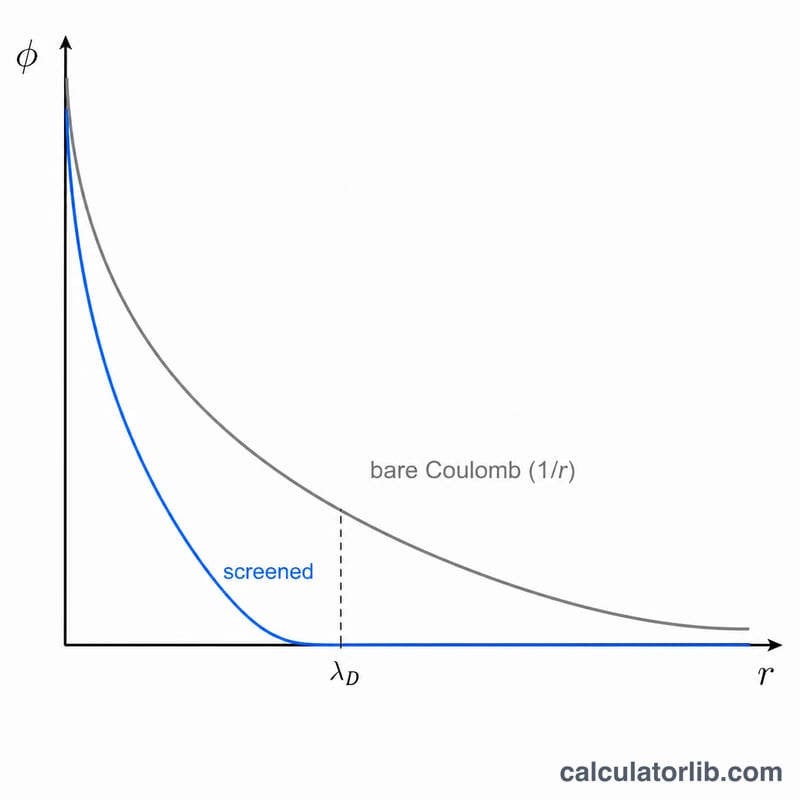
The Debye length (\(\lambda_D\)) is the characteristic distance over which mobile charge carriers in a plasma or electrolyte screen out electric fields. Beyond this distance, the electric potential of a charge is effectively shielded by the surrounding sea of opposite charges. It is one of the most fundamental scales in plasma physics, electrochemistry, and semiconductor physics.
How to Use This Calculator
Enter the relative permittivity of the medium (\(\varepsilon_r \approx 1\) for a plasma in vacuum, \(\approx 80\) for water), the temperature in kelvin, the charge-carrier number density in particles per cubic meter, and the charge per particle in units of the elementary charge \(e\). The calculator returns the Debye length in meters, millimeters, and micrometers.
The Formula
The Debye length is given by $$\lambda_D = \sqrt{\dfrac{\varepsilon\,k_B\,T}{n\,q^2}},$$ where \(\varepsilon = \varepsilon_r\,\varepsilon_0\) is the permittivity (\(\varepsilon_0 = 8.854\times10^{-12}\ \text{F/m}\)), \(k_B = 1.381\times10^{-23}\ \text{J/K}\) is the Boltzmann constant, \(T\) is temperature, \(n\) is the number density, and \(q\) is the carrier charge (\(q = Z\,e\) with \(e = 1.602\times10^{-19}\ \text{C}\)).
Worked Example
For a hydrogen plasma with \(\varepsilon_r = 1\), \(T = 10{,}000\ \text{K}\), \(n = 1\times10^{18}\ \text{m}^{-3}\), and \(q = e\): the numerator is $$\varepsilon_0\,k_B\,T = 8.854\times10^{-12} \times 1.381\times10^{-23} \times 10^4 \approx 1.2226\times10^{-30}.$$ The denominator is $$n\,q^2 = 10^{18} \times (1.602\times10^{-19})^2 \approx 2.567\times10^{-20}.$$ The ratio is \(\approx 4.762\times10^{-11}\), and its square root is \(\approx 6.90\times10^{-6}\ \text{m}\), i.e. about \(6.9\ \mu\text{m}\).
FAQ
Why does temperature increase the Debye length? Hotter particles move faster and are harder to confine, so the screening distance grows as \(\sqrt{T}\).
What density should I use? Use the number density of the charged species that does the screening — typically the electron density in a plasma.
Does charge sign matter? No — the charge enters as \(q^2\), so only its magnitude affects the result.