
什么是德拜长度?
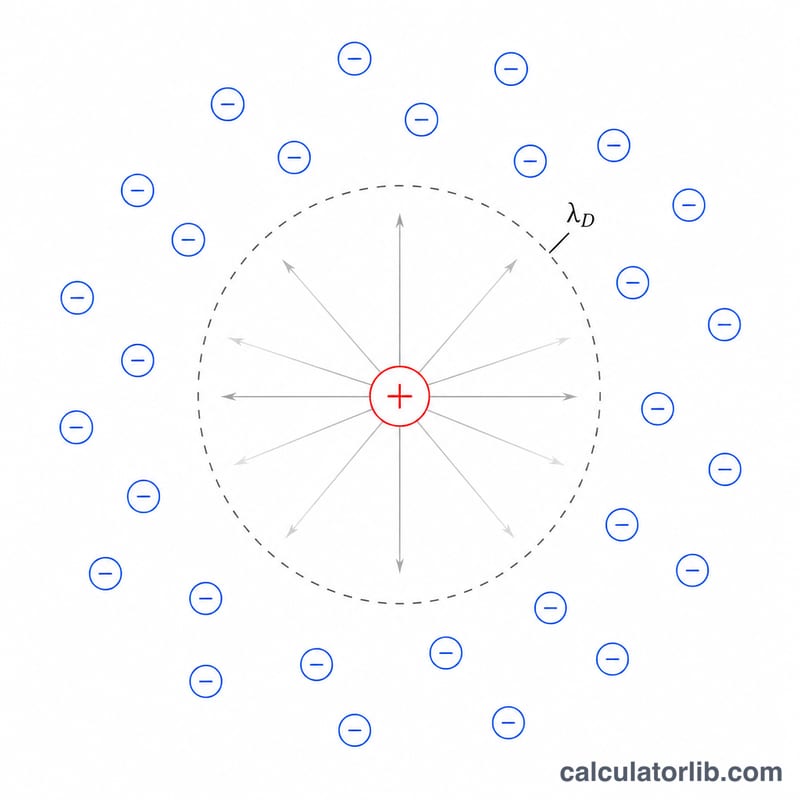
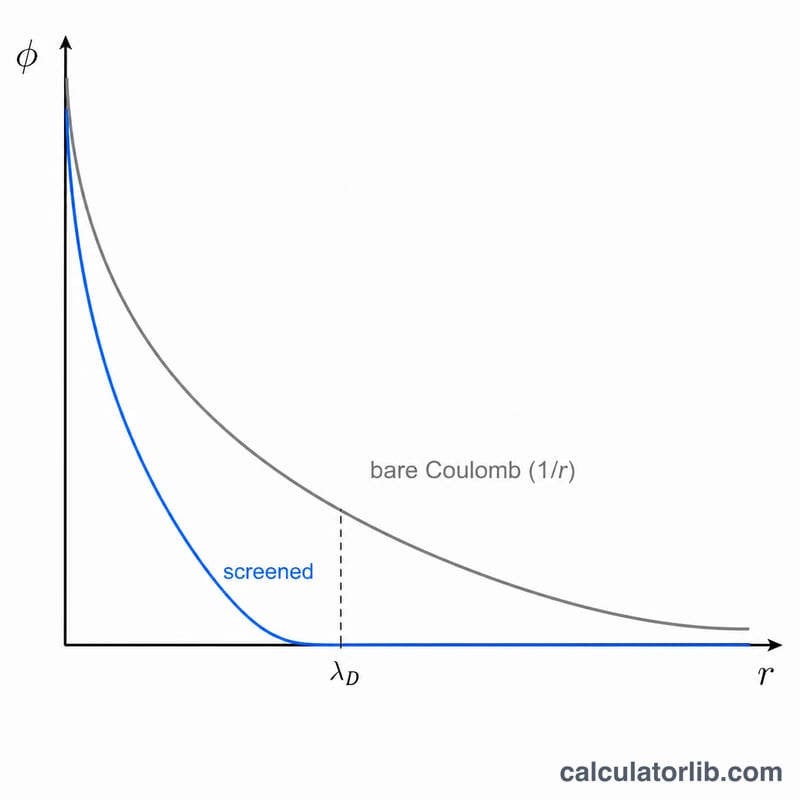
德拜长度(\(\lambda_D\))描述的是等离子体或电解质中可移动电荷载流子屏蔽电场的特征距离。超过这一距离后,某个电荷产生的电势便会被周围异号电荷"海洋"有效地屏蔽掉。它是等离子体物理、电化学和半导体物理中最基本的尺度之一。
如何使用本计算器
依次填入介质的相对介电常数(真空中的等离子体 \(\varepsilon_r \approx 1\),水约为 80)、以开尔文为单位的温度、以"每立方米粒子数"为单位的电荷载流子数密度,以及以基本电荷 \(e\) 为单位的单粒子电荷量。计算器会同时给出以米、毫米和微米表示的德拜长度。
计算公式
德拜长度的表达式为
$$\lambda_D = \sqrt{\dfrac{\varepsilon \cdot k_B \cdot T}{n \cdot q^2}}$$其中 \(\varepsilon = \varepsilon_r \cdot \varepsilon_0\) 为介电常数(真空介电常数 \(\varepsilon_0 = 8.854\times10^{-12}\ \text{F/m}\)),\(k_B = 1.381\times10^{-23}\ \text{J/K}\) 为玻尔兹曼常数,\(T\) 为温度,\(n\) 为数密度,\(q\) 为载流子电荷(\(q = Z \cdot e\),基本电荷 \(e = 1.602\times10^{-19}\ \text{C}\))。
计算实例
以氢等离子体为例:\(\varepsilon_r = 1\),\(T = 10{,}000\ \text{K}\),\(n = 1\times10^{18}\ \text{m}^{-3}\),\(q = e\)。分子为
$$\varepsilon_0 \cdot k_B \cdot T = 8.854\times10^{-12} \times 1.381\times10^{-23} \times 10^4 \approx 1.2226\times10^{-30}$$分母为
$$n \cdot q^2 = 10^{18} \times (1.602\times10^{-19})^2 \approx 2.567\times10^{-20}$$两者相除约为 \(4.762\times10^{-11}\),再开平方根得到约 \(6.90\times10^{-6}\ \text{m}\),即大约 6.9 µm。
常见问题
为什么温度升高会让德拜长度变大? 温度越高,粒子运动越快、越难被束缚,因此屏蔽距离会按 \(\sqrt{T}\) 的规律增大。
应该用哪个数密度? 应当使用真正起屏蔽作用的带电粒子的数密度——在等离子体中通常就是电子的数密度。
电荷的正负有影响吗? 没有。公式中电荷以 \(q^2\) 的形式出现,因此只有电荷的大小会影响结果,正负号无关紧要。