
What Is Drift Velocity?
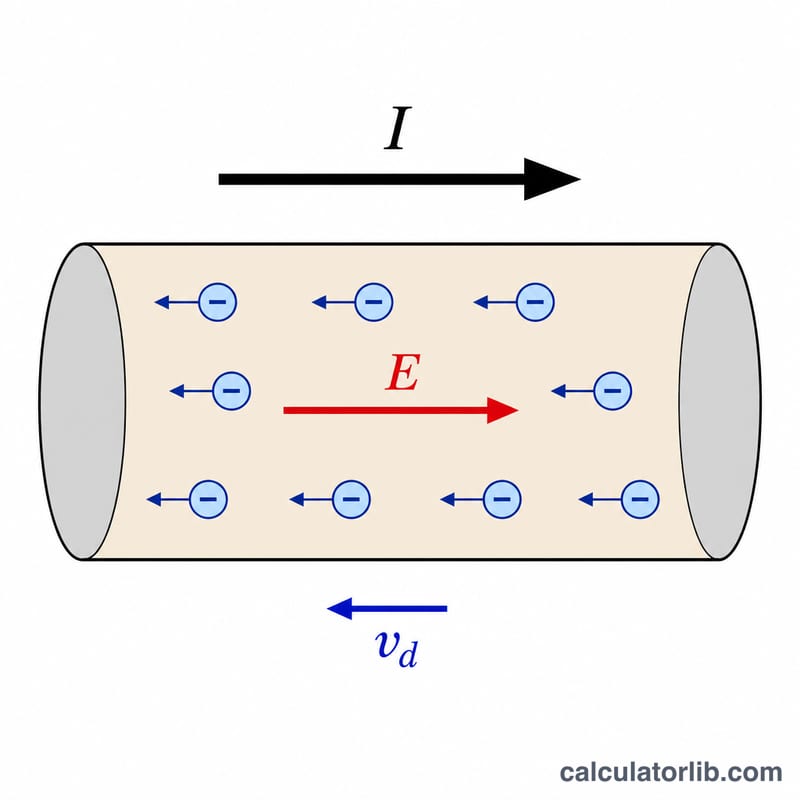
Drift velocity is the average velocity that charge carriers (typically electrons) attain in a conductor due to an applied electric field. Although individual electrons move randomly at high speeds, their net drift in the direction of current flow is surprisingly slow — often just fractions of a millimetre per second. This calculator finds the drift velocity from the current, the charge carrier density, the wire's cross-sectional area, and the charge of each carrier.
How to Use This Calculator
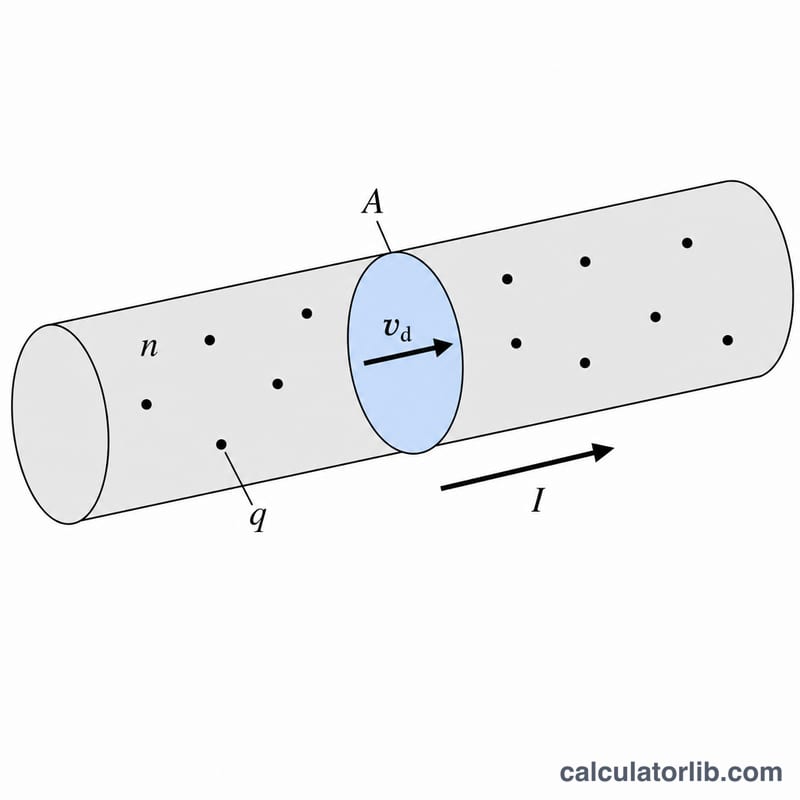
Enter the current I in amperes, the charge carrier density n (number of carriers per cubic metre — about 8.5×10²⁸ for copper), the cross-sectional area A in square metres, and the charge per carrier q (1.602×10⁻¹⁹ C for an electron). The calculator returns the drift velocity in metres per second. You can use scientific notation such as 8.5e28 in any field.
The Formula Explained
The relationship comes from the definition of current as charge flow per unit time: $$v_d = \frac{\text{Current }I}{\text{Density }n \cdot \text{Area }A \cdot \text{Charge }q}$$ Here the denominator \(n\cdot A\cdot q\) represents the total mobile charge per unit length of the conductor. Dividing the current by this quantity yields the average speed at which carriers must move to deliver that current.
Worked Example
Consider a copper wire carrying 1 A with \(n = 8.5\times10^{28}\ /\text{m}^3\), \(A = 1\times10^{-6}\ \text{m}^2\) (1 mm²), and \(q = 1.602\times10^{-19}\ \text{C}\). The denominator is $$8.5\times10^{28} \times 1\times10^{-6} \times 1.602\times10^{-19} \approx 13617.$$ So $$v_d = \frac{1}{13617} \approx 7.34\times10^{-5}\ \text{m/s}$$ — about 0.073 mm/s, far slower than the near-light-speed signal propagation.
FAQ
Why is drift velocity so slow? Because the carrier density is enormous; vast numbers of electrons each moving slowly still carry a large current.
Does this differ from signal speed? Yes — the electrical signal travels near the speed of light, while individual electrons drift very slowly.
What value of q should I use? For electrons use the elementary charge 1.602×10⁻¹⁹ C; for ions use the appropriate multiple.