
What is the Electric Dipole Moment?
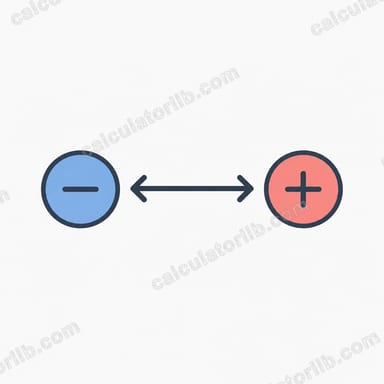
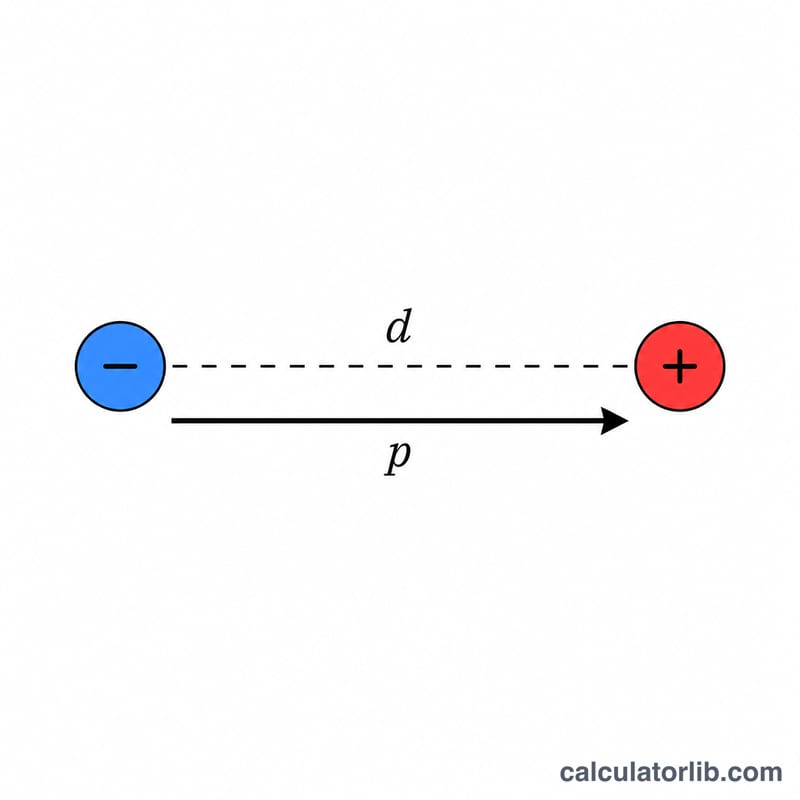
An electric dipole consists of two equal and opposite charges separated by a small distance. The electric dipole moment p measures the strength and orientation of this charge separation. It is a vector pointing from the negative to the positive charge, and its magnitude is simply the product of the charge magnitude and the separation distance.
How to Use This Calculator
Enter the magnitude of the charge q in coulombs (C) and the separation distance d in meters (m). The calculator returns the dipole moment in coulomb-meters (C·m) and also converts it to the more common molecular-scale unit, the debye (D).
The Formula Explained
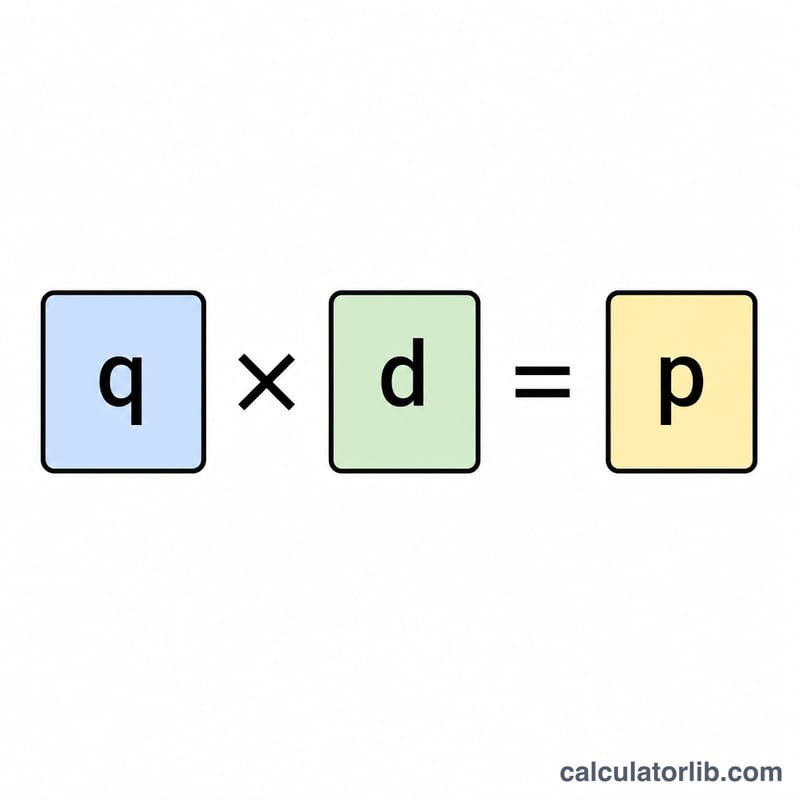
The defining equation is $$p = q \times d$$ Here q is the charge in coulombs and d is the separation in meters, giving p in coulomb-meters. To express the result in debye, divide by the conversion factor \(3.33564095 \times 10^{-30}\) C·m per debye, since \(1\ \text{D} \equiv 10^{-18}\ \text{esu}\cdot\text{cm}\).
Worked Example
Suppose a charge of 1 C is separated by 1 m. Then $$p = 1 \times 1 = 1\ \text{C}\cdot\text{m}.$$ Converting: \(1 \div 3.33564095 \times 10^{-30} \approx 2.998 \times 10^{29}\ \text{D}\). For a more realistic molecular dipole, an electron charge (\(1.6 \times 10^{-19}\) C) over 0.1 nm (\(1 \times 10^{-10}\) m) gives \(p = 1.6 \times 10^{-29}\ \text{C}\cdot\text{m} \approx 4.8\ \text{D}\).
FAQ
What units does dipole moment use? The SI unit is the coulomb-meter (C·m), but chemists usually use the debye (D), where \(1\ \text{D} \approx 3.336 \times 10^{-30}\ \text{C}\cdot\text{m}\).
Why is the moment a vector? It has both magnitude and direction, pointing from the negative toward the positive charge, which determines how the dipole interacts with electric fields.
Can I enter scientific notation? Yes — values like 1.6e-19 are accepted for very small charges and distances.