
What is a Dipole Antenna Calculator?
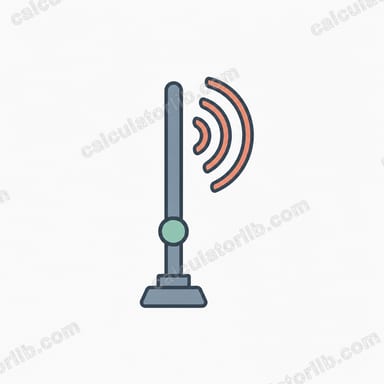
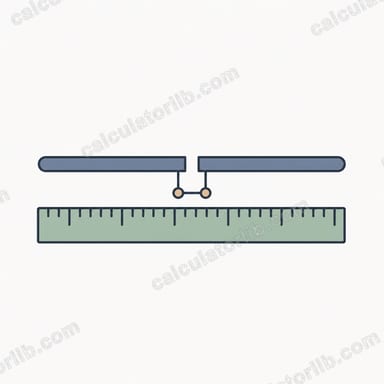
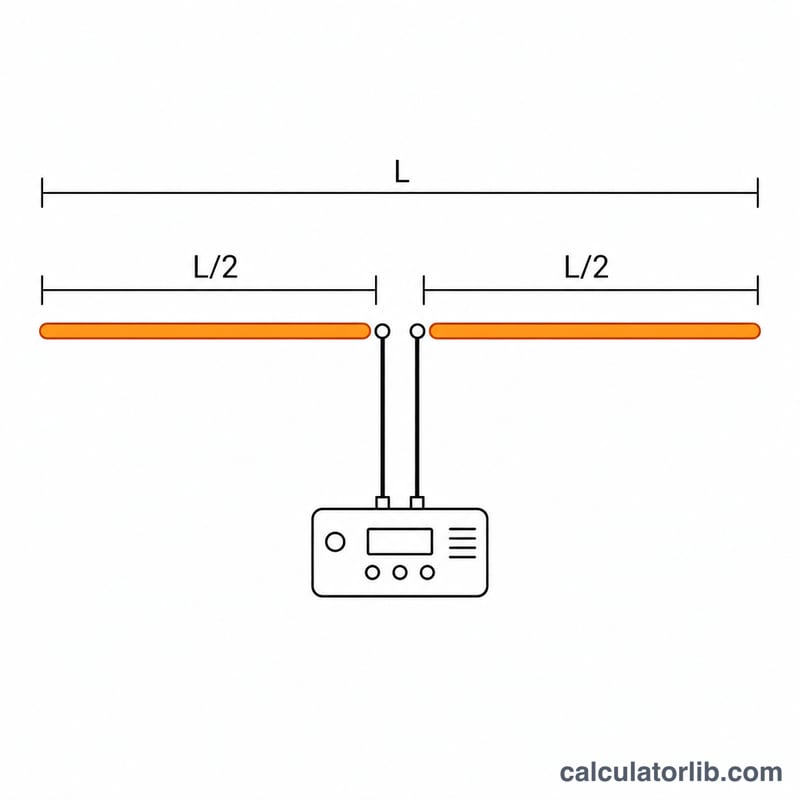
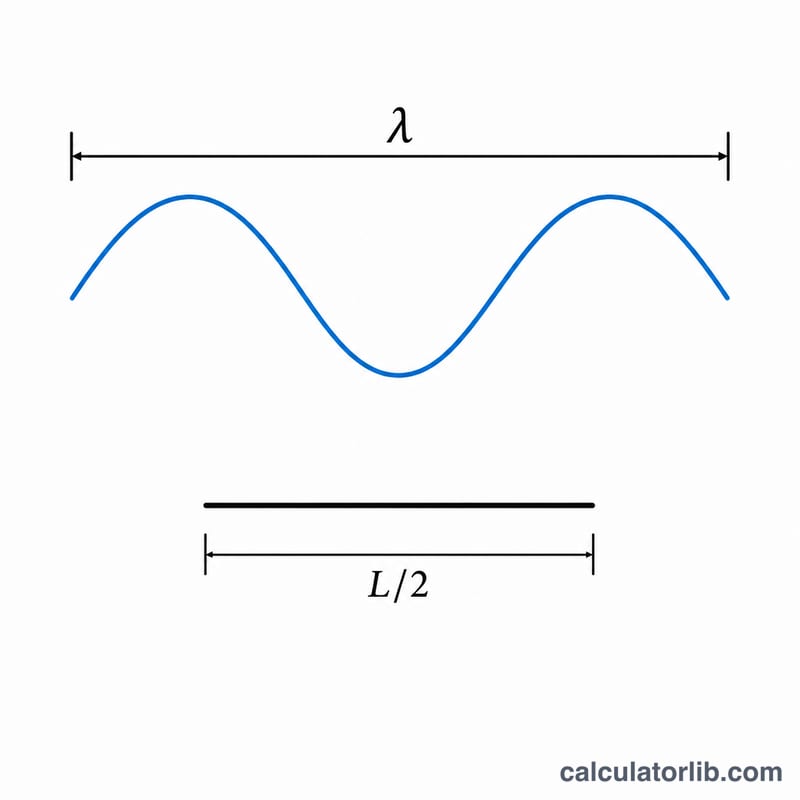
A half-wave dipole is one of the simplest and most effective antennas: two equal conductors fed at the center. This calculator gives you the total length and each leg length for a given operating frequency, so you can cut your wire to the right dimensions for the best resonance and lowest SWR.
How to use it
Enter your target frequency in megahertz (MHz) — for example the center of a ham band or your transmit frequency — and the calculator instantly returns the total dipole length and the length of each of the two legs, in both meters and feet.
The formula explained
The classic approximation for a wire half-wave dipole is $$L_{\text{total}} = \frac{143.0}{\text{Frequency (MHz)}}\ \text{m}$$. The constant 143 already accounts for a typical velocity factor of about 0.95, which reflects the slight slowing of the wave on real wire compared to free space (where the constant would be ~150). Each leg is simply half the total: \(L_{\text{leg}} = \frac{L_{\text{total}}}{2}\).
Worked example
For the 40-meter band at 7.1 MHz: $$L = \frac{143}{7.1} \approx 20.141 \text{ meters total}$$ so each leg is about \(10.07\) meters (\(\approx 33.04\ \text{ft}\)). Cut slightly long and trim to tune for minimum SWR.
FAQ
Why is my real antenna slightly different? Nearby objects, height above ground, wire diameter and insulation all affect resonance. Always cut a little long and trim.
Can I use feet directly? The classic imperial version is \(\frac{468}{f(\text{MHz})}\) for total feet — this tool shows feet alongside meters.
Does this work for any band? Yes, the formula scales for any HF/VHF frequency you enter.