
What is the Helical Coil Inductance Calculator?
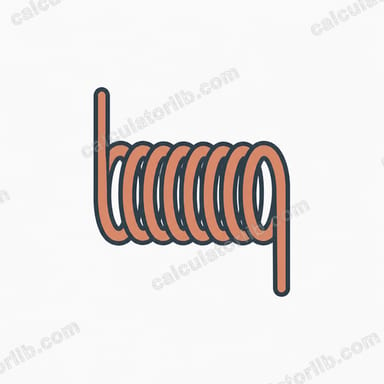
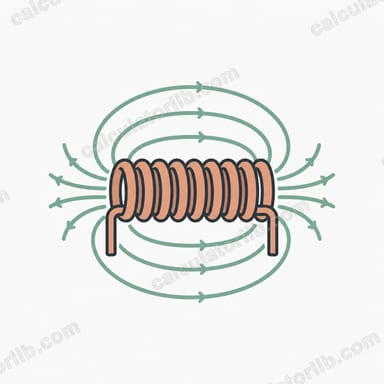
This tool estimates the inductance of a helical coil, also called a solenoid, from three physical dimensions: the number of turns, the coil radius, and the coil length. It uses the long-solenoid approximation, which is widely used in electronics, RF design, and physics education to size air-core inductors.
How to use it
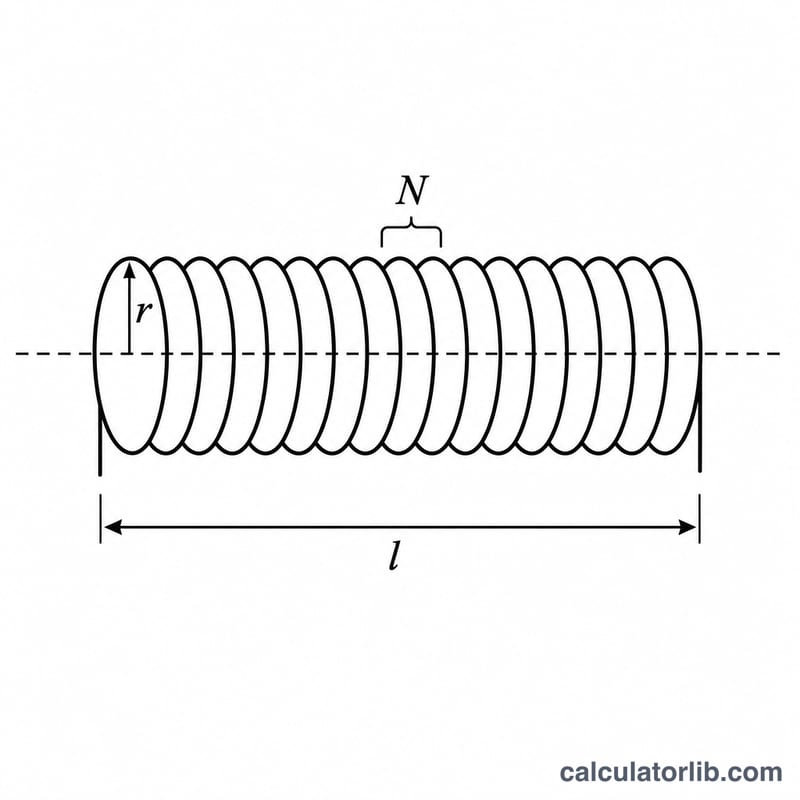
Enter the number of turns (\(N\)), the coil radius in millimetres, and the coil length in millimetres. The calculator converts the dimensions to metres, computes the cross-sectional area, and returns the inductance in microhenries (µH), millihenries (mH), and henries (H).
The formula explained
The single-layer solenoid inductance is given by:
$$L = \frac{\mu_0 \times N^{2} \times A}{l}, \quad \text{where} \quad A = \pi r^{2}.$$
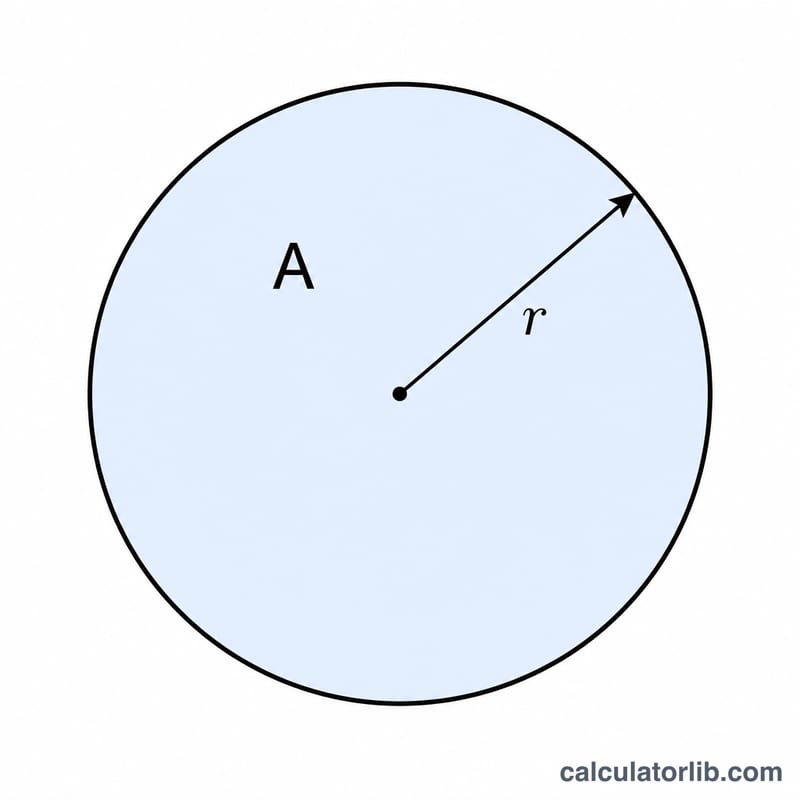
Here \(\mu_0\) is the permeability of free space (\(4\pi \times 10^{-7}\ \text{H/m}\)), \(N\) is the turn count, \(A\) is the cross-sectional area of the coil in square metres, and \(l\) is the axial length of the winding in metres. This idealized formula assumes an air core and a coil that is long compared with its diameter; for short coils a correction factor (e.g. Nagaoka) gives more accuracy.
Worked example
Suppose a coil has \(N = 100\) turns, radius \(r = 10\) mm (\(0.01\) m), and length \(l = 50\) mm (\(0.05\) m). The area $$A = \pi \times 0.01^{2} \approx 3.1416 \times 10^{-4}\ \text{m}^2.$$ Then $$L = \frac{4\pi \times 10^{-7} \times 100^{2} \times 3.1416 \times 10^{-4}}{0.05} \approx 7.896 \times 10^{-5}\ \text{H} \approx 78.96\ \text{µH}.$$
FAQ
Is this for air-core coils only? Yes — to model a magnetic core, multiply the result by the core's relative permeability \(\mu_r\).
Why does my real coil read differently? The long-solenoid formula overestimates inductance for short, fat coils. Use it as a design starting point.
What units should I enter? Radius and length in millimetres; the calculator handles the conversion to SI internally.