
What Is the Inductor Energy Calculator?
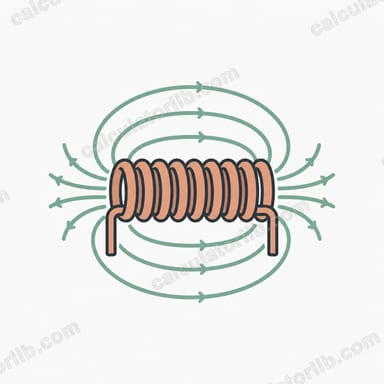
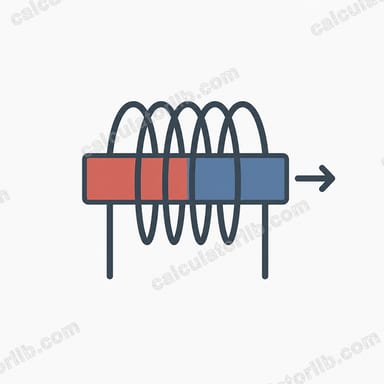
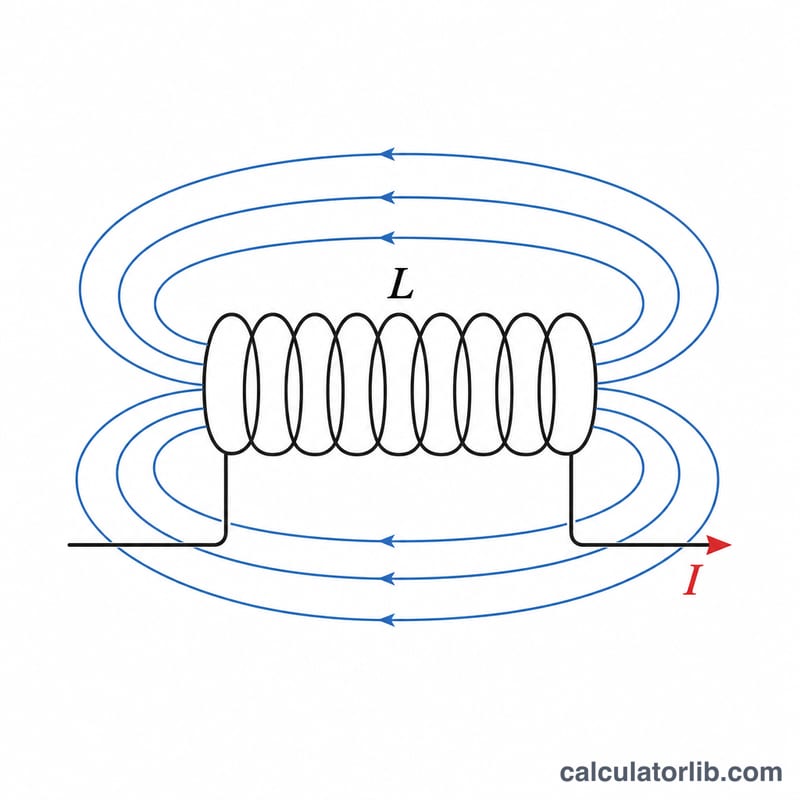
An inductor stores energy in the magnetic field created by current flowing through its windings. This calculator works out exactly how much energy is held in that field using the standard physics relationship \(E = \tfrac{1}{2} \cdot L \cdot I^{2}\). Just enter the inductance and the current, and you get the stored energy in joules (and millijoules for small values). It applies universally — the formula is the same everywhere in the world.
How to Use It
Enter the inductance L in henries (H) — note that real components are often in millihenries (mH = 0.001 H) or microhenries (µH = 0.000001 H), so convert first. Then enter the current I in amperes (A). Click calculate and the tool returns the stored magnetic energy.
The Formula Explained
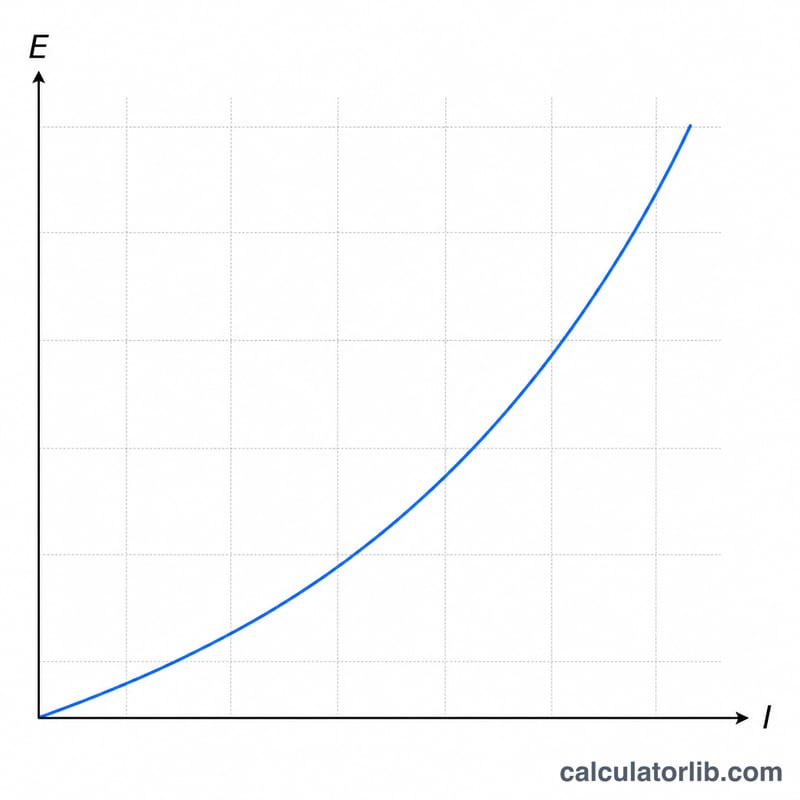
The energy stored in an inductor is $$E = \frac{1}{2} \cdot L \cdot I^{2}$$ Energy grows linearly with inductance but with the square of current — doubling the current quadruples the stored energy. This energy is what an inductor releases when current changes, which is why a sudden interruption can produce a large voltage spike (the basis of boost converters and ignition coils).
Worked Example
Suppose L = 0.1 H and I = 2 A. Then $$E = \frac{1}{2} \times 0.1 \times 2^{2} = 0.5 \times 0.1 \times 4 = 0.2\ \text{J}$$ 0.2 J (200 mJ). If the current rose to 4 A, energy would jump to \(\tfrac{1}{2} \times 0.1 \times 16 = 0.8\ \text{J}\).
FAQ
Why does current matter more than inductance? Because current is squared in the formula. Small increases in current produce much larger increases in stored energy.
What units does the result use? Joules (J) for the primary value, with a millijoule (mJ) conversion shown for small inductors.
Does this account for resistance or core losses? No. It gives the ideal magnetic field energy; real inductors also dissipate energy through resistance and core losses.