
What is the Heat Conduction Calculator?
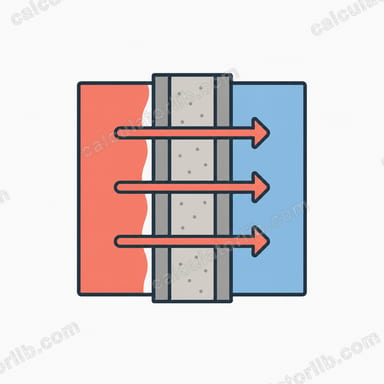
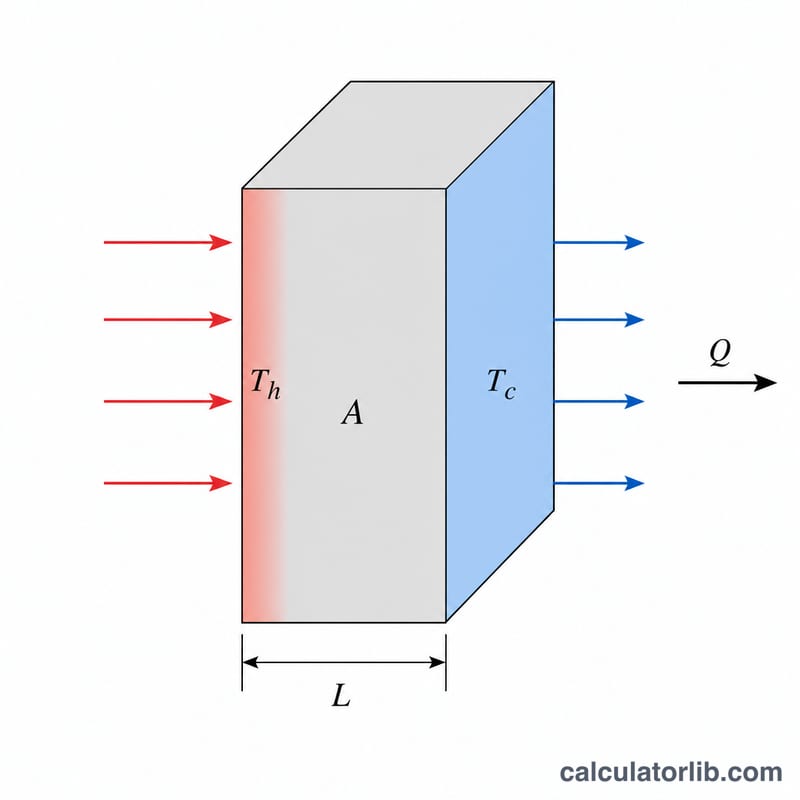
This tool computes the rate of heat transfer by conduction through a flat material such as a wall, window, or insulation slab. It applies Fourier's Law of heat conduction for steady-state, one-dimensional flow. The result is the heat flow rate in watts (joules per second), telling you how fast thermal energy passes from the warm side to the cold side.
How to use it
Enter four values: the material's thermal conductivity \(k\) (W/m·K), the cross-sectional area \(A\) (m²), the temperature difference \(\Delta T\) across the material (K or °C — both give the same difference), and the thickness \(L\) (m). The calculator returns the conduction rate and the conductive thermal resistance \(R\).
The formula explained
Fourier's Law states $$\frac{Q}{t} = \frac{k \cdot A \cdot \Delta T}{L}$$ Heat flow increases with a more conductive material (higher \(k\)), a larger area, and a bigger temperature gap, while a thicker material (larger \(L\)) slows the flow. The related thermal resistance is $$R = \frac{L}{k \cdot A}$$ a higher \(R\) means better insulation.
Worked example
A 10 m² wall of insulation with \(k = 0.04\) W/m·K, thickness 0.1 m, and a 20 °C temperature difference: $$\frac{Q}{t} = \frac{0.04 \times 10 \times 20}{0.1} = \mathbf{80 \text{ W}}$$ The thermal resistance is $$R = \frac{0.1}{0.04 \times 10} = 0.25 \text{ K/W}$$
FAQ
Do I use °C or K for ΔT? Either works — a temperature difference of 1 °C equals 1 K, so the numeric value is identical.
What is thermal conductivity \(k\)? A material property: copper ≈ 400, glass ≈ 1, wood ≈ 0.15, fiberglass insulation ≈ 0.04 W/m·K.
Does this account for convection or radiation? No. It models pure conduction through a solid slab at steady state, not air-film or radiative effects.