
What Is the Buoyant Force Calculator?
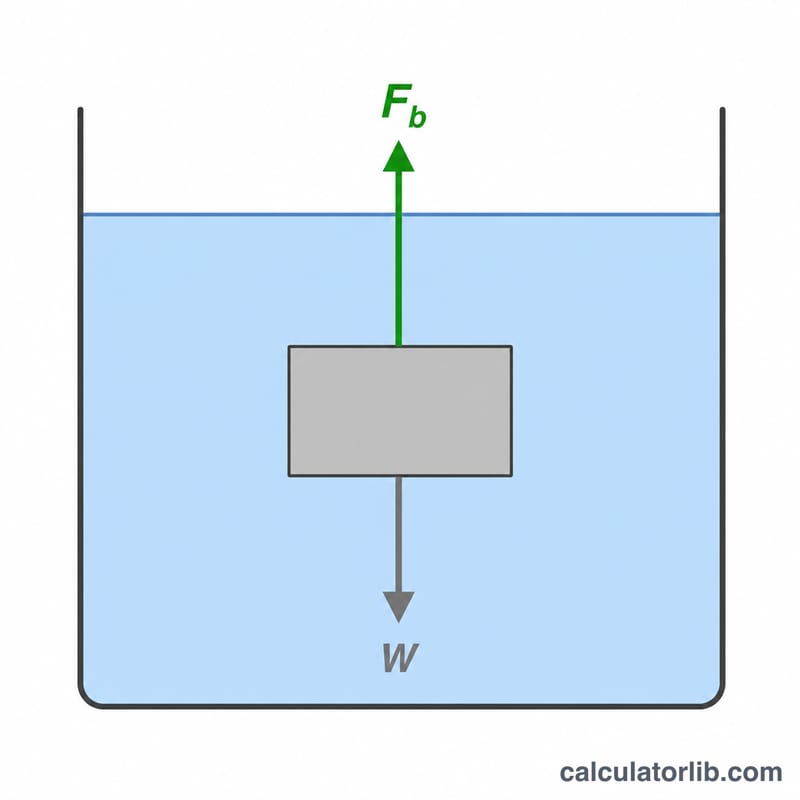
This tool computes the buoyant force (upthrust) acting on an object submerged in a fluid using Archimedes' principle. Archimedes' principle states that any object wholly or partly immersed in a fluid experiences an upward force equal to the weight of the fluid it displaces. The calculator works for any fluid and any consistent SI inputs, so it applies universally — no jurisdiction-specific assumptions.
How to Use It
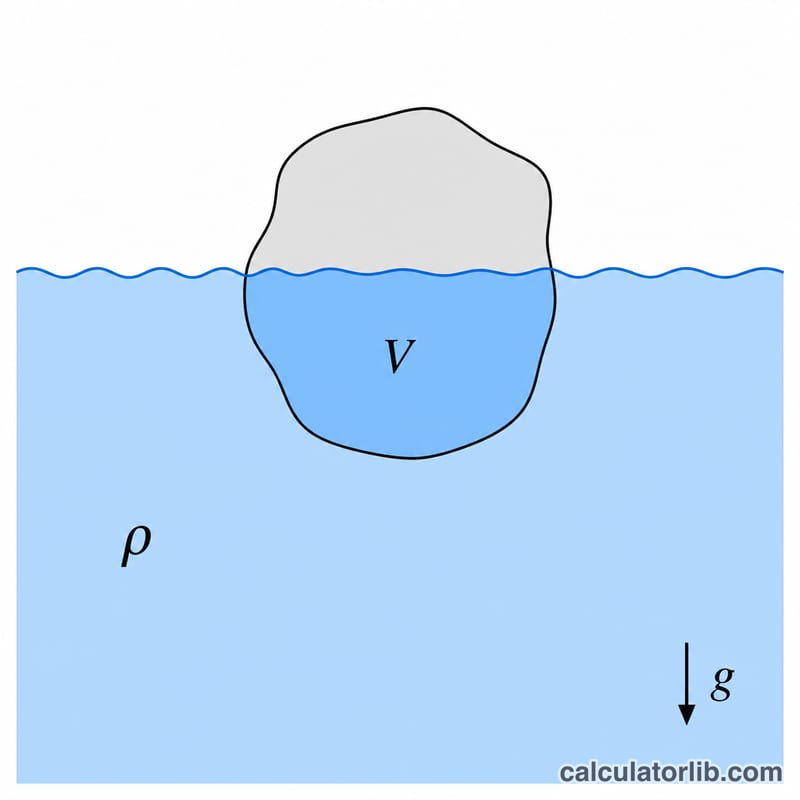
Enter three values: the density of the fluid (kg/m³), the volume of fluid displaced by the object (m³), and the acceleration due to gravity (m/s², typically 9.81 on Earth). For a fully submerged object, the displaced volume equals the object's own volume. For a floating object, it equals only the submerged portion. The result is the buoyant force in newtons, plus the mass of displaced fluid in kilograms.
The Formula Explained
The governing equation is Fb = ρ · V · g, where ρ is the fluid density, V is the displaced volume, and g is gravitational acceleration. The product ρ·V is the mass of displaced fluid, and multiplying by g converts that mass into a weight (force). Common fluid densities: fresh water ≈ 1000 kg/m³, seawater ≈ 1025 kg/m³, air ≈ 1.225 kg/m³.
Worked Example
A block displaces 0.05 m³ of fresh water (ρ = 1000 kg/m³) on Earth (g = 9.81 m/s²). The buoyant force is F = 1000 × 0.05 × 9.81 = 490.5 N, and the displaced mass is 1000 × 0.05 = 50 kg. If this force exceeds the object's weight, it floats.
Common Fluid Densities
The buoyant force depends directly on the density of the displaced fluid, \(\rho\), in the relation \(F_b = \rho \, V \, g\). The table below lists representative densities at standard temperature (about 20 °C, except where the substance's normal state differs). Values are given in kilograms per cubic metre (kg/m³), the SI unit used by this calculator.
| Fluid | Density (kg/m³) | Notes |
|---|---|---|
| Fresh water | 998 | 20 °C; ~1000 at 4 °C |
| Seawater | 1025 | Typical ocean salinity |
| Oil (light crude / vegetable) | ~900 | Varies 850–950 |
| Gasoline (petrol) | ~745 | Varies 720–775 |
| Ethanol | 789 | Pure, 20 °C |
| Mercury | 13534 | Liquid metal, 20 °C |
| Glycerin (glycerol) | 1261 | 20 °C |
| Air | 1.204 | Dry air, 20 °C, 101.325 kPa |
| Helium | 0.1664 | 0 °C, 101.325 kPa |
As an example, a 0.010 m³ object fully submerged in seawater (\(\rho = 1025\) kg/m³) at standard gravity experiences a buoyant force of \(F_b = 1025 \times 0.010 \times 9.80665 = \) 100.5 N. The density of air shown here can be derived independently from the ideal gas law for given pressure and temperature.
Constants & Reference Values
The buoyant force formula uses three quantities. Keeping consistent SI units ensures the result comes out in newtons (N):
| Symbol | Quantity | SI Unit |
|---|---|---|
| \(F_b\) | Buoyant force | newton (N = kg·m/s²) |
| \(\rho\) | Fluid density | kg/m³ |
| \(V\) | Displaced volume | m³ |
| \(g\) | Gravitational acceleration | m/s² |
The standard value used for gravity is the internationally defined standard gravity, \(g_0 = 9.80665\) m/s². The actual local value varies slightly with latitude and altitude:
| Location | g (m/s²) | Relative to standard |
|---|---|---|
| Standard gravity (defined) | 9.80665 | — |
| Equator (sea level) | ≈ 9.780 | slightly weaker |
| Poles (sea level) | ≈ 9.832 | slightly stronger |
| Moon (surface) | ≈ 1.62 | ≈ 1/6 of Earth |
| Mars (surface) | ≈ 3.72 | ≈ 0.38 of Earth |
The difference between equatorial and polar gravity (about 0.5%) arises from Earth's rotation and its oblate shape. For most engineering and physics problems the standard value 9.80665 m/s² (often rounded to 9.81 m/s²) is sufficiently accurate.
Interpreting Your Result
The buoyant force \(F_b\) is the upward push a fluid exerts on any object that displaces it. To predict whether an object floats or sinks, compare \(F_b\) with the object's weight \(W = m g\):
- Floats: if the maximum possible buoyant force (object fully submerged) is greater than or equal to the weight, \(F_b \ge W\). The object rises until only enough volume is submerged to displace fluid equal to its own weight.
- Sinks: if \(F_b < W\) even when fully submerged, the net force is downward and the object descends.
- Neutral buoyancy: when \(F_b = W\), the net vertical force is zero and the object hovers at any depth — the condition a submarine or a scuba diver trims toward.
A useful equivalent test compares the object's average density \(\rho_{obj}\) to the fluid density \(\rho_{fluid}\): the object floats when \(\rho_{obj} \le \rho_{fluid}\) and sinks when \(\rho_{obj} > \rho_{fluid}\). This is why a steel hull can float — its average density (steel plus enclosed air) is lower than that of water.
Apparent Weight When Submerged
For a submerged object that does not float, buoyancy reduces the force you must support. The apparent weight equals the true weight minus the buoyant force:
$$W_{apparent} = W - F_b = m g - \rho V g$$For example, a solid object weighing 50 N in air that displaces 0.002 m³ of fresh water (\(\rho = 998\) kg/m³) loses a buoyant force of \(F_b = 998 \times 0.002 \times 9.80665 = \) 19.57 N, so its apparent (submerged) weight is about 30.4 N. This apparent weight loss is exactly what a hanging scale reads when the object is lowered into water, and it is the basis of the classic Archimedes density measurement.
FAQ
Does buoyancy depend on the object's weight? No — buoyant force depends only on the displaced fluid (density × volume × gravity). Whether it floats depends on comparing buoyancy to the object's weight.
What volume should I use if the object floats? Use only the submerged volume, since only that part displaces fluid.
What units does the result use? Newtons (N) for force, given SI inputs of kg/m³, m³ and m/s².