
What Is Wien's Displacement Law?
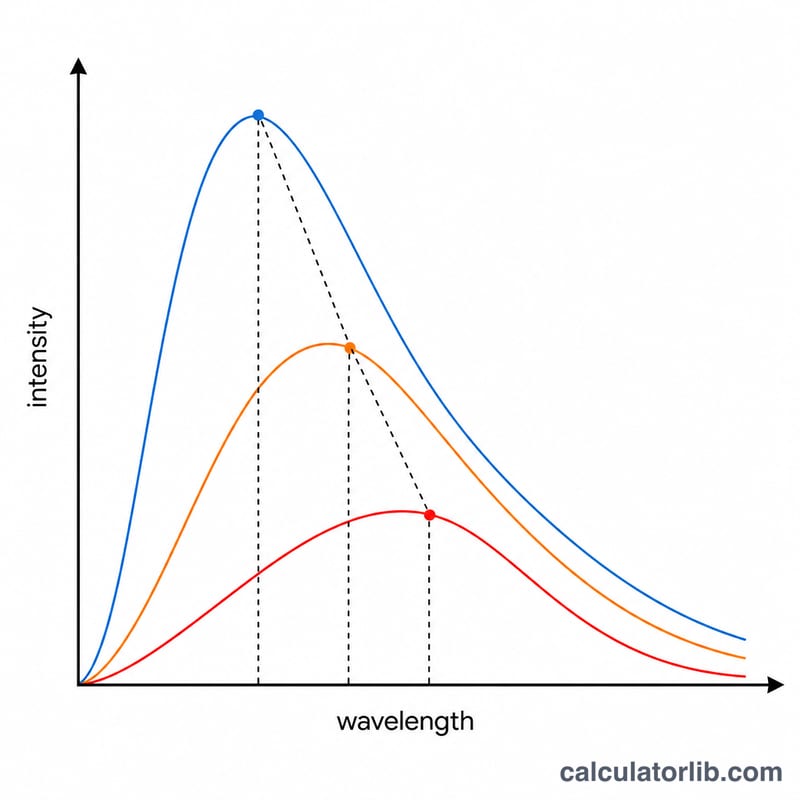
Wien's displacement law describes how the wavelength at which a black body emits the most radiation shifts as its temperature changes. Hotter objects glow at shorter wavelengths (toward blue and ultraviolet), while cooler objects peak at longer wavelengths (toward red and infrared). The law states that the peak wavelength is inversely proportional to absolute temperature: as temperature rises, the peak wavelength falls.
The Formula
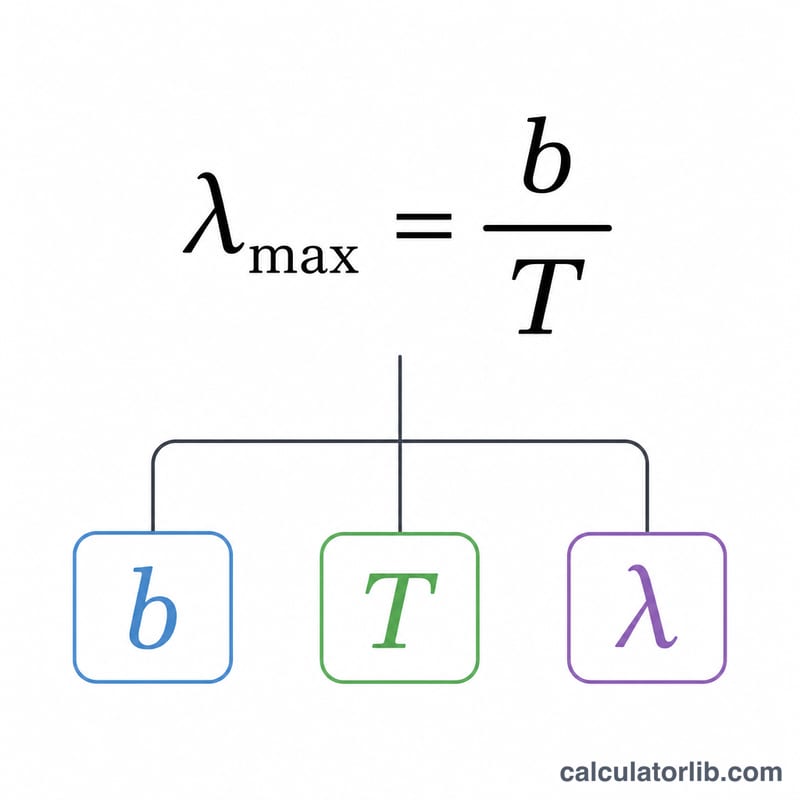
The peak wavelength is given by:
$$\lambda_{\max} = \frac{b}{T}$$where T is the absolute temperature in kelvin (K), and b is Wien's displacement constant, equal to \(2.897771955 \times 10^{-3}\ \text{m}\cdot\text{K}\). The result \(\lambda_{\max}\) comes out in meters; this calculator also converts it to nanometers (nm) and micrometers (µm) for convenience.
How to Use This Calculator
Enter the absolute temperature of the object in kelvin and press calculate. To convert from Celsius, add 273.15; to convert from Fahrenheit, use \(K = (°F - 32) \times 5/9 + 273.15\). The calculator returns the peak emission wavelength in nanometers, micrometers, and meters.
Worked Example
The Sun's photosphere has an effective temperature of about 5778 K. Applying the law: $$\lambda_{\max} = \frac{2.897771955 \times 10^{-3}}{5778} \approx 5.015 \times 10^{-7}\ \text{m} = 501.5\ \text{nm}$$ This falls in the green part of the visible spectrum, which is why the Sun's output peaks in visible light — a key reason life on Earth evolved to see these wavelengths.
FAQ
Why must temperature be in kelvin? Wien's law uses absolute temperature, so the value must be measured from absolute zero. Using Celsius or Fahrenheit gives incorrect results.
Does this work for any object? The law applies to ideal black bodies, but it gives a good approximation for stars, heated metals, and other thermal emitters.
What is Wien's displacement constant? It is a fixed physical constant, \(b \approx 2.897771955 \times 10^{-3}\ \text{m}\cdot\text{K}\), derived from the peak of Planck's radiation law.