
What Is Torricelli's Law?
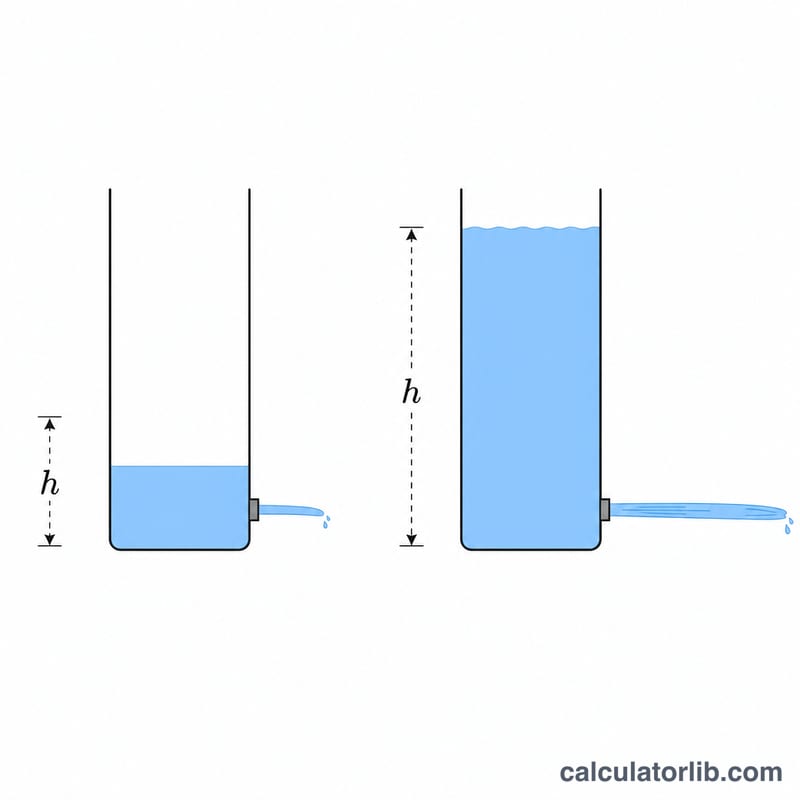
Torricelli's Law describes the speed at which a fluid escapes through an opening in a container. Discovered by Evangelista Torricelli in 1643, it states that the efflux velocity of an ideal (frictionless, incompressible) fluid leaving a hole equals the speed an object would reach falling freely from the height of the fluid surface above the hole. This makes it a special case of Bernoulli's equation.
The Formula
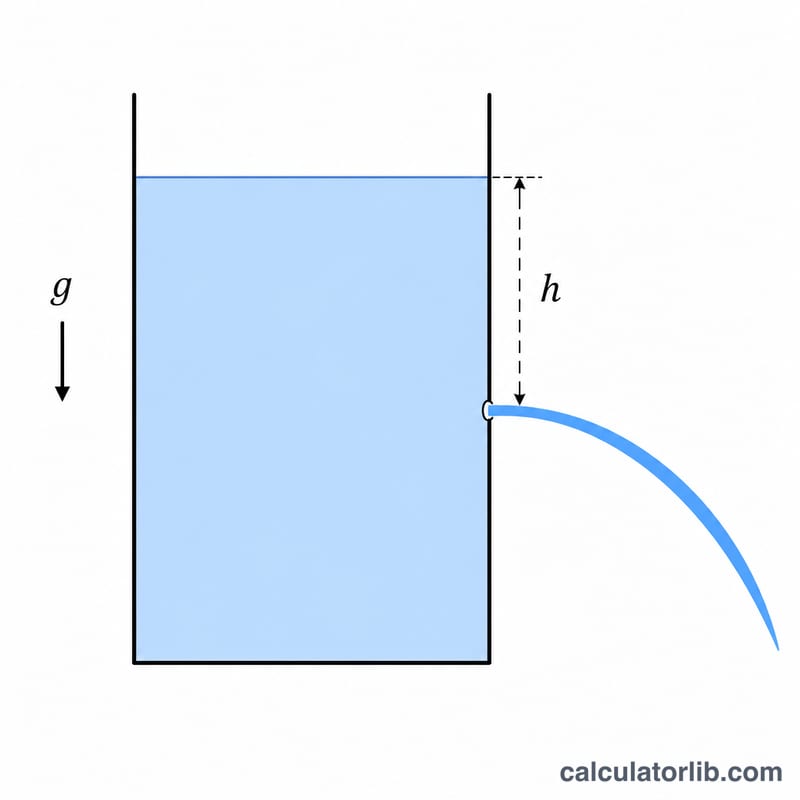
The efflux velocity is given by:
$$v = \sqrt{2gh}$$
where v is the exit velocity (m/s), g is the gravitational acceleration (about 9.81 m/s² on Earth), and h is the vertical distance from the free surface of the fluid down to the center of the opening (m). Notice the velocity does not depend on the fluid's density — only on the height of fluid above the hole.
How to Use the Calculator
Enter the height of fluid above the opening in meters and the gravitational acceleration (defaulting to Earth's 9.81 m/s²). The calculator returns the efflux velocity in meters per second. To model another planet, simply change the gravity value — for example, use 1.62 for the Moon or 3.71 for Mars.
Worked Example
Suppose a water tank has its surface 2 meters above a small drain hole, with \(g = 9.81\) m/s². Then $$v = \sqrt{2 \times 9.81 \times 2} = \sqrt{39.24} \approx 6.26 \text{ m/s}.$$ The water jets out at roughly 6.3 meters per second regardless of whether it is water, oil, or any other ideal liquid.
FAQ
Does the size of the hole matter? The exit speed predicted by Torricelli's Law does not depend on the hole size, though the volumetric flow rate (speed × area) does.
Is the prediction exact in real life? No. Real fluids have viscosity and the jet contracts (vena contracta), so actual velocity is slightly lower. A discharge coefficient (typically 0.6–0.98) corrects for this.
Why doesn't density appear? Gravitational potential energy and kinetic energy both scale with mass, so density cancels out, leaving velocity dependent only on g and h.