
What Is Mass-Energy Equivalence?
Mass-energy equivalence is one of the most famous results in physics, expressed by Albert Einstein's equation \(E = mc^2\). It states that mass and energy are interchangeable: even a tiny amount of mass contains an enormous amount of energy. This calculator converts any mass you enter into its equivalent rest energy, then expresses that energy in joules, kilowatt-hours, and tons of TNT so you can grasp its scale.
How to Use This Calculator
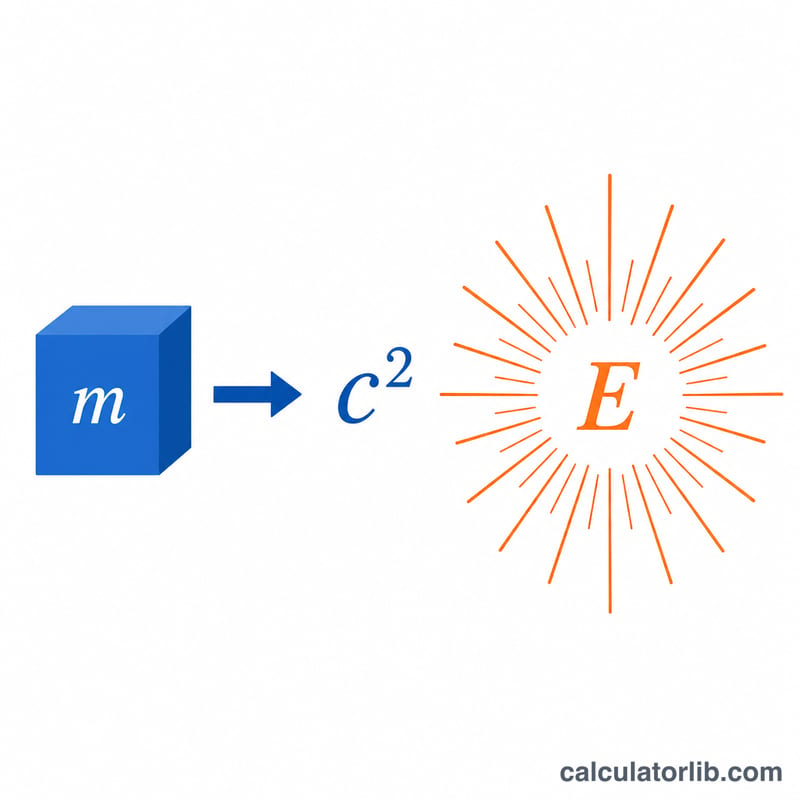
Enter a mass in kilograms and the calculator instantly computes the rest energy using \(E = mc^2\). The result appears in joules, the SI unit of energy. Because the numbers are huge, we also convert them into kilowatt-hours (the unit on your electricity bill) and tons of TNT (a common measure of explosive energy).
The Formula Explained
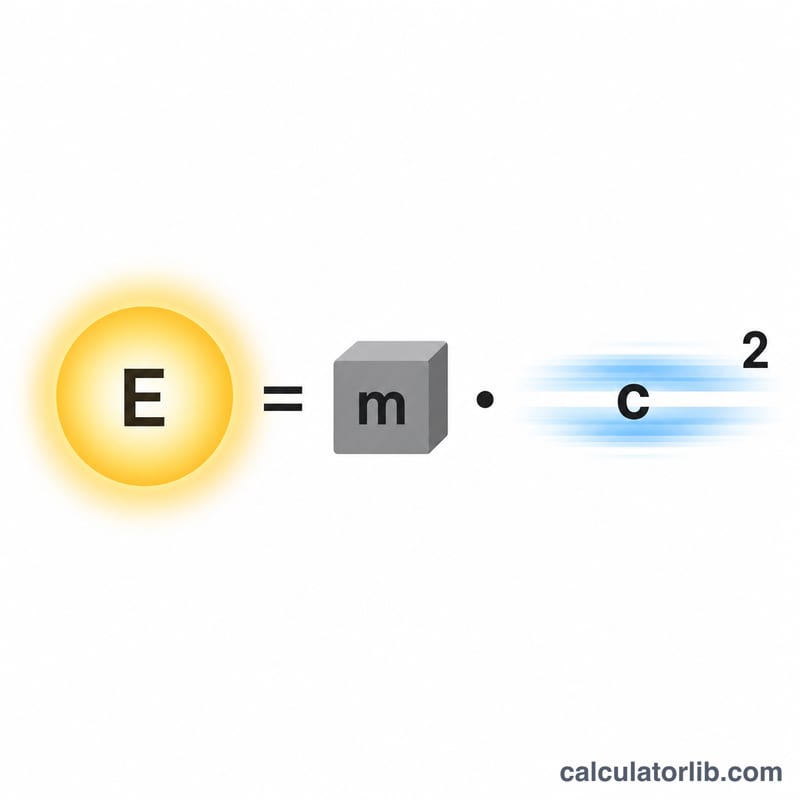
The equation is $$E = m \cdot c^{2}$$ where:
• \(E\) is the energy in joules (J)
• \(m\) is the mass in kilograms (kg)
• \(c\) is the speed of light, exactly 299,792,458 meters per second
Because c is squared (\(c^2 \approx 8.988 \times 10^{16}\)), multiplying even a 1 kg mass yields about 90 quadrillion joules.
Worked Example
For a mass of 1 kg: $$E = 1 \times (299{,}792{,}458)^{2} = 8.98755179 \times 10^{16}\ \text{joules}$$ That equals roughly 24.96 billion kilowatt-hours, or about 21.5 million tons of TNT — enough energy to power a city for years from converting a single kilogram entirely into energy.
FAQ
Does this happen in everyday objects? Complete mass-to-energy conversion only occurs in matter-antimatter annihilation. In nuclear reactions only a small fraction of mass converts to energy, but \(E = mc^2\) still governs the amount.
What units does the result use? The primary result is in joules; secondary rows show kilowatt-hours and tons of TNT for intuition.
Is c always 299,792,458 m/s? Yes — the speed of light in a vacuum is a defined physical constant.