
What This Displacement Calculator Does
This calculator solves the kinematic equation for displacement using initial velocity, final velocity, and time. It applies to objects moving with constant (uniform) acceleration — a core topic in physics mechanics. Unlike a single-purpose tool, it can rearrange the same equation to solve for any one of four quantities, so it works as a displacement, velocity, or time calculator depending on what you need.
The Formula
The calculator is built on the average-velocity form of the kinematic equation:
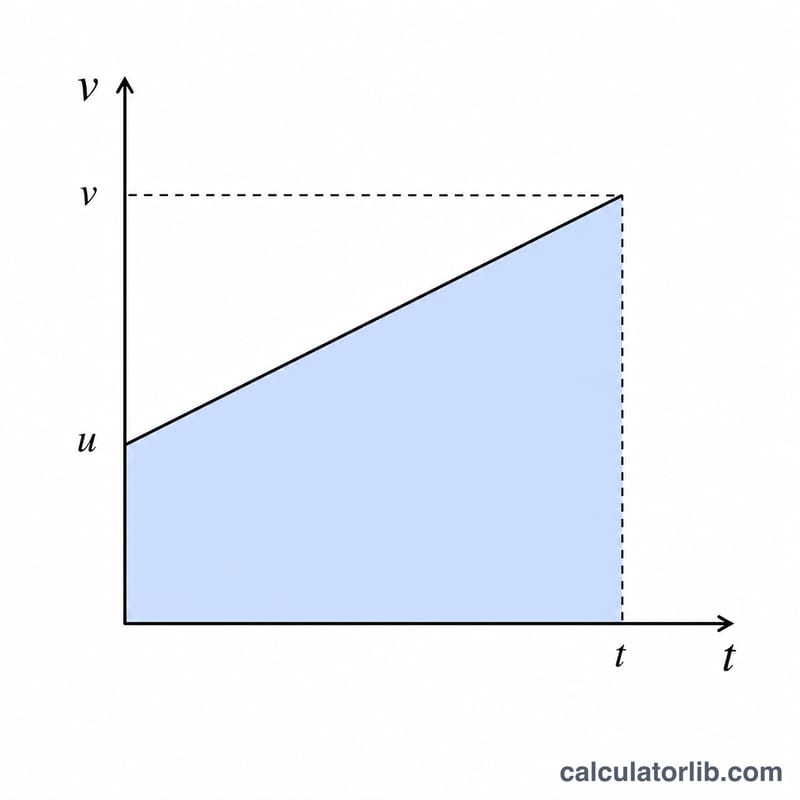
$$\text{x} = \frac{1}{2}\left(\text{u} + \text{v}\right)\,\text{t}$$
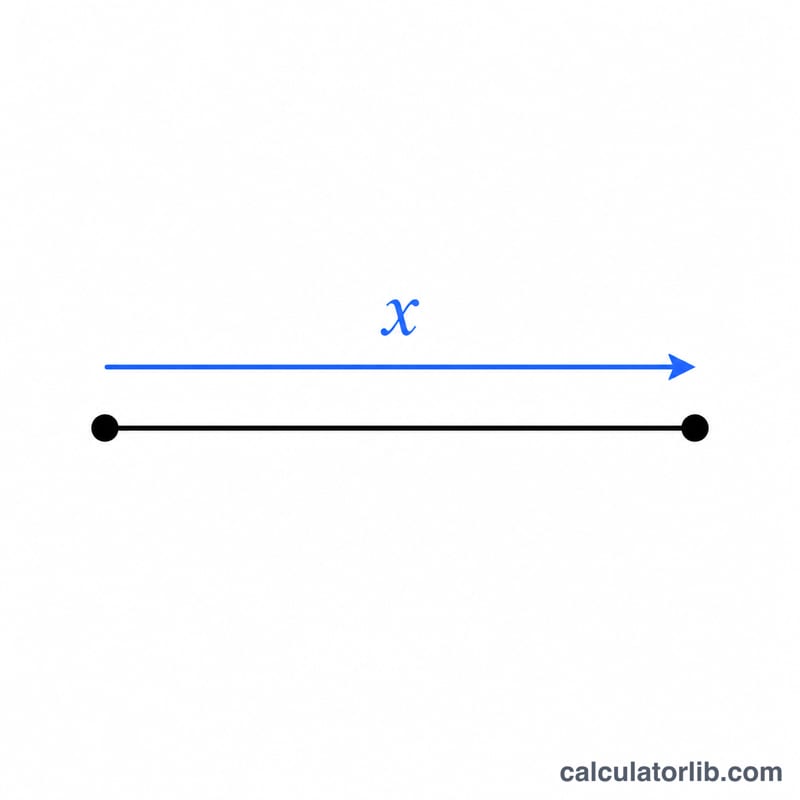
- x = displacement (e.g. metres)
- u = initial velocity (e.g. m/s)
- v = final velocity (e.g. m/s)
- t = time (e.g. seconds)
Because the term \(\frac{1}{2}(\text{u} + \text{v})\) is simply the average velocity over the interval, displacement equals average velocity multiplied by time. The tool also reports this average velocity as a bonus output.
How to Use It
First, pick what you want to find using the Calculate selector — displacement (x), initial velocity (u), final velocity (v), or time (t). Then enter the three known values in their fields. The calculator rearranges the formula automatically:
- Displacement: \(\text{x} = \frac{1}{2}(\text{u} + \text{v})\text{t}\)
- Initial velocity: \(\text{u} = \frac{2\text{x}}{\text{t}} - \text{v}\)
- Final velocity: \(\text{v} = \frac{2\text{x}}{\text{t}} - \text{u}\)
- Time: \(\text{t} = \frac{2\text{x}}{\text{u} + \text{v}}\)
Worked Example
Suppose a car starts at u = 5 m/s, speeds up to v = 25 m/s over a time of t = 4 s. Set Calculate to displacement and enter these values:
$$\text{x} = \frac{1}{2}(5 + 25) \times 4 = \frac{1}{2} \times 30 \times 4 = \textbf{60 metres}$$ The average velocity is \(\frac{1}{2}(5 + 25) = 15\) m/s.
Now flip it: choose to solve for time, enter x = 60, u = 5, v = 25, and you get \(\text{t} = \frac{2 \times 60}{5 + 25} = 4\) s — confirming the result.
FAQ
Does this account for acceleration? Not directly, but it assumes constant acceleration. Acceleration is implied by the change from u to v over t. The formula is only valid when acceleration is uniform.
What units should I use? Any consistent set works. If velocity is in m/s and time in seconds, displacement comes out in metres. Use mph with hours and you'll get miles.
Can displacement be negative? Yes. If the velocities are negative (motion in the opposite direction), the result is negative, indicating displacement opposite to your chosen positive direction.