
What Is the Darcy-Weisbach Head Loss Calculator?
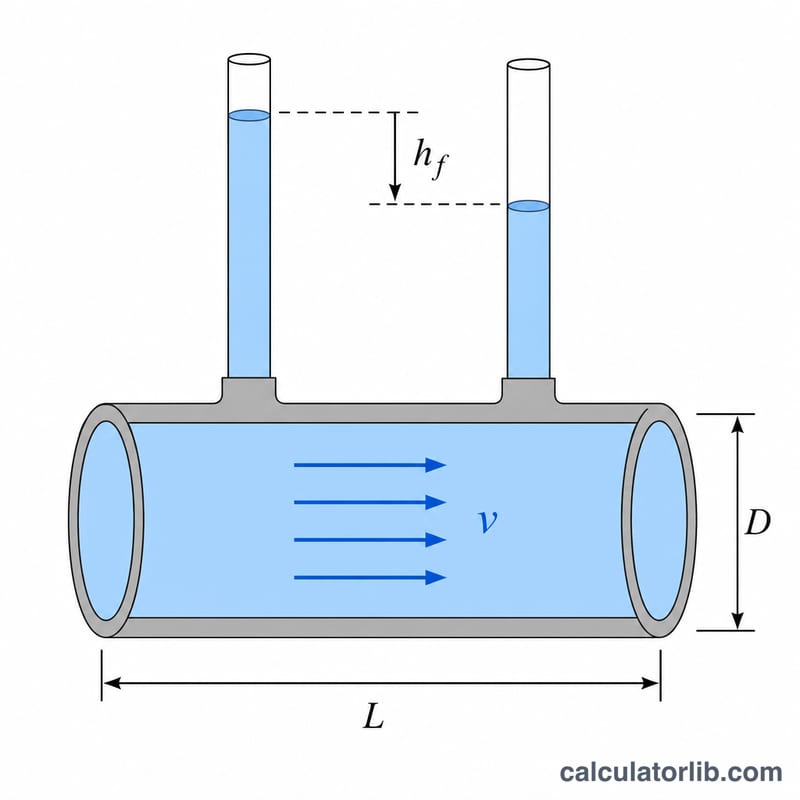
This calculator finds the friction head loss of a fluid flowing through a straight pipe using the Darcy-Weisbach equation, one of the most reliable methods in fluid mechanics. Head loss represents the energy lost to friction between the moving fluid and the pipe wall, expressed as an equivalent height (meters) of the fluid column. Engineers use it to size pumps, select pipe diameters, and verify that a system can deliver the required flow and pressure.
How to Use It
Enter five values: the dimensionless Darcy friction factor (f), pipe length (L) in meters, internal diameter (D) in meters, mean flow velocity (v) in m/s, and gravitational acceleration g (default 9.81 m/s²). The calculator returns the head loss hf in meters of fluid. To convert to pressure drop, multiply by fluid density and g: \(\Delta p = \rho \cdot g \cdot h_f\).
The Formula Explained
The equation is $$h_f = f \cdot \frac{L}{D} \cdot \frac{v^{2}}{2 \cdot g}$$ The ratio \(L/D\) scales loss with how long and how narrow the pipe is. The term \(v^2/2g\) is the velocity head — the kinetic energy of the flow expressed as a height. The friction factor \(f\) captures the combined effect of Reynolds number (laminar vs turbulent) and relative roughness, and is typically read from a Moody chart or computed with the Colebrook or Swamee-Jain equations (often 0.015–0.04 for turbulent water flow).
Worked Example
For f = 0.02, L = 100 m, D = 0.1 m, v = 2 m/s, g = 9.81 m/s²: \(L/D = 1000\), \(v^2/2g = 4 / 19.62 = 0.2039\). So $$h_f = 0.02 \times 1000 \times 0.2039 = 4.077 \text{ m}$$ of head loss.
FAQ
Where do I get the friction factor? Use a Moody diagram or solve the Swamee-Jain equation from Reynolds number and relative roughness (ε/D).
What units does this use? SI units throughout — meters, m/s, and m/s² — giving head loss in meters of fluid.
Does this include fittings? No. This computes major (friction) loss only. Minor losses from valves, bends and fittings should be added separately using loss coefficients.