
What Is the Minor Head Loss Calculator?
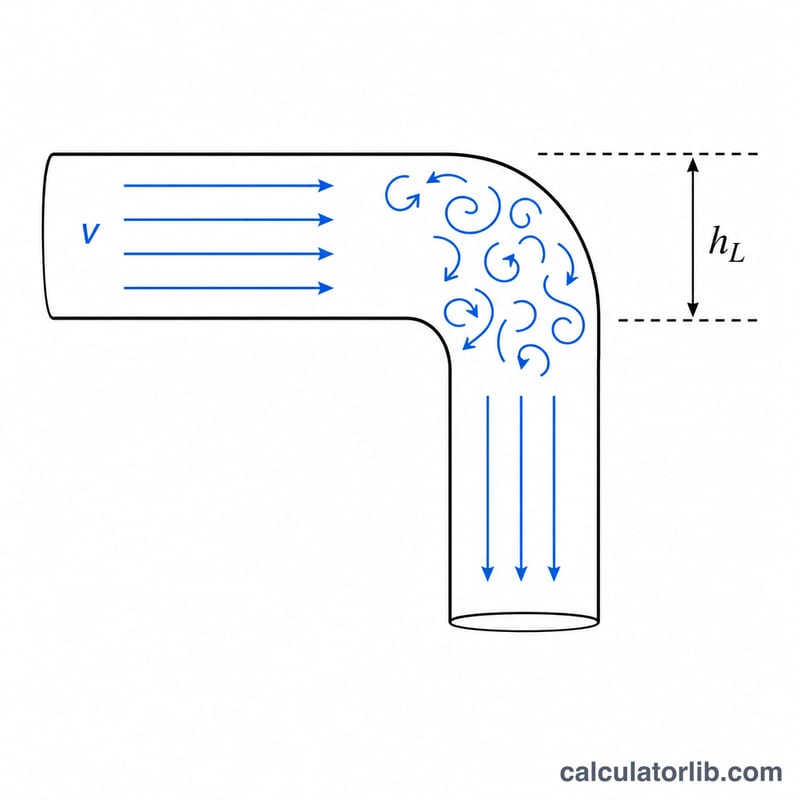
Minor head loss (also called local or fitting loss) is the energy lost when fluid passes through valves, bends, elbows, tees, expansions, contractions, and other pipe fittings. Unlike major loss caused by wall friction along straight pipe, minor losses come from turbulence and flow separation at disturbances. This universal calculator uses the standard relation \(h_L = K \cdot \frac{v^{2}}{2g}\) to return the head loss in meters of fluid column.
How to Use It
Enter the loss coefficient K for your fitting and the mean flow velocity v in metres per second. The calculator multiplies K by the velocity head \(\frac{v^{2}}{2g}\) to give the head loss hL. Typical K values: 90° standard elbow ≈ 0.9, fully open gate valve ≈ 0.2, fully open globe valve ≈ 10, sharp pipe entrance ≈ 0.5, sudden exit ≈ 1.0. Sum the K values of multiple fittings to model a fitting train at one velocity.
The Formula Explained
The equation $$h_L = K \cdot \frac{v^{2}}{2g}$$ expresses head loss as a multiple of the velocity head. The velocity head \(\frac{v^{2}}{2g}\) is the kinetic energy of the flow expressed as an equivalent fluid height. K scales that velocity head: a larger, more disruptive fitting has a higher K and therefore a larger loss. The standard gravitational acceleration \(g = 9.80665\ \text{m/s}^2\) is used.
Worked Example
For a 90° elbow with K = 0.9 and a velocity of 3 m/s: velocity head $$= \frac{3^{2}}{2 \times 9.80665} = \frac{9}{19.6133} = 0.4589\ \text{m}.$$ Head loss $$= 0.9 \times 0.4589 = 0.413\ \text{m of fluid}.$$
FAQ
What is K? K is the dimensionless minor loss coefficient, found in fitting manufacturer data or standard tables.
What units does the result use? The result is head loss in metres of the flowing fluid (independent of density).
How do I combine fittings? If several fittings share the same velocity, add their K values and enter the total.