
What Is the Continuity Equation?
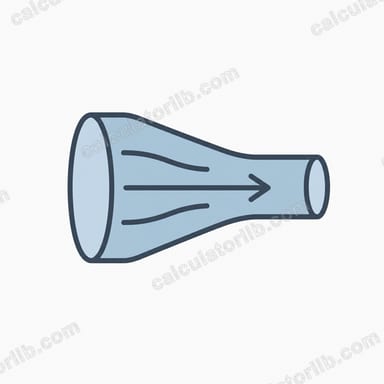
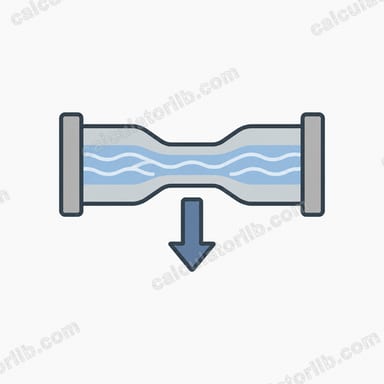
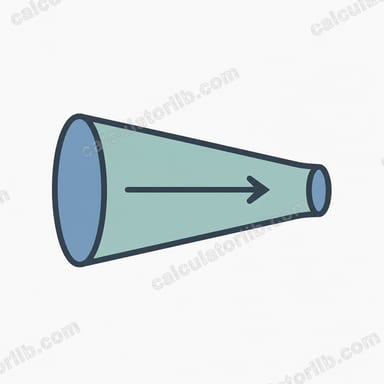
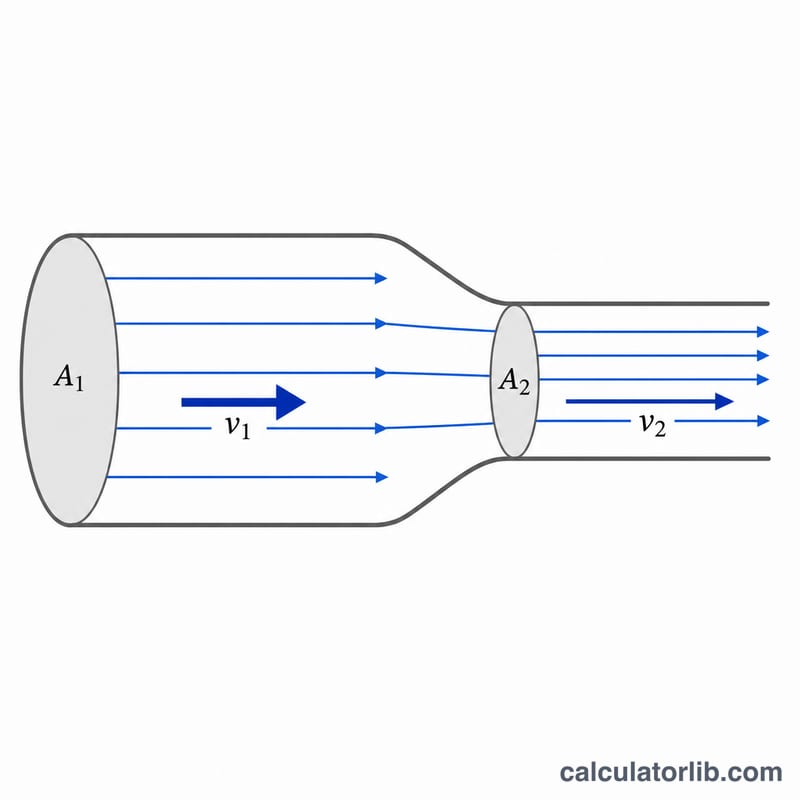
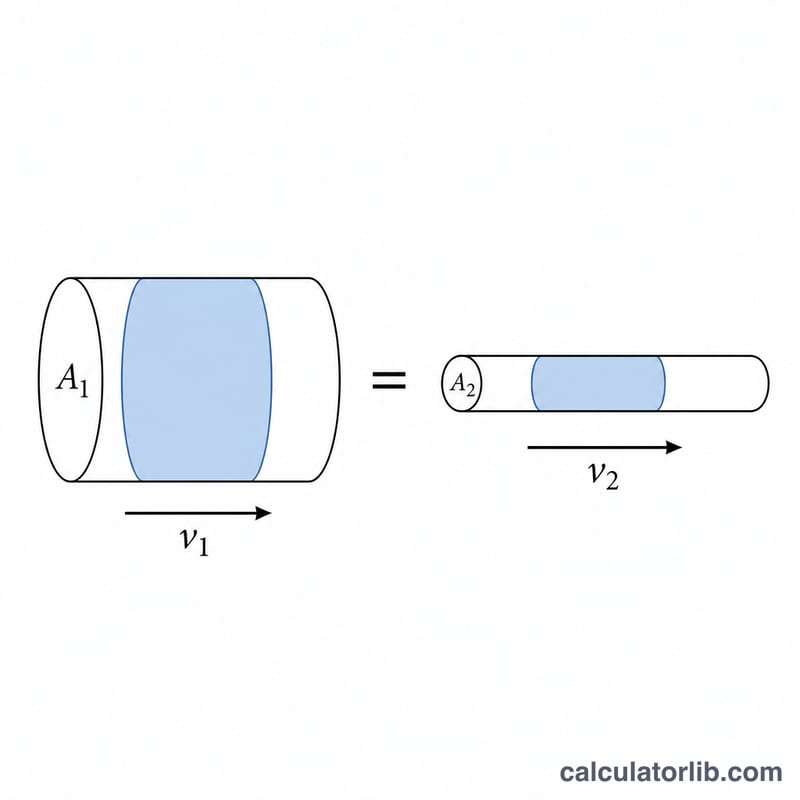
The continuity equation describes the conservation of mass for an incompressible fluid flowing through a pipe or channel. It states that the product of cross-sectional area and flow velocity is constant along the flow: \(\text{A}_1 \cdot v_1 = \text{A}_2 \cdot v_2\). When a pipe narrows, the fluid must speed up; when it widens, the fluid slows down. This calculator works for any consistent set of units (SI by default: area in m², velocity in m/s, giving flow rate in m³/s).
How to Use This Calculator
Enter the inlet cross-sectional area (\(\text{A}_1\)) and inlet velocity (\(v_1\)), plus the outlet area (\(\text{A}_2\)). The calculator solves for the unknown outlet velocity \(v_2\) and also returns the volumetric flow rate Q. Make sure all areas use the same unit and both velocities use the same unit so the result stays consistent.
The Formula Explained
Starting from \(\text{A}_1 \cdot v_1 = \text{A}_2 \cdot v_2\), solve for the outlet velocity:
$$v_2 = \frac{\text{A}_1 \cdot v_1}{\text{A}_2}$$The volumetric flow rate is the shared quantity on both sides: $$Q = \text{A}_1 \cdot v_1 = \text{A}_2 \cdot v_2$$ Because mass is conserved, Q is the same at every point of an incompressible, steady flow.
Worked Example
Suppose water enters a pipe with area \(\text{A}_1 = 0.1\ \text{m}^2\) at \(v_1 = 2\ \text{m/s}\), and the pipe narrows to \(\text{A}_2 = 0.04\ \text{m}^2\). The flow rate is $$Q = 0.1 \times 2 = 0.2\ \text{m}^3/\text{s}$$ The outlet velocity is $$v_2 = \frac{0.2}{0.04} = 5\ \text{m/s}$$ The fluid accelerates as the pipe constricts, exactly as expected.
FAQ
Does this work for gases? Only approximately. The continuity equation in this A·v form assumes incompressible flow, which is accurate for liquids and for gases at low Mach numbers.
What units should I use? Any consistent set. With area in m² and velocity in m/s, flow rate Q comes out in m³/s. Use cm² and cm/s if you prefer, and Q will be in cm³/s.
Why does velocity increase when the pipe narrows? Because the same volume of fluid per second must pass through a smaller opening, so it has to move faster to keep the flow rate constant.