
What Is Manning's Equation?
Manning's equation is the most widely used empirical formula in hydraulics for estimating the velocity and discharge of water flowing in an open channel under uniform, steady, gravity-driven conditions. It applies to rivers, canals, storm drains, culverts, and pipes flowing partly full. This calculator uses SI (metric) units, where the conversion factor k equals 1.0.
How to Use This Calculator
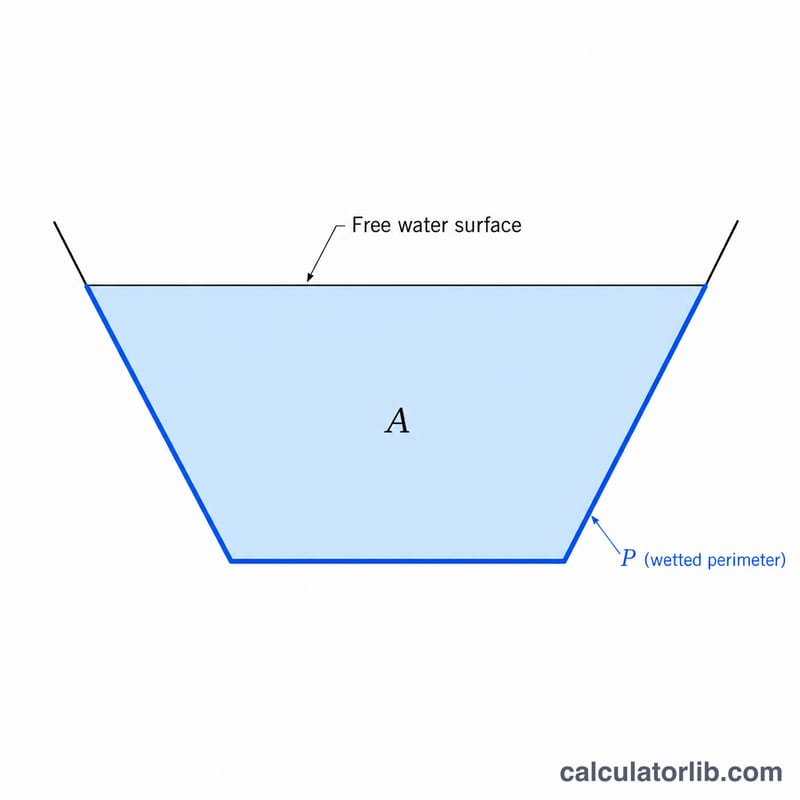
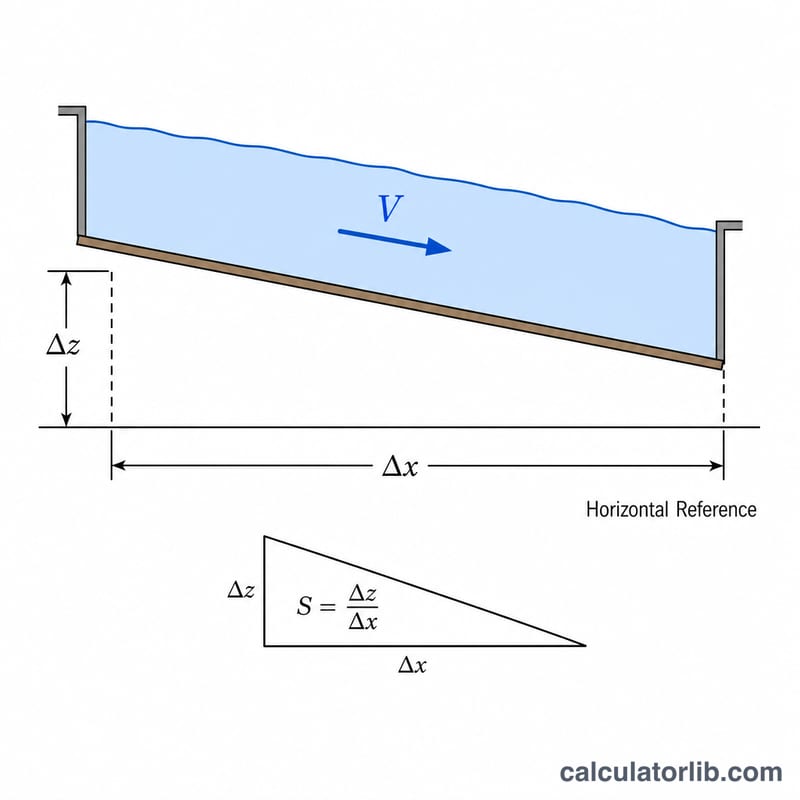
Enter four values: Manning's roughness coefficient n (a dimensionless surface-friction factor, e.g. ~0.013 for concrete, ~0.035 for natural streams), the cross-sectional flow area A in m², the wetted perimeter P in metres (the length of channel boundary in contact with water), and the channel slope S as a dimensionless gradient (rise over run, e.g. 0.001). The calculator returns velocity, discharge, and the hydraulic radius.
The Formula Explained
Velocity is computed as $$V = \frac{k}{n} \cdot R_h^{2/3} \cdot S^{1/2}$$ where the hydraulic radius \(R_h = \frac{A}{P}\). Discharge is then \(Q = V \cdot A\). Lower roughness, larger hydraulic radius, and steeper slope all increase velocity. Because the slope term is square-rooted, doubling the slope only raises velocity by about 41%.
Worked Example
For a channel with \(n = 0.013\), \(A = 2\ \text{m}^2\), \(P = 3\ \text{m}\), \(S = 0.001\): \(R_h = \frac{2}{3} = 0.6667\ \text{m}\). \(R_h^{2/3} = 0.6667^{0.6667} \approx 0.7631\). \(\sqrt{0.001} \approx 0.031623\). $$V = \frac{1}{0.013} \times 0.7631 \times 0.031623 \approx 1.856\ \text{m/s}$$ $$Q = 1.856 \times 2 \approx 3.713\ \text{m}^3/\text{s}$$
FAQ
What value of k should I use? Use \(k = 1.0\) for SI/metric units (as this tool does) and \(k = 1.486\) for US customary units (feet/seconds).
What is the wetted perimeter? It is the length of the channel cross-section boundary that is in contact with the flowing water — it excludes the free water surface.
Does this work for full pipes? Manning's equation works for open channel and partially-full pipe flow; for pressurized full-pipe flow use Darcy-Weisbach or Hazen-Williams instead.