
What this calculator does
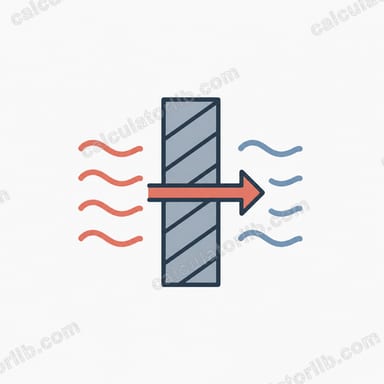
This tool applies Fourier's Law of heat conduction to find how fast heat passes through a solid layer such as a wall, window, insulation board, or pipe lagging. It returns both the total heat flow rate (in watts) and the heat flux (watts per square metre). The physics is universal and applies in any country.
How to use it
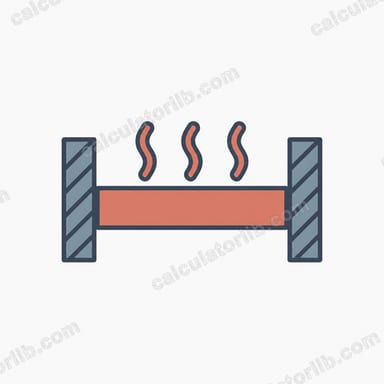
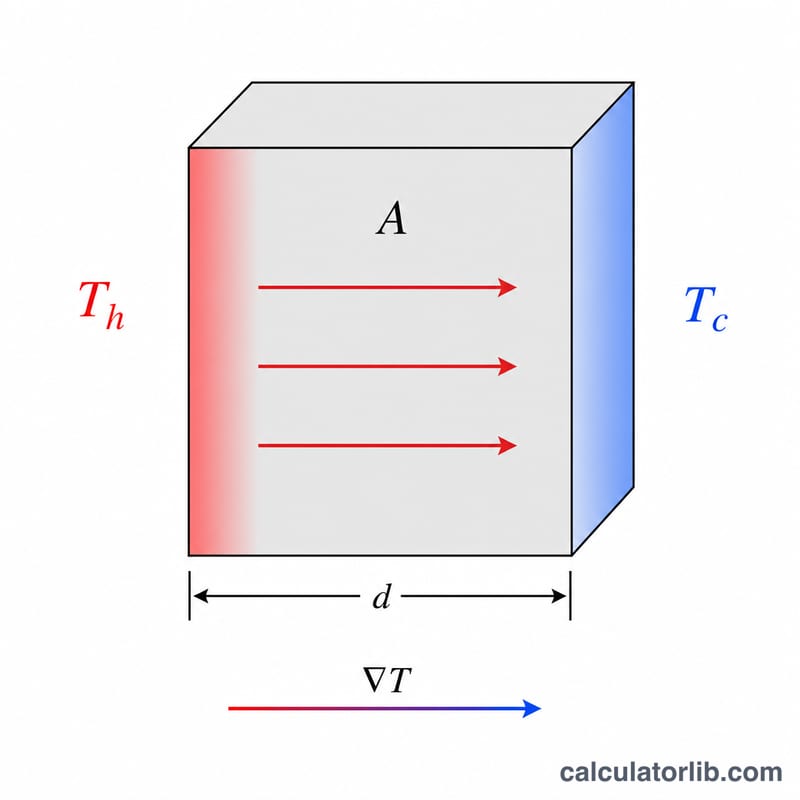
Enter the material's thermal conductivity k (W/m·K), the cross-sectional area A (m²) perpendicular to heat flow, the layer thickness d (m), and the temperatures on the hot and cold faces. Because only the difference matters, you may enter both temperatures in °C or both in K — the result is identical.
The formula explained
Steady-state conduction follows $$\frac{Q}{t} = \frac{k \cdot A \cdot \Delta T}{d}$$ where \(\Delta T = T_{hot} - T_{cold}\). A higher conductivity, larger area, or bigger temperature gap all increase heat flow, while a thicker layer reduces it. The heat flux \(q = \frac{k \cdot \Delta T}{d}\) is simply the flow per unit area.
Worked example
Consider a 10 m² insulating panel, 0.1 m thick, with k = 0.04 W/m·K, hot side at 20 °C and cold side at 0 °C. \(\Delta T = 20\). Heat flow = $$0.04 \times 10 \times 20 / 0.1 = 80 \text{ W}$$ and heat flux = $$0.04 \times 20 / 0.1 = 8 \text{ W/m}^2$$
FAQ
Does it matter whether I use °C or K? No. The law uses a temperature difference, and a 1 °C change equals a 1 K change, so the result is the same.
What is thermal conductivity k? A material property: how readily it conducts heat. Copper ≈ 400 W/m·K, glass ≈ 1, fibreglass insulation ≈ 0.04.
Is this valid for steady state only? Yes — this models steady-state conduction with constant properties and no internal heat generation.