
What is the Double Digit Multiplication Calculator?
This tool multiplies any two two-digit numbers (10–99) and shows not just the answer but the underlying place-value breakdown. It is a universal arithmetic helper — handy for students learning the standard multiplication algorithm, parents checking homework, and anyone who wants to verify mental-math shortcuts.
How to use it
Enter the first number and the second number, each between 10 and 99, then read the result. The hero box shows the final product, while the table splits the answer into its hundreds, tens, and units contributions so you can see exactly where each part comes from.
The formula explained
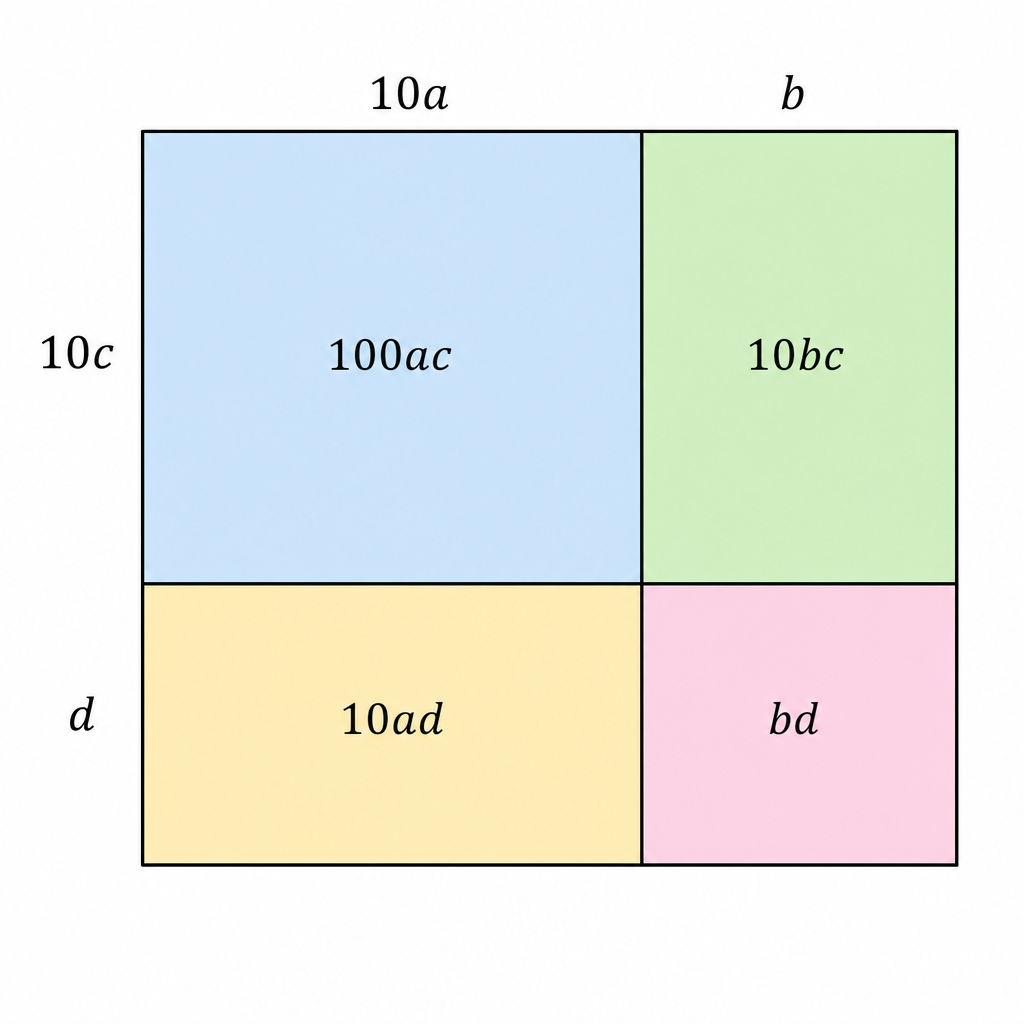
Write each number with its tens digit and units digit. The first number is \(10a + b\) and the second is \(10c + d\). Multiplying them out gives:
$$(10a + b)(10c + d) = 100ac + 10(ad + bc) + bd$$
The three terms are the hundreds part (\(100\cdot ac\)), the tens part (\(10\cdot(ad + bc)\)), and the units part (\(bd\)). Adding them returns the full product, which is identical to simply doing \(n_1 \times n_2\).
Worked example
Take \(23 \times 47\). Here \(a = 2\), \(b = 3\), \(c = 4\), \(d = 7\).
- Hundreds: $$100 \times (2 \times 4) = 800$$
- Tens: $$10 \times (2 \times 7 + 3 \times 4) = 10 \times (14 + 12) = 260$$
- Units: $$3 \times 7 = 21$$
Total: $$800 + 260 + 21 = \mathbf{1{,}081}$$ which matches \(23 \times 47\).
FAQ
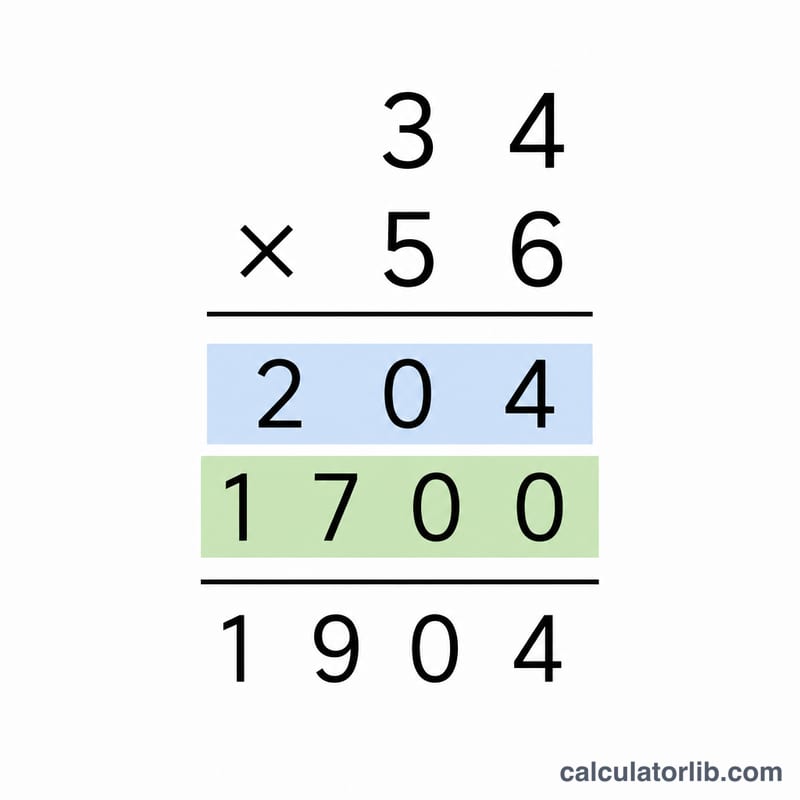
Why split the answer into parts? The expansion mirrors the column ("long") multiplication method, making it easier to understand and to spot mistakes.
Can I use single-digit numbers? This calculator is designed for two-digit inputs (10–99). For single digits, just treat the tens digit as 0.
Will the components always add up to the product? Yes — by algebra the three parts sum exactly to \(n_1 \times n_2\) for any valid inputs.