
What is the FOIL Method?
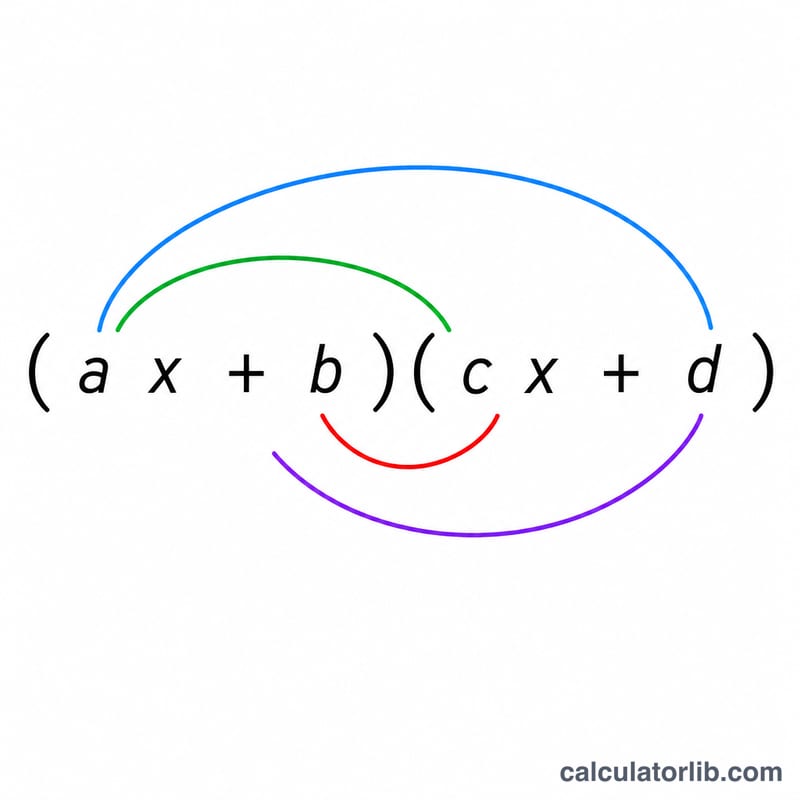
FOIL is a mnemonic for multiplying two binomials. It stands for First, Outer, Inner, Last — the four pairs of terms you multiply when expanding an expression like \((ax + b)(cx + d)\). Adding those four products and combining like terms gives the expanded polynomial. This calculator does the arithmetic for you and shows every step so you can check your own work.
How to Use It
Each binomial has two parts. For the first binomial, enter a (the coefficient of x) and b (the constant). For the second binomial enter c and d. The calculator returns the expanded quadratic in the form \((ac)x^2 + (ad+bc)x + bd\), along with each individual FOIL product. If you only need to multiply two simple sums like \((3+4)(5+6)\), set the x-coefficients a and c so the structure matches, or treat the constants directly.
The Formula Explained
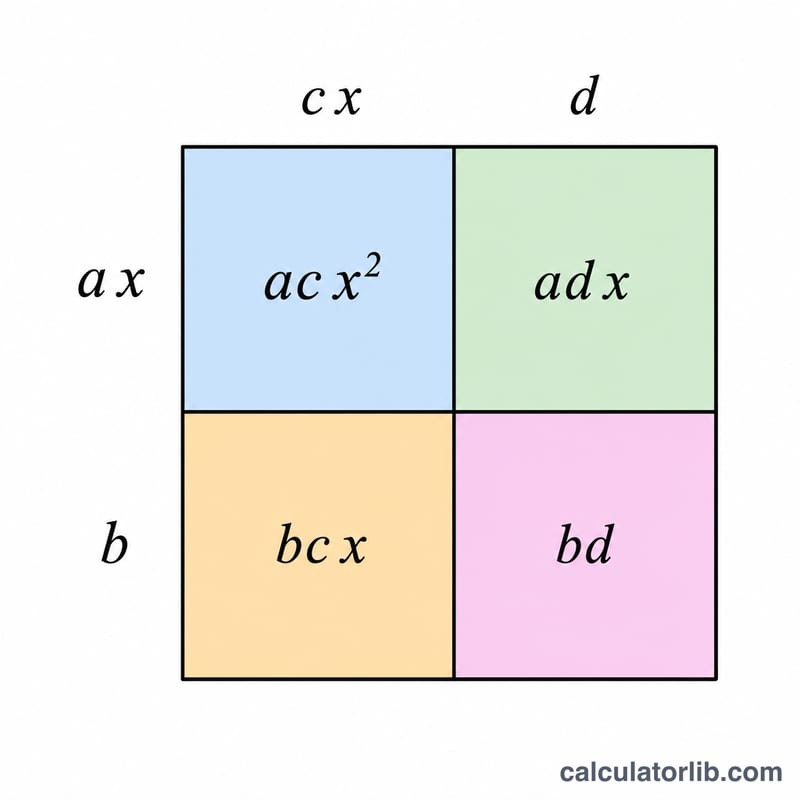
The expansion is $$(ax+b)(cx+d) = acx^2 + adx + bcx + bd.$$ The First product is \(a\times c\), the Outer is \(a\times d\), the Inner is \(b\times c\), and the Last is \(b\times d\). The two middle terms (Outer and Inner) share the variable x, so they combine into \((ad + bc)x\).
Worked Example
Expand \((2x + 3)(4x + 5)\). First: \(2\times 4 = 8\). Outer: \(2\times 5 = 10\). Inner: \(3\times 4 = 12\). Last: \(3\times 5 = 15\). Combine: $$8x^2 + (10+12)x + 15 = \mathbf{8x^2 + 22x + 15}.$$
FAQ
Can I use negative numbers? Yes. Enter a negative coefficient like -3 and the signs propagate correctly through every product.
Does FOIL work for trinomials? No — FOIL applies only to two binomials. For larger polynomials use the distributive property term by term.
What if both binomials are pure numbers? Set a and c to represent the structure; the constant term \(bd\) plus the cross terms still give the correct total via \((a+b)(c+d) = ac + ad + bc + bd\).