
What Is the Reverse FOIL Calculator?
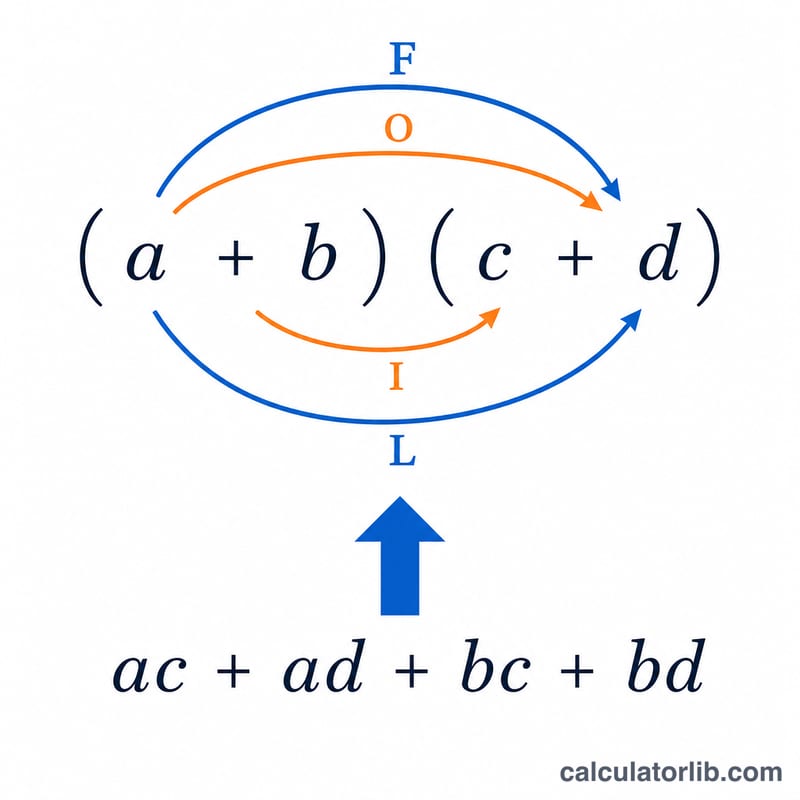
The Reverse FOIL Calculator factors a quadratic trinomial of the form ax² + bx + c back into two binomials, such as (px + q)(rx + s). "FOIL" stands for First, Outer, Inner, Last — the method used to multiply two binomials together. Reverse FOIL simply runs that process backward: instead of expanding binomials into a trinomial, you start with the trinomial and find the binomials that produced it. This calculator handles the trial-and-error guesswork for you and returns clean factors whenever the quadratic factors over the integers.
How to Use It
- Enter the coefficient a (the number in front of x²).
- Enter the coefficient b (the number in front of x).
- Enter the constant c.
- Read the factored form. If no integer factors exist, the calculator tells you so.
For example, for x² + 5x + 6, type a = 1, b = 5, c = 6 to get (x + 2)(x + 3).
The Method Explained
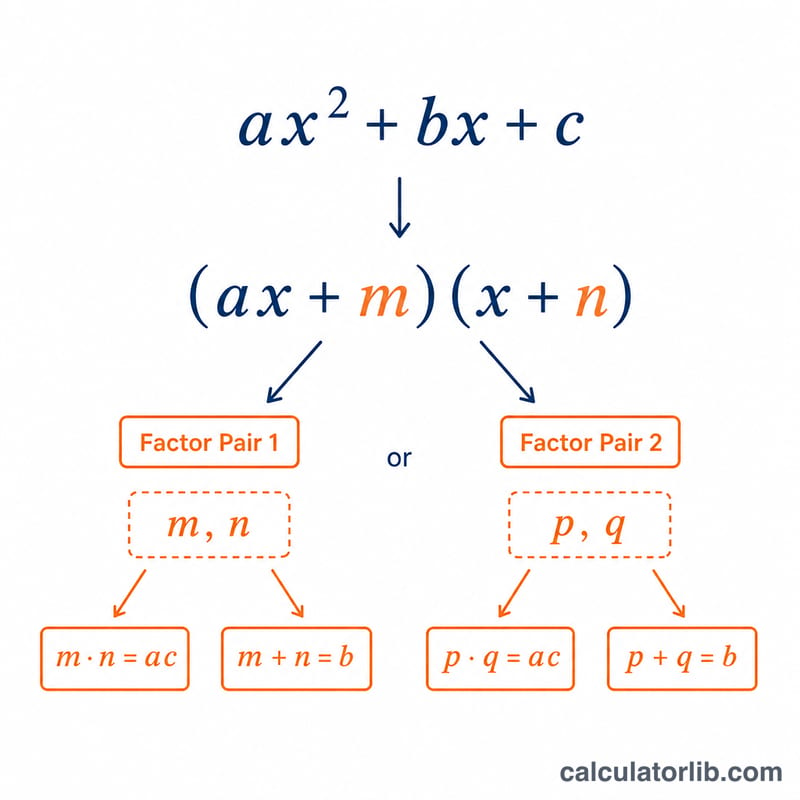
To factor ax² + bx + c, multiply a × c, then look for two numbers that multiply to that product and add to b. Split the middle term using those two numbers, then factor by grouping. The result is two binomials. Multiplying them with FOIL recovers the original trinomial, which confirms the answer.
Worked Example
Factor 2x² + 7x + 3. Here a × c = 2 × 3 = 6. We need two numbers that multiply to 6 and add to 7: those are 6 and 1. Rewrite as 2x² + 6x + x + 3, then group: 2x(x + 3) + 1(x + 3) = (2x + 1)(x + 3). Checking with FOIL: 2x·x + 2x·3 + 1·x + 1·3 = 2x² + 7x + 3. Correct.
Frequently Asked Questions
Why does it say "cannot be factored"? Some quadratics have irrational or complex roots and do not break into integer binomials. For those, use the quadratic formula instead.
Does it work when a is not 1? Yes — the calculator handles leading coefficients greater than one using the grouping approach shown above.
Can a, b, or c be negative? Absolutely. Negative coefficients are fully supported and produce the correct signs in the binomials.