
What This Calculator Does
The Chi-Square P-Value Calculator converts a chi-square test statistic into a p-value, the probability of observing a result at least as extreme as yours if the null hypothesis were true. It works for any chi-square test — goodness-of-fit, test of independence, or homogeneity — as long as you know the test statistic and the degrees of freedom. The calculator also reports critical values at the common significance levels of 0.05, 0.01, and 0.001 so you can see exactly where your result falls.
How to Use It
- Chi-square statistic (χ²): Enter the value produced by your test, usually from statistics software or a hand calculation.
- Degrees of freedom (df): For a goodness-of-fit test, df = number of categories − 1. For a contingency table, df = (rows − 1) × (columns − 1).
- Read the resulting p-value and compare it to your chosen alpha (commonly 0.05).
The Formula Explained
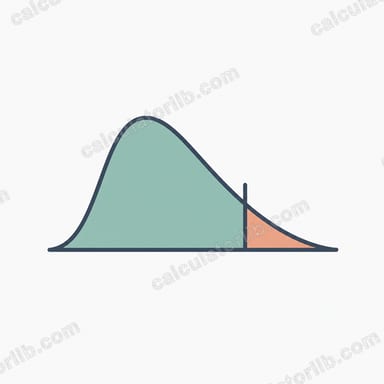
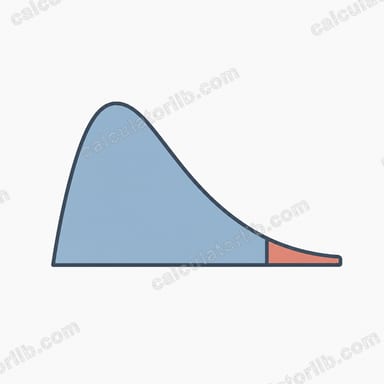
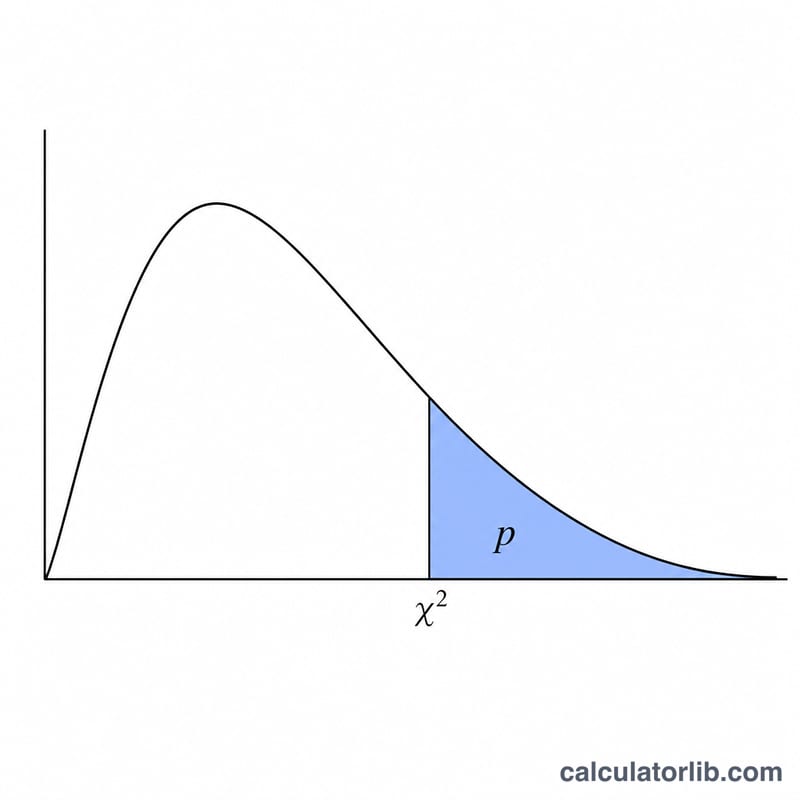
The chi-square distribution depends only on degrees of freedom. The p-value is the upper-tail area beyond your statistic:
p = P(χ²df ≥ observed value)
This is computed using the regularized upper incomplete gamma function. Because chi-square tests are inherently one-tailed (larger statistics mean a bigger discrepancy from expectation), only the right tail is used. A smaller p-value means stronger evidence against the null hypothesis.
Worked Example
Suppose you roll a die 60 times to test whether it is fair. You compute a chi-square statistic of 12.6 with df = 5 (six faces minus one). Entering these values returns a p-value of about 0.027. Since 0.027 is less than 0.05 but greater than 0.01, you would reject the null hypothesis at the 5% level and conclude the die appears biased — though the evidence is not strong enough to reach the 1% level.
Frequently Asked Questions
What p-value counts as significant? A p-value below your chosen alpha (commonly 0.05) is considered statistically significant. Stricter thresholds like 0.01 or 0.001 reduce the chance of a false positive.
Why does degrees of freedom matter so much? The shape of the chi-square distribution changes with df, so the same statistic can be significant with few degrees of freedom but not with many. Always enter df accurately.
Can the p-value be exactly zero? No. Extremely large statistics produce vanishingly small p-values that may display as 0.000, but the true value is always positive.