

What is the FOIL Method?
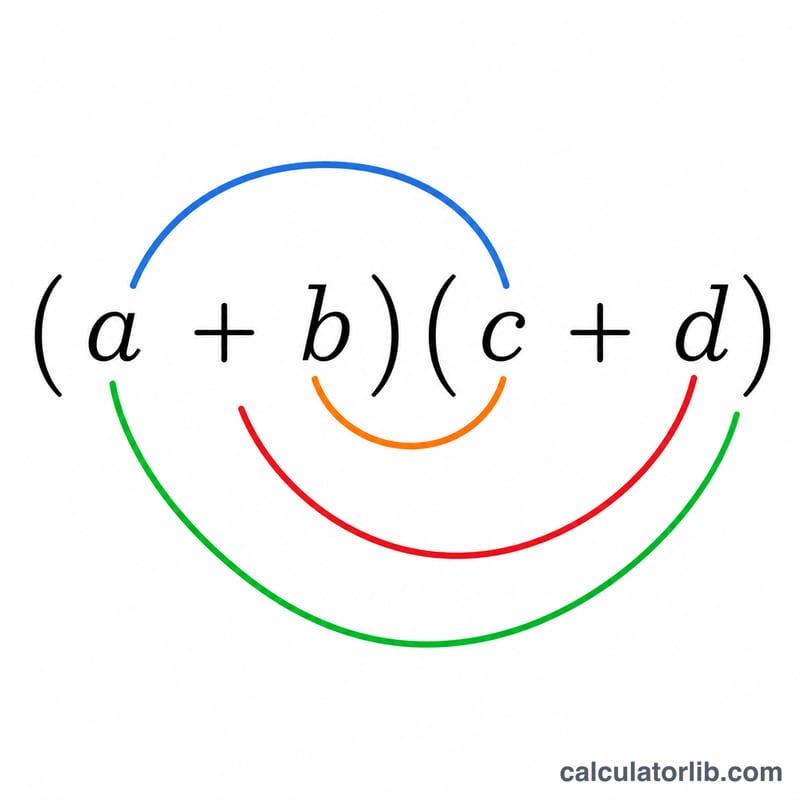
FOIL is a memory aid for multiplying two binomials. The letters stand for First, Outer, Inner, Last — the four pairs of terms you multiply together before adding the results. For two binomials \((a + b)(c + d)\), the expansion is \(ac + ad + bc + bd\). This calculator does each step for you and shows the four partial products so you can check your own work.
How to Use This Calculator
Enter the four numeric terms: a and b from the first binomial, and c and d from the second. The calculator multiplies First (\(a \cdot c\)), Outer (\(a \cdot d\)), Inner (\(b \cdot c\)), and Last (\(b \cdot d\)), then sums them into the final product. Values can be positive, negative, or decimals.
The Formula Explained
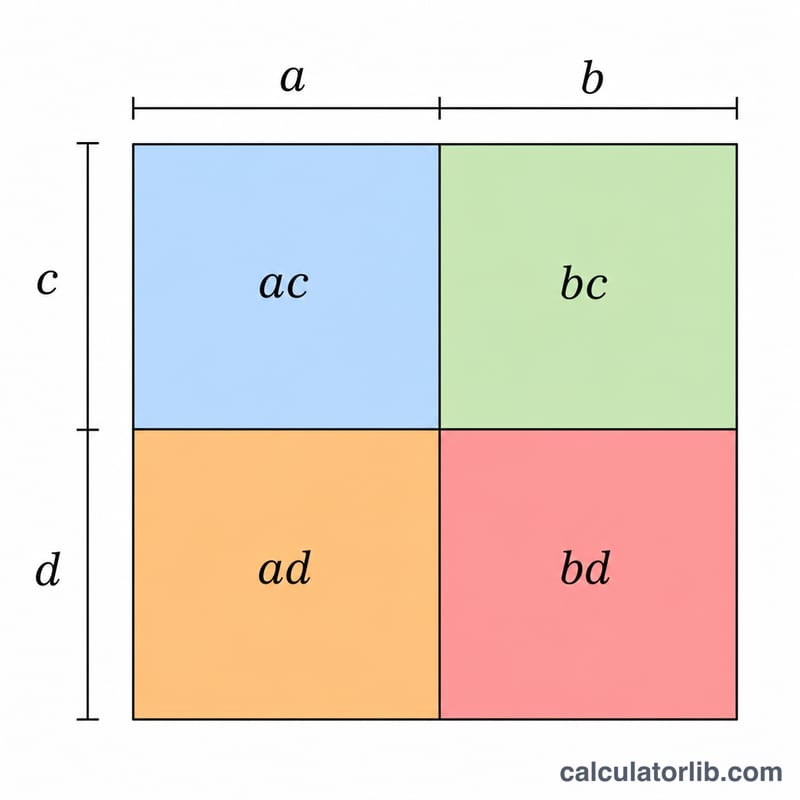
The FOIL rule is just the distributive property applied twice:
$$(a + b)(c + d) = a(c + d) + b(c + d) = ac + ad + bc + bd.$$
First multiplies the first terms of each binomial, Outer multiplies the outermost terms, Inner the innermost, and Last the final terms. Adding all four gives the expanded expression.
Worked Example
Expand \((2 + 3)(4 + 5)\):
- First: \(2 \times 4 = 8\)
- Outer: \(2 \times 5 = 10\)
- Inner: \(3 \times 4 = 12\)
- Last: \(3 \times 5 = 15\)
Sum: $$8 + 10 + 12 + 15 = 45.$$ As a check, \((2 + 3)(4 + 5) = 5 \times 9 = 45\). ✓
FAQ
Does FOIL work for trinomials? No — FOIL applies only to multiplying two binomials. For larger polynomials use full distribution.
Can I use negative numbers? Yes. Enter a negative value (e.g. -3) and the signs are handled automatically.
Why show four partial products? Seeing First, Outer, Inner, and Last separately helps you verify each multiplication step and learn the method.