
What Is a Fractional Exponent?
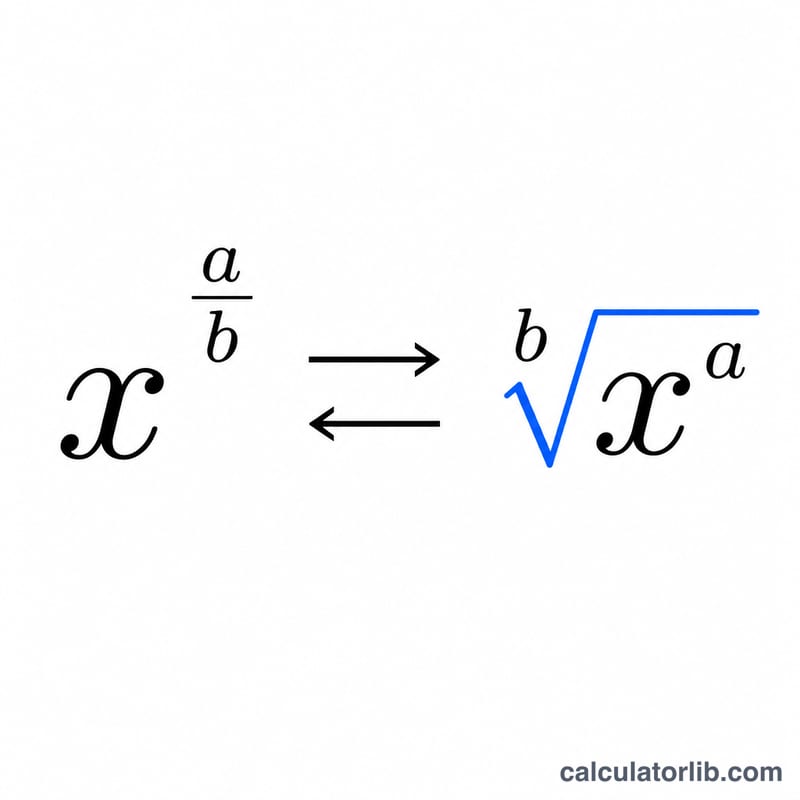
A fractional exponent is a power written as a fraction, such as \(x^{a/b}\). The denominator b tells you which root to take, and the numerator a tells you which power to raise to. So \(x^{a/b}\) is the same as the b-th root of x raised to the a-th power. For example, \(8^{2/3}\) means "take the cube root of 8, then square it."
How to Use This Calculator
Enter three values: the base (x), the numerator (a) of the exponent, and the denominator (b) of the exponent. The calculator converts the fraction to a decimal exponent (a ÷ b) and computes x raised to that power. It also shows the decimal exponent so you can see exactly what power was applied.
The Formula Explained
The key identity is:
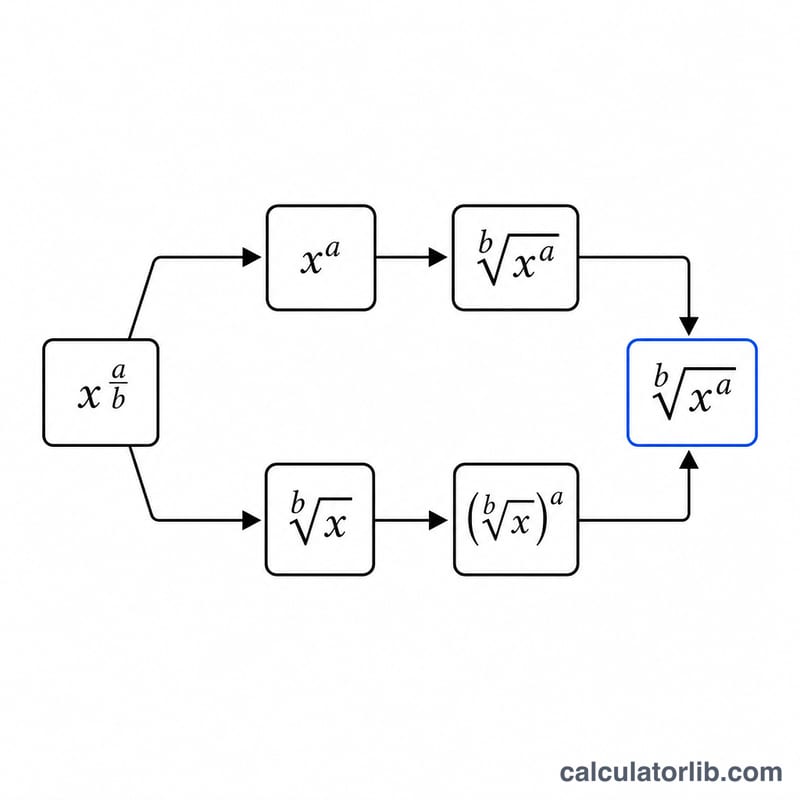
$$x^{\frac{a}{b}} = \left(x^{a}\right)^{\frac{1}{b}} = \sqrt[b]{x^{a}}$$
Raising to the power \(\frac{1}{b}\) is the same as taking the b-th root. Because powers and roots commute, you can also take the root first and then the power: \(\left(\sqrt[b]{x}\right)^{a}\). The result is identical, but doing the root first often keeps the numbers smaller and easier to read.
Worked Example
Solve \(8^{2/3}\). The denominator is 3, so take the cube root of 8, which is 2. The numerator is 2, so square that result: \(2^{2} = 4\). Therefore $$8^{\frac{2}{3}} = 4.$$ You can verify this on the calculator by entering base = 8, numerator = 2, denominator = 3.
FAQ
What does a negative base do? Fractional powers of negative numbers can produce complex (non-real) results, especially with even denominators. This calculator returns real-number results only, so negative bases with even roots may not behave as expected.
What if the denominator is 0? Division by zero is undefined, so the calculator guards against it and returns 0 — choose a non-zero denominator.
Is \(x^{1/2}\) the same as a square root? Yes. A denominator of 2 is exactly the square root, a denominator of 3 is the cube root, and so on.