
What is the FOIL Method?
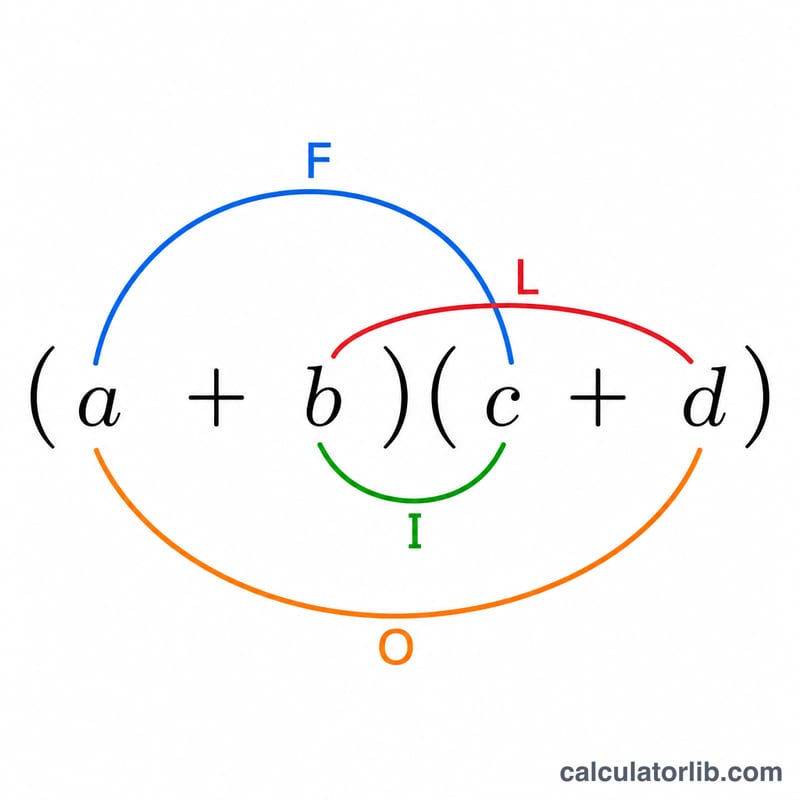
FOIL is a simple technique for multiplying two binomials — expressions of the form \((a + b)\) and \((c + d)\). The name FOIL is an acronym for First, Outer, Inner, Last, which describes the order in which you multiply the pairs of terms. This calculator takes your four coefficients a, b, c and d and instantly returns each product as well as the combined expanded result.
How to Use This Calculator
Enter the four values that make up your two binomials: a and b for the first bracket \((a + b)\), and c and d for the second bracket \((c + d)\). Press calculate to see the four partial products and their sum. Negative numbers and decimals are fully supported, so you can use it for any pair of numeric binomials.
The Formula Explained
The FOIL rule expands the product as follows:
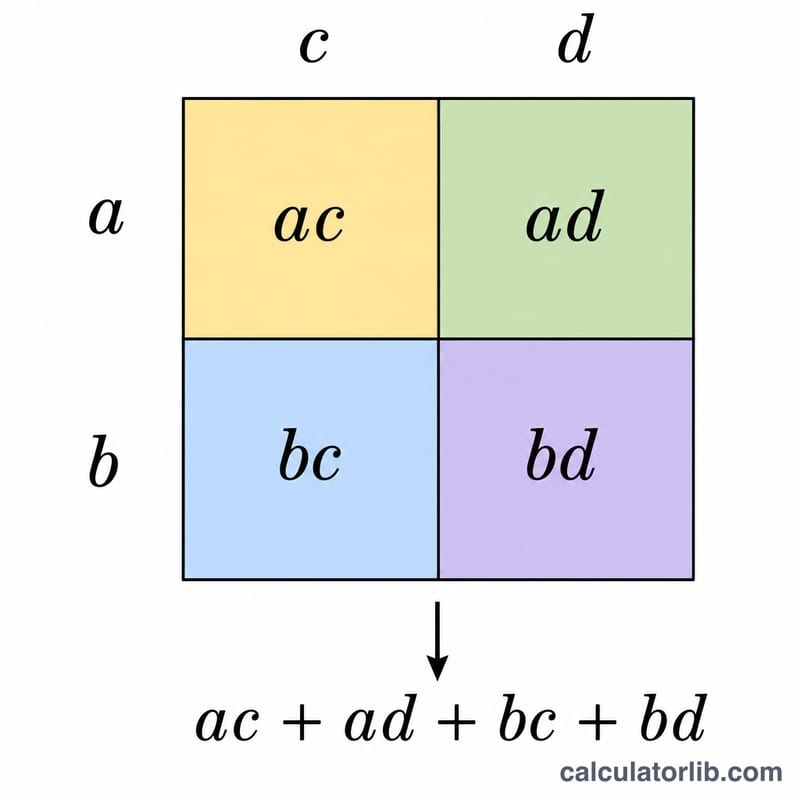
$$\left(a + b\right)\left(c + d\right) = ac + ad + bc + bd$$
- First: multiply the first terms → \(a \times c\)
- Outer: multiply the outer terms → \(a \times d\)
- Inner: multiply the inner terms → \(b \times c\)
- Last: multiply the last terms → \(b \times d\)
Adding all four products gives the fully expanded expression.
Worked Example
Expand \((2 + 3)(4 + 5)\). First: \(2 \times 4 = 8\). Outer: \(2 \times 5 = 10\). Inner: \(3 \times 4 = 12\). Last: \(3 \times 5 = 15\). Sum = \(8 + 10 + 12 + 15 = 45\). As a check, \((2 + 3)(4 + 5) = 5 \times 9 = 45\) ✓.
FAQ
Does FOIL work for any two binomials? Yes — FOIL applies to the product of any two two-term expressions. For larger expressions (trinomials, etc.) use the more general distributive method.
Can I use negative numbers? Absolutely. Enter negative values for any term and the calculator handles the signs automatically.
Why are there four terms? Because each of the 2 terms in the first bracket must be multiplied by each of the 2 terms in the second bracket, giving \(2 \times 2 = 4\) products.