
What is SHA-256?
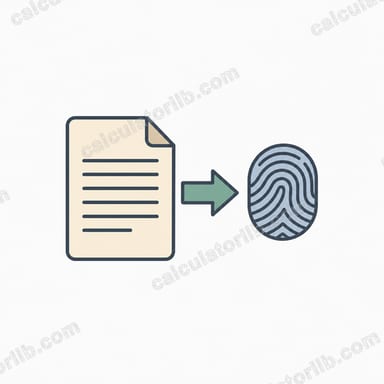
SHA-256 is a member of the SHA-2 family of cryptographic hash functions, standardized by NIST. It takes an input message of any length and produces a fixed 256-bit (32-byte) digest, displayed here as 64 hexadecimal characters. The same input always yields the same digest, while even a one-character change produces a completely different output (the avalanche effect). SHA-256 is widely used in TLS certificates, digital signatures, blockchain (Bitcoin), and file-integrity checks.
How to use this calculator
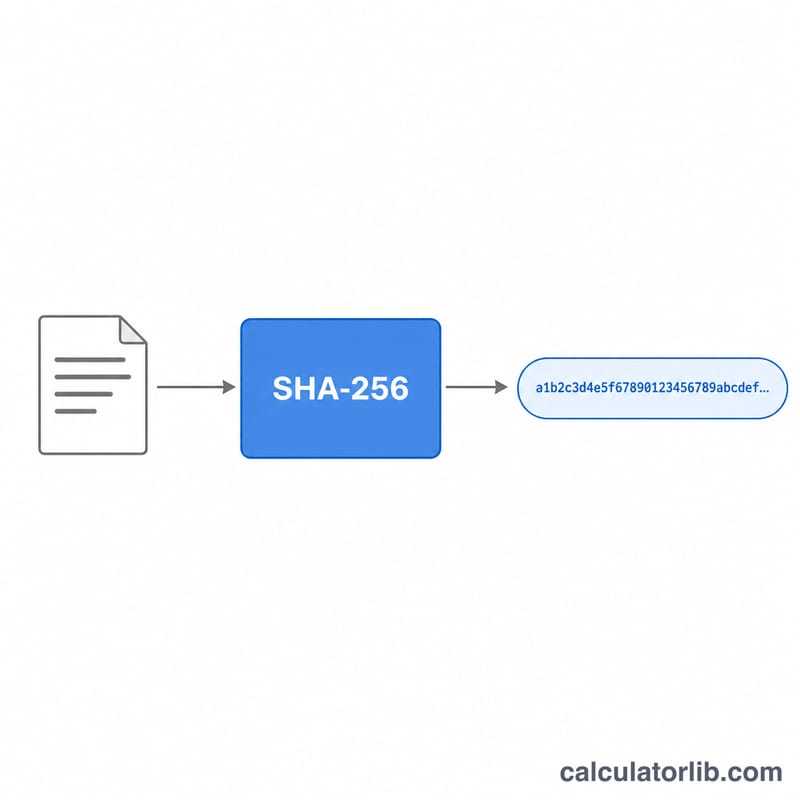
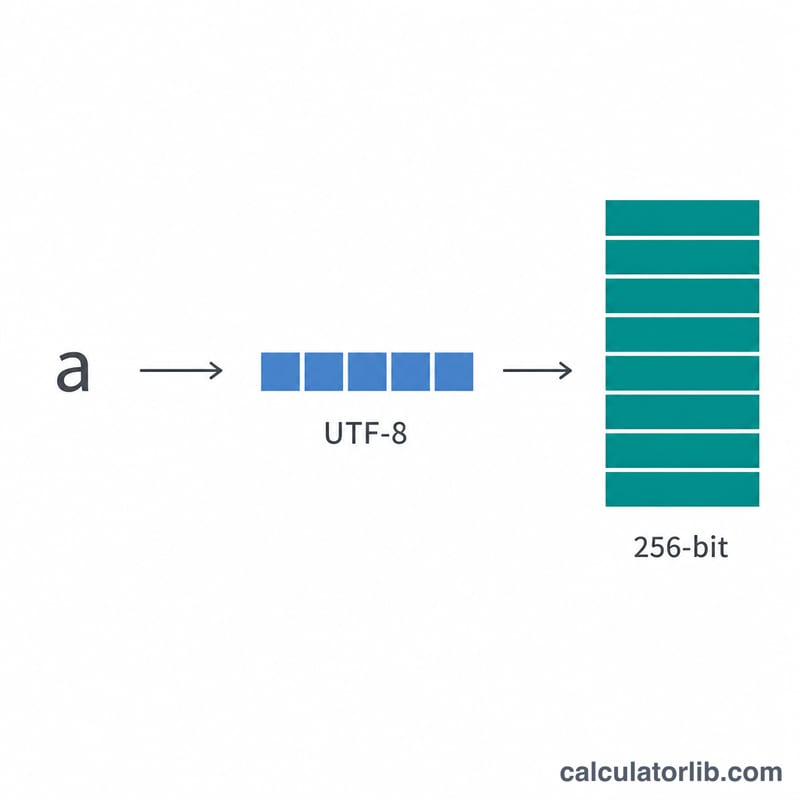
Type or paste any text into the input box and submit. The calculator UTF-8 encodes your text, runs the SHA-256 algorithm, and returns the hexadecimal digest along with the input's byte length. An empty input is valid and produces the well-known empty-string digest.
The formula explained
The core operation is:
$$\text{Hash} = \operatorname{SHA\text{-}256}\!\left(\text{Input Text}\right)$$SHA-256 pads the message so its length is a multiple of 512 bits, splits it into 512-bit blocks, and processes each block through 64 rounds of bitwise operations (rotations, shifts, AND/XOR, modular addition) mixing eight 32-bit working variables initialized from fractional parts of square roots of primes. The eight registers are added back into the running hash state after each block; concatenating them gives the final 256-bit digest.
Worked example
The input abc (3 bytes) produces the digest ba7816bf8f01cfea414140de5dae2223b00361a396177a9cb410ff61f20015ad. The empty string produces e3b0c44298fc1c149afbf4c8996fb92427ae41e4649b934ca495991b7852b855 — a standard test vector.
FAQ
Is SHA-256 reversible? No. It is a one-way function; you cannot recover the input from the digest.
Why is my byte count larger than the character count? Non-ASCII characters (accents, emoji, CJK) take multiple bytes in UTF-8, so the byte length can exceed the number of characters.
Is SHA-256 still secure? Yes. As of today there are no practical collision or preimage attacks against SHA-256; it remains a recommended hash for general use.