
What is the MD5 Hash Calculator?
The MD5 Hash Calculator computes the 128-bit MD5 message digest of any text you enter. MD5 (Message-Digest Algorithm 5, defined in RFC 1321) takes an arbitrary-length input and produces a fixed 32-character hexadecimal fingerprint. The same input always yields the same hash, while even a single-character change produces a completely different result.
How to use it
Type or paste your text into the input box and submit. The calculator encodes your text as UTF-8 bytes, applies the MD5 algorithm, and returns the lowercase hexadecimal digest along with the input length in characters and its size in UTF-8 bytes. Leave the box empty to see the well-known empty-string hash.
The formula explained
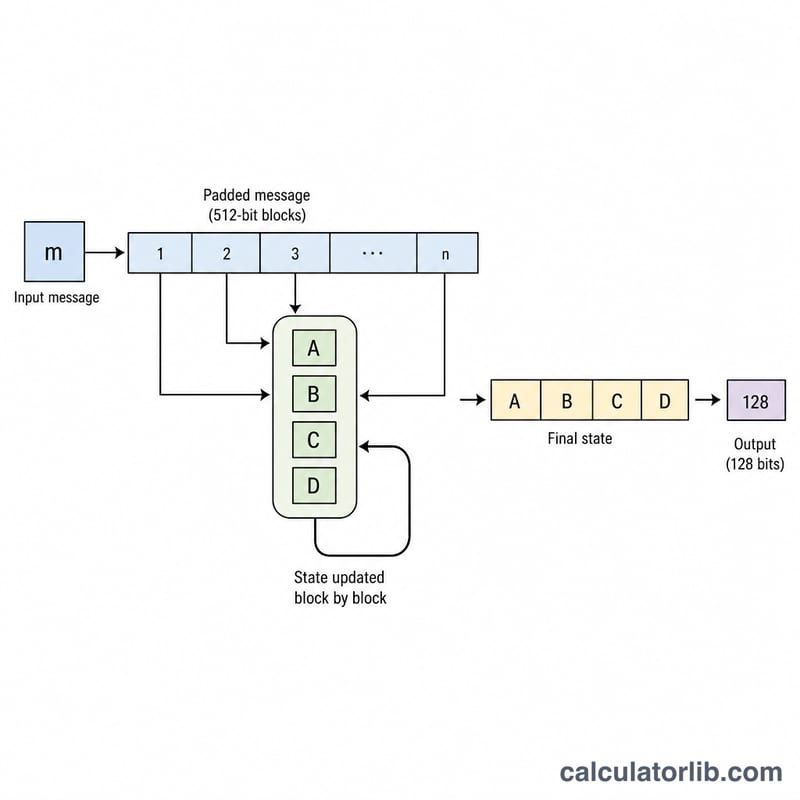
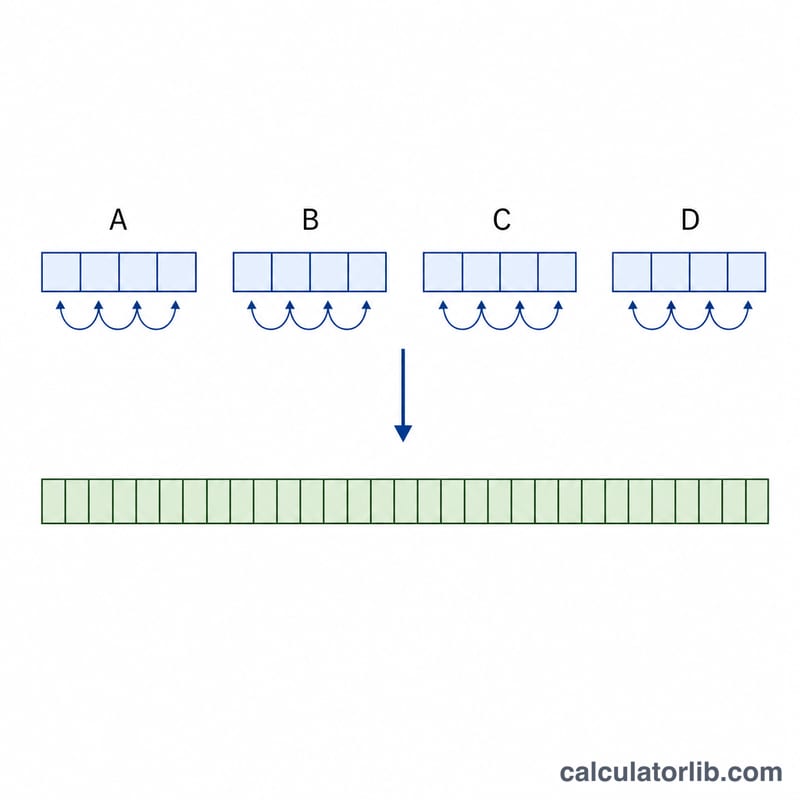
MD5 is a Merkle–Damgård construction. The message is padded with a single 0x80 byte, then zeros, until its length is 56 mod 64 bytes, and finally the original bit-length is appended as a 64-bit little-endian value. The padded message is split into 512-bit blocks, each processed in 64 operations across four rounds using nonlinear functions, per-step constants derived from sin, and left-rotations. The four 32-bit state words (A, B, C, D) are initialized to fixed seeds and updated for each block; their final little-endian concatenation is the digest.
$$\text{MD5}\!\left(\text{Text}\right) = \text{Hex}_{128}\big(A \Vert B \Vert C \Vert D\big)$$
Worked example
The empty string ("") has zero bytes. After padding it becomes a single 512-bit block, and MD5 returns d41d8cd98f00b204e9800998ecf8427e. The text "hello" (5 bytes) hashes to 5d41402abc4b2a76b9719d911017c592.
FAQ
Is MD5 secure? No. MD5 is cryptographically broken — collisions can be generated easily. Use it only for checksums and non-security fingerprints, not for passwords or signatures.
Why is the byte count different from character count? Non-ASCII characters take more than one byte in UTF-8, so a 3-character emoji string can be several bytes.
Does input casing matter? Yes. "Hello" and "hello" produce entirely different hashes.