
What this calculator does
This tool multiplies two two-digit numbers, each intended to be in the range 20-99 (the "20s to 90s"), and shows the answer instantly. It also illustrates the popular "Indian method" of fast mental multiplication so you can learn to do the same calculation in your head. The numeric answer is just ordinary multiplication - it works for any integers - but the step-by-step breakdown turns it into a teaching aid. The technique is universal arithmetic; no country-specific rules apply.
How to use it
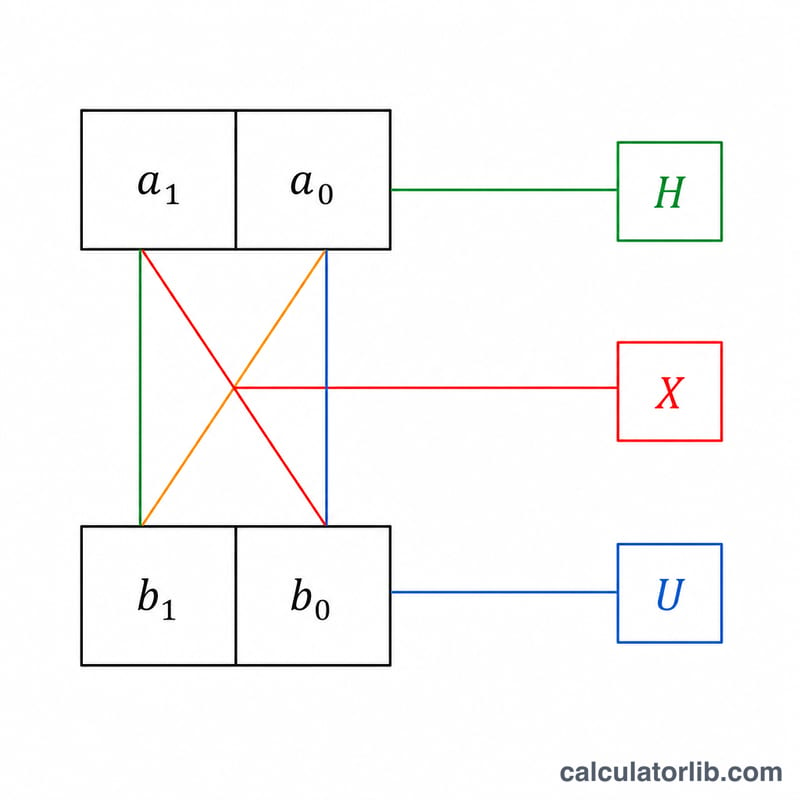
Type your first number (A) and second number (B), both whole numbers between 20 and 99, then read the answer. Below the answer you will see the vertical-and-crosswise (Urdhva-Tiryagbhyam) decomposition: a hundreds partial, a cross-terms partial, and a units partial that add up to the final product.
The formula explained
Write each number using its tens and units digits: \(\text{A} = 10\cdot a_1 + a_0\) and \(\text{B} = 10\cdot b_1 + b_0\). Then the product equals
$$\text{A} \times \text{B} = 100\,(a_1 b_1) + 10\,(a_1 b_0 + a_0 b_1) + (a_0 b_0)$$The first term gives the hundreds, the middle "cross" term gives the tens contribution, and the last term gives the units. This is algebraically identical to \(\text{A} \times \text{B}\), so the answer is always exact.
Worked example
Take \(22 \times 24\). Here \(a_1=2\), \(a_0=2\), \(b_1=2\), \(b_0=4\). Hundreds: \(H = 2\times 2 = 4\) (so 400). Cross: \(M = 2\times 4 + 2\times 2 = 12\) (so 120). Units: \(L = 2\times 4 = 8\). Sum:
$$400 + 120 + 8 = 528$$which matches \(22 \times 24 = 528\).
FAQ
Does the Indian method give a different answer? No. It is just a structured way to reach the same product more quickly in your head.
Can I use numbers outside 20-99? The multiplication itself works for any numbers, but the step-by-step breakdown only displays when both inputs are exactly two digits so the tens digits stay single.
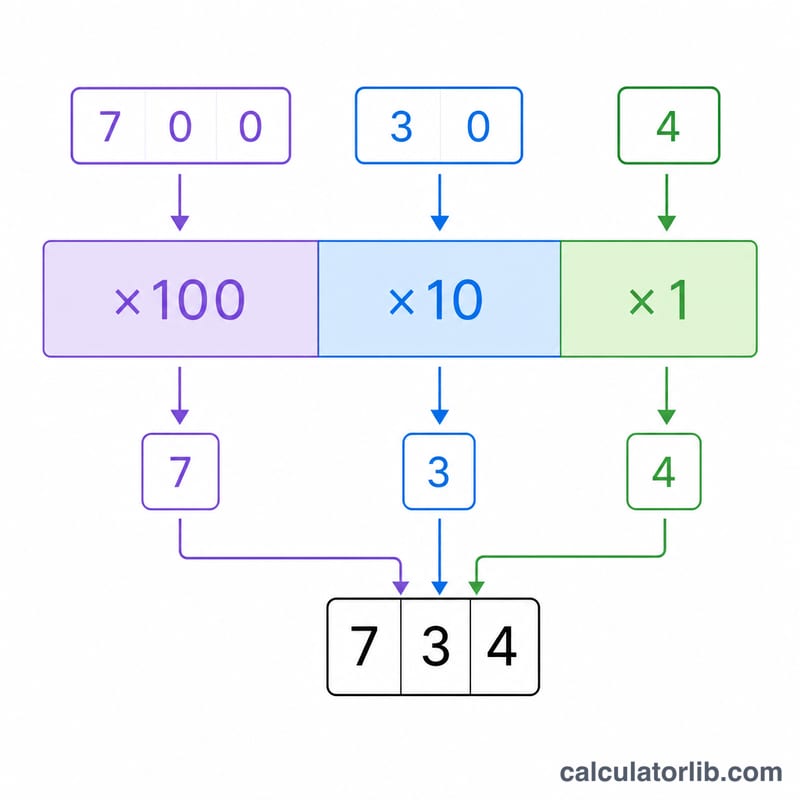
Why split into three parts? Splitting by place value (hundreds, tens, units) lets you add small partial products instead of doing one large multiplication, which is easier mentally.