
What this calculator does
This tool divides any non-negative whole number by 9 and shows the exact quotient and remainder. More importantly, it illustrates the classic Indian-style (Vedic) mental-math shortcut for dividing by 9 using nothing but the addition of digits instead of long division. The divisor is fixed at 9.
How to use it
Type the number you want to divide into the "Number (problem)" box. The "÷ 9" next to it is fixed. Press calculate and you get the quotient, the remainder, and a casting-out-nines check that proves the remainder using the sum of the number's digits.
The formula and the trick
The exact result is simple integer division: \(\text{quotient} = \left\lfloor N / 9 \right\rfloor\) and \(\text{remainder} = N - 9 \times \text{quotient}\), which always lands the remainder in the range 0 to 8.
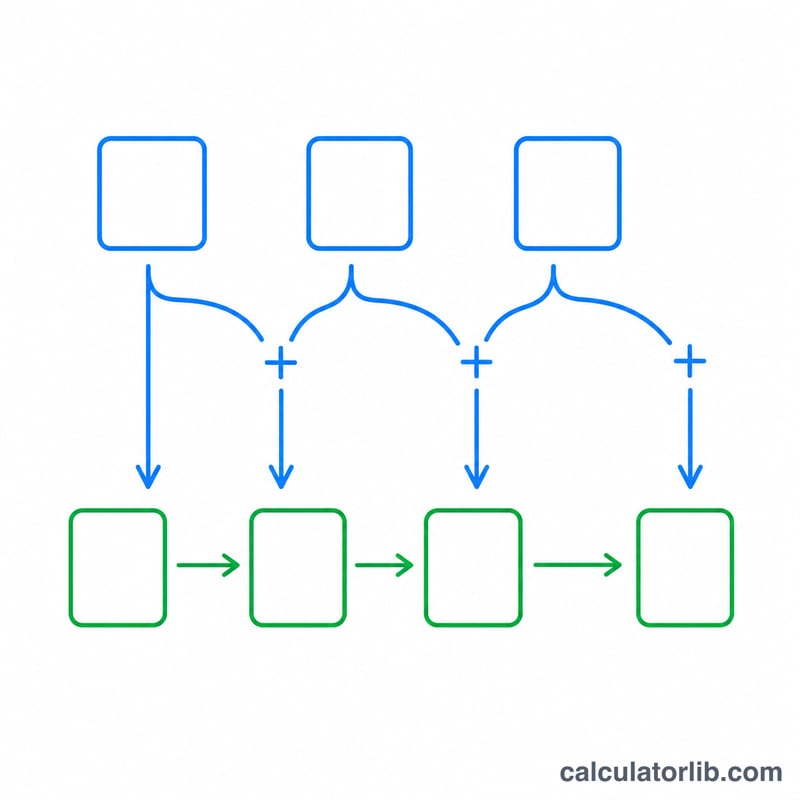
The "addition trick" works because 10 leaves a remainder of 1 when divided by 9, so 100, 1000 and every power of ten do too. That means a number is congruent to the sum of its digits modulo 9. So the remainder of N divided by 9 equals the digit sum of N taken modulo 9 - you can find it in your head just by adding digits. Building the quotient digit by digit uses a running cumulative sum of the digits, carrying tens leftward whenever a running total reaches 9 or more.
$$\begin{gathered} q = \left\lfloor \frac{N}{9} \right\rfloor, \qquad r = N - 9\,q \\[1.5em] \text{where}\quad N = \left\lfloor \left| \text{Number} \right| \right\rfloor \end{gathered}$$
Worked example
Take \(N = 1234\). Digit sum = \(1 + 2 + 3 + 4 = 10\), and \(10 \bmod 9 = 1\), so the remainder is 1. The quotient is \(\left\lfloor 1234 / 9 \right\rfloor = 137\), since \(9 \times 137 = 1233\) and \(1234 - 1233 = 1\). Result: 137 remainder 1.
FAQ
Why does the digit-sum trick give the remainder? Because every power of ten is congruent to 1 modulo 9, the whole number reduces to its digit sum modulo 9 - the centuries-old "casting out nines" identity.
What if my number is smaller than 9? Then the quotient is 0 and the remainder equals the number itself (for example 5 gives 0 remainder 5).
Can I use negative numbers? No. This trick is defined for non-negative integers; the calculator takes the absolute value and uses its whole-number part.