
What is the Vedic Rectangle (Box) Multiplication Calculator?
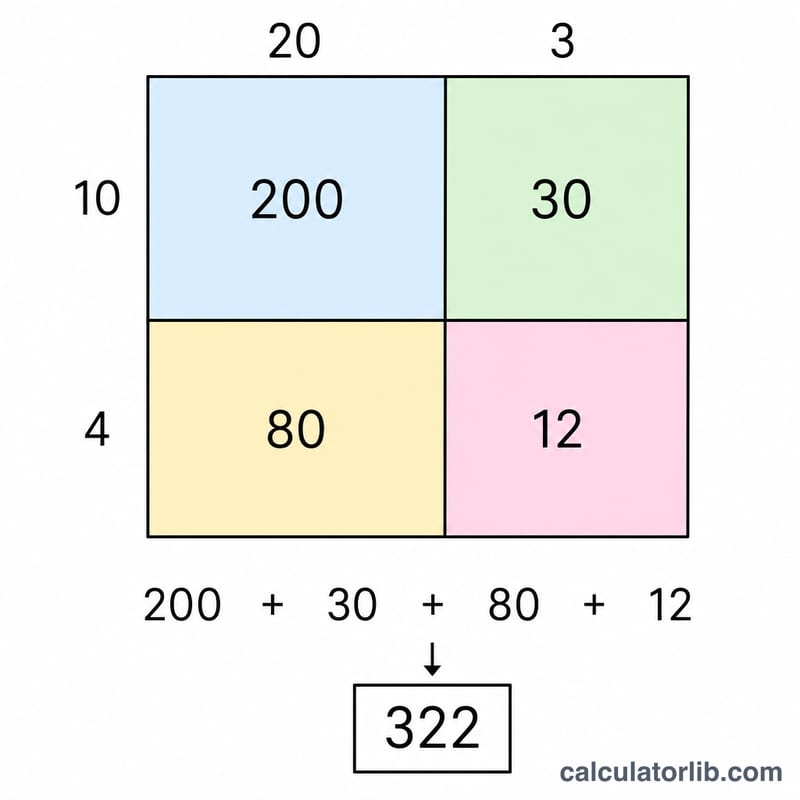
This tool multiplies two numbers and shows the answer the "rectangle" or "box method" way used in Indian and Vedic mental-math training. Instead of a single column multiplication, the digits of each number are laid out along the sides of a rectangle, and the area of each cell becomes a partial product. Adding the partial products gives the final answer. The headline result is just the ordinary product A times B, so it works for any numbers; the grid breakdown is a learning aid for two-digit non-negative integers.
How to use it
Enter the first number A and the second number B, then read the Answer. If both numbers are non-negative integers, a table appears showing the four cell products and their place values, so you can see exactly how the total is built up. This trains you to do the same decomposition in your head.
The formula explained
Write A as \(10\cdot a_1 + a_0\) and B as \(10\cdot b_1 + b_0\), where \(a_1\), \(b_1\) are the tens digits and \(a_0\), \(b_0\) are the ones digits. The rectangle has four cells whose areas are \(a_1\cdot b_1\), \(a_1\cdot b_0\), \(a_0\cdot b_1\) and \(a_0\cdot b_0\). Scaling by place value:
$$\text{product} = 100\cdot(a_1\cdot b_1) + 10\cdot(a_1\cdot b_0 + a_0\cdot b_1) + 1\cdot(a_0\cdot b_0)$$More generally:
$$\begin{gathered} \text{A} \times \text{B} = a_1 b_1\cdot 100 + (a_1 b_0 + a_0 b_1)\cdot 10 + a_0 b_0 \\[1.5em] \text{where}\quad \left\{ \begin{aligned} a_1 &= \left\lfloor \text{A} / 10 \right\rfloor, \quad a_0 = \text{A} \bmod 10 \\ b_1 &= \left\lfloor \text{B} / 10 \right\rfloor, \quad b_0 = \text{B} \bmod 10 \end{aligned} \right. \end{gathered}$$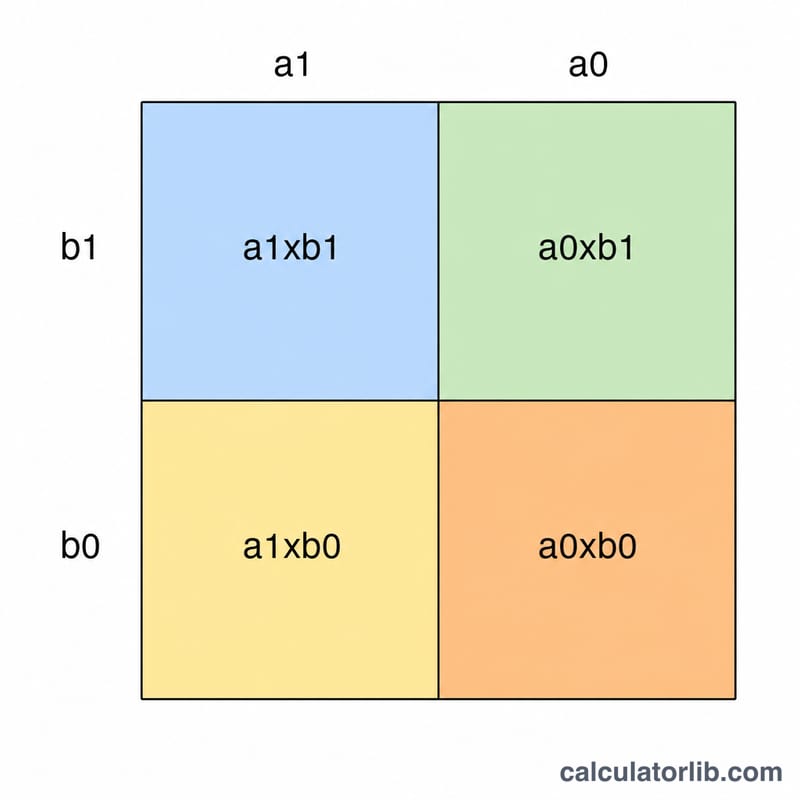
Worked example
For \(44 \times 36\): \(a_1=4\), \(a_0=4\), \(b_1=3\), \(b_0=6\). Cells: \(4\cdot 3=12\) (\(\times 100 = 1200\)), \(4\cdot 6=24\) (\(\times 10 = 240\)), \(4\cdot 3=12\) (\(\times 10 = 120\)), \(4\cdot 6=24\) (\(\times 1 = 24\)). Sum =
$$1200 + 240 + 120 + 24 = 1584,$$which equals \(44 \times 36\).
FAQ
Does it work for decimals or negatives? Yes for the product itself — the Answer is always \(\text{A} \times \text{B}\). The box grid is only shown for non-negative integers, where digit decomposition makes sense.
Why use the box method? It exposes place value clearly and is excellent for mental arithmetic practice and teaching multiplication.
What about numbers with more than two digits? The Answer is still exact; the simple four-cell grid is designed for two-digit inputs.