

What this calculator does
This tool multiplies two whole numbers and reveals the popular "Indian-style" (Vedic) complement method that makes the multiplication fast to do in your head — especially when the numbers sit just below a power of ten such as 9, 99, 999, 98 or 86. The mathematics is completely universal; "Indian style" is simply the name of the mental technique.
How to use it
Enter your first number and second number, then read the Answer. Below it you also get every intermediate value of the complement method — the working base, both complements, the cross-subtraction (left part), and the product of the complements (right part) — so you can practise the trick yourself.
The formula explained
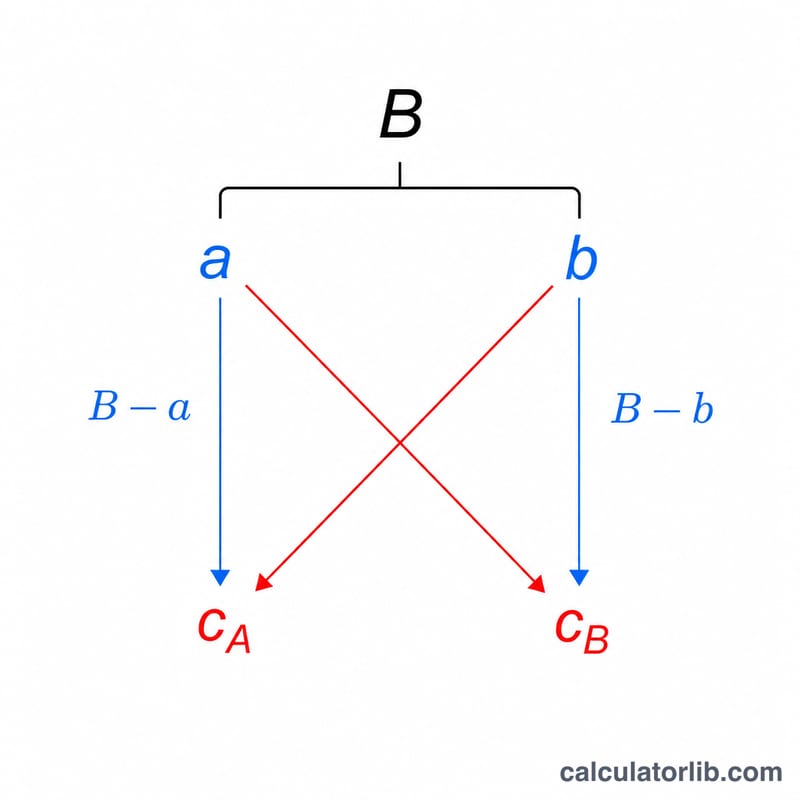
Pick a base \(B = 10^{k}\), where \(k\) is the digit-count of the larger number (so \(B = 100\) for two-digit numbers). Compute the complements \(c_A = B - a\) and \(c_B = B - b\). Then:
$$a \times b = (a - c_B) \times B + c_A \times c_B$$ The left part is a cross-subtraction (note \(a - c_B = b - c_A\)) and the right part is just the product of the two small complements — easy to do mentally.
Worked example: 86 × 99
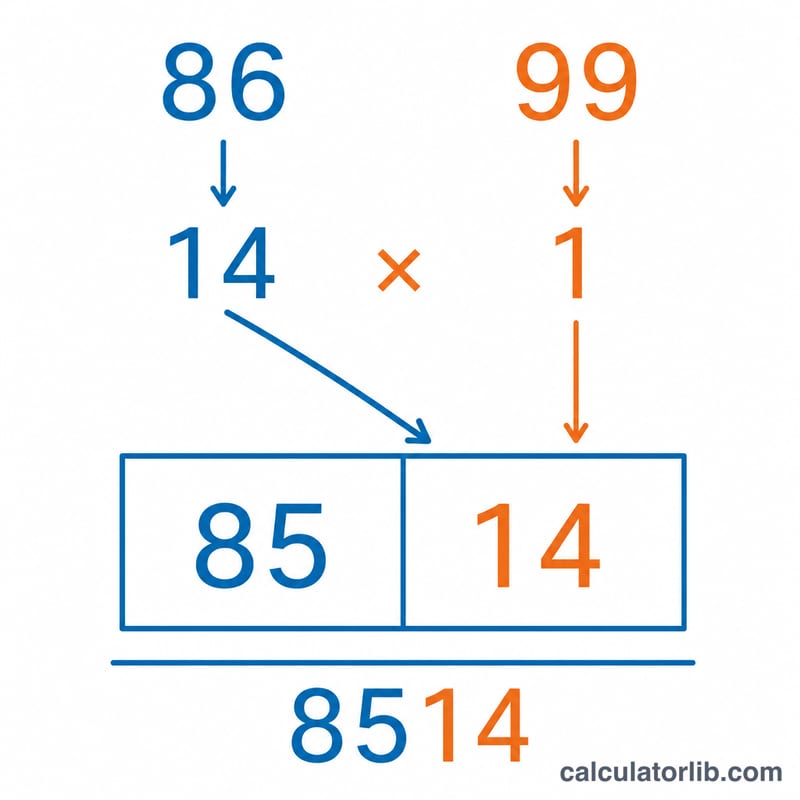
Larger number 99 has 2 digits, so \(B = 100\). \(c_A = 100 - 86 = 14\); \(c_B = 100 - 99 = 1\). Cross-subtraction: \(86 - 1 = 85\). Right part: \(14 \times 1 = 14\). $$\text{Product} = 85 \times 100 + 14 = 8500 + 14 = \mathbf{8514}$$ Check the all-nines shortcut: \(86 \times 99 = 8600 - 86 = 8514\).
FAQ
Does it work for any numbers? Yes — the answer is always exact. The complement breakdown is most useful when both numbers are near the same power of ten.
What if a number is above the base, like 103? The identity still holds; the complement simply becomes negative, and the formula gives the correct product.
What does "9...9" mean? A number made of all nines (9, 99, 999). Multiplying by it is the same as shifting left and subtracting the original number.