
What is line multiplication?
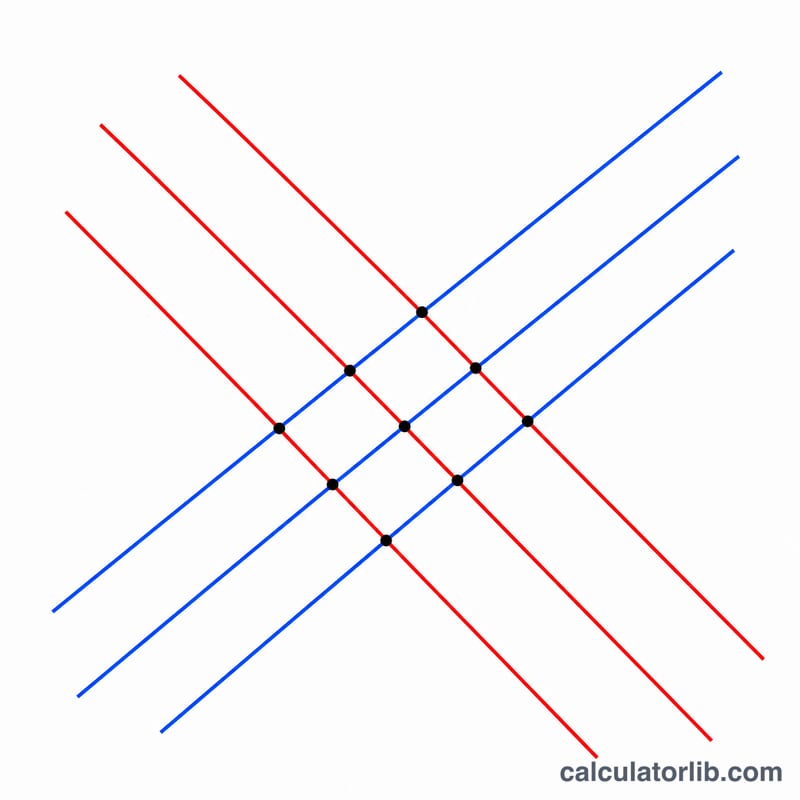
Line multiplication (often called the Vedic or Indian line method) is a visual way to multiply whole numbers by drawing two sets of crossing diagonal lines and counting where they intersect. Each digit of the first number becomes a band of parallel lines in one direction; each digit of the second number becomes a band in the crossing direction. Counting intersections along each diagonal column gives the digits of the answer. This calculator gives you the exact product instantly and also breaks down the intersection counts so you can sketch the diagram yourself.
How to use it
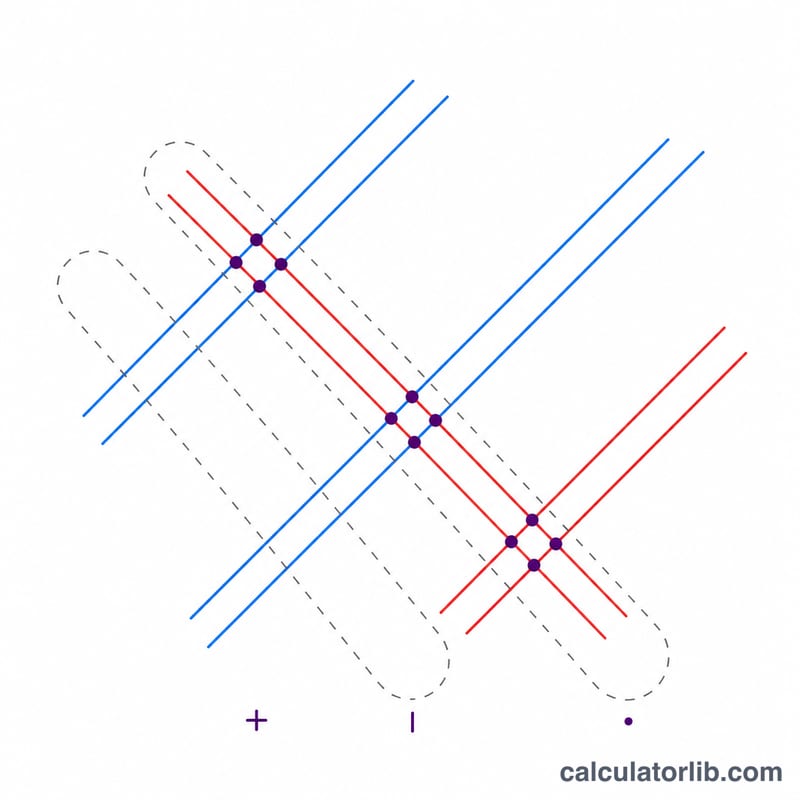
Enter your first number (the "problem") and the second number, then read the Answer box. For two-digit numbers the table shows three intersection groups — hundreds (left crossings), tens (middle crossings) and units (right crossings) — which is exactly what you would count from the drawn lines before resolving carries from right to left.
The formula explained
The product is plain arithmetic: product = multiplicand x multiplier. The line method is a geometric way to organize the same partial products. Writing \(a = 10a_1 + a_0\) and \(b = 10b_1 + b_0\), the units column counts \(a_0 \cdot b_0\), the middle column counts \(a_1 \cdot b_0 + a_0 \cdot b_1\), and the left column counts \(a_1 \cdot b_1\). Resolve each column right to left, carrying tens into the next column, and concatenate the digits.
$$\begin{gathered} \text{First} \times \text{Second} = 100\,(a_1 b_1) + 10\,(a_1 b_0 + a_0 b_1) + (a_0 b_0) \\[1.5em] \text{where}\quad \left\{ \begin{aligned} a_1, a_0 &= \text{tens, units digits of } \text{First} \\ b_1, b_0 &= \text{tens, units digits of } \text{Second} \end{aligned} \right. \end{gathered}$$Worked example
Take 12 x 23. Here \(a_1=1\), \(a_0=2\), \(b_1=2\), \(b_0=3\). Units = \(2 \cdot 3 = 6\) (digit 6, no carry). Tens = \(1 \cdot 3 + 2 \cdot 2 = 7\) (digit 7). Hundreds = \(1 \cdot 2 = 2\). Reading 2 | 7 | 6 gives 276, which matches $$12 \times 23 = 276.$$
FAQ
Does it work for any numbers? The product is correct for any whole numbers. The drawn-line visualization is most natural for small positive multi-digit integers; with large carries you simply resolve columns like ordinary addition.
What about a digit of 0? A zero digit means zero lines in that band and therefore no intersections in its groups — handled automatically.
What about negative numbers? Standard sign rules give the correct product, but the line drawing itself only makes sense for non-negative integers, so use absolute values when sketching the diagram.