
What this calculator does
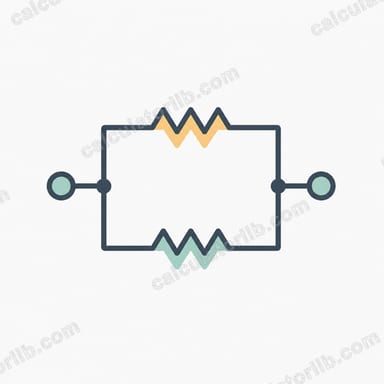
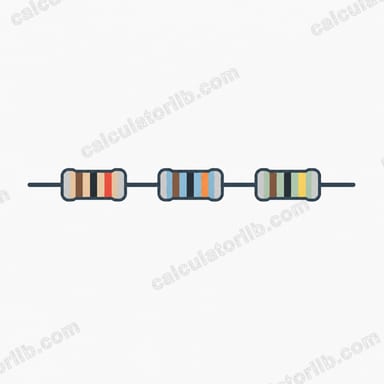
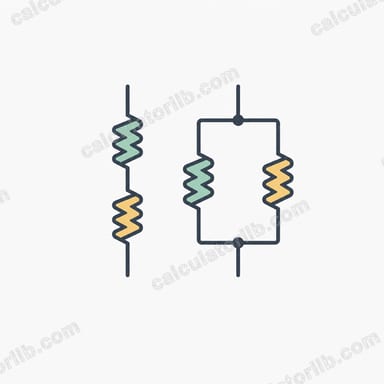
This tool computes the equivalent (combined) resistance of two resistors, R1 and R2, when they are wired in two common ways: in series (end to end, sharing one current path) and in parallel (both connected across the same two nodes). Enter each resistance, pick a unit from gigaohms down to microohms, and the calculator reports both the series result Rs and the parallel result Rp in ohms.
How to use it
Type the value of Resistance R1 and choose its unit, then do the same for Resistance R2. Both inputs are converted to base ohms before the math runs, so you can freely mix units (for example R1 in kOhm and R2 in Ohm). Press calculate to see Rs and Rp instantly.
The formulas explained
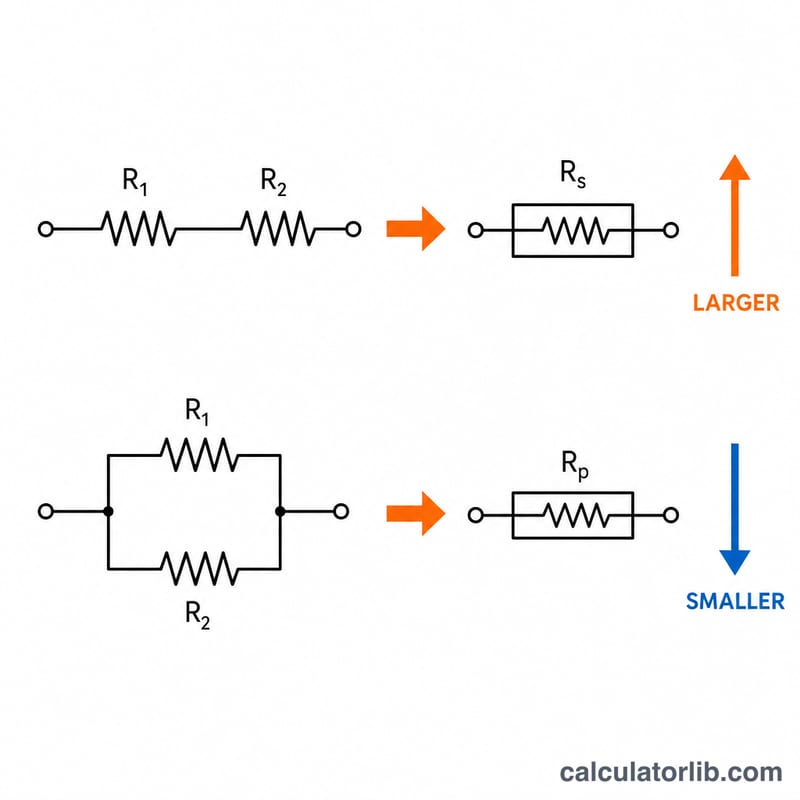
Resistance in series simply adds: \(R_s = R_1 + R_2\), because the same current flows through both and the voltage drops add up. In parallel the reciprocals add, which is most safely written as the product-over-sum form \(R_p = \frac{R_1 \times R_2}{R_1 + R_2}\). The parallel result is always smaller than the smaller of the two resistors. If either resistor is zero ohms it shorts that branch, so Rp becomes 0.
$$R_{\text{series}} = R_1 + R_2 \qquad R_{\text{parallel}} = \frac{R_1 \cdot R_2}{R_1 + R_2}$$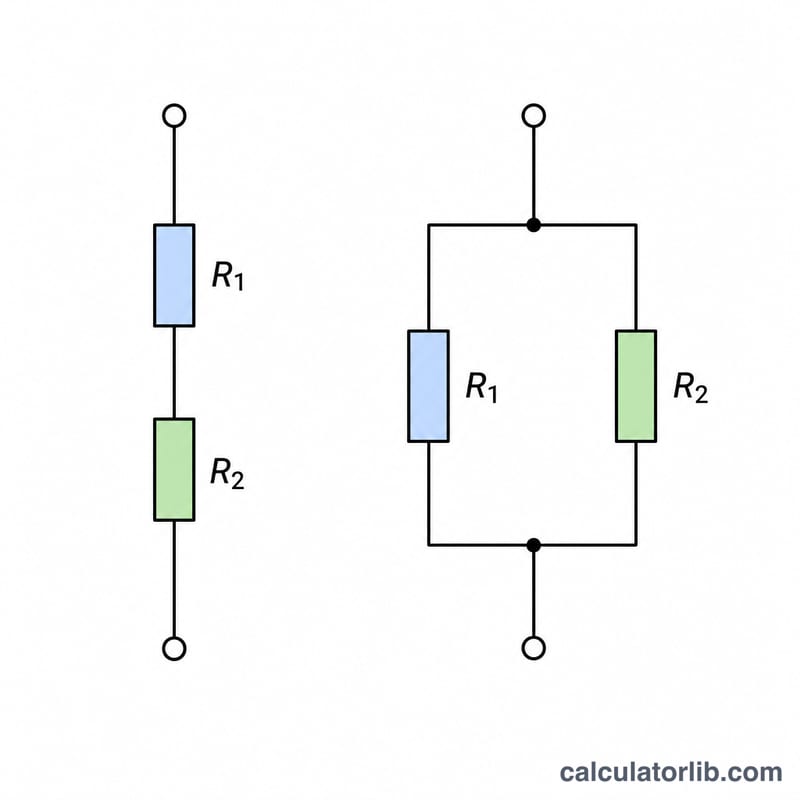
Worked example
Take R1 = 100 Ohm and R2 = 300 Ohm. Series: $$R_s = 100 + 300 = 400 \text{ Ohm}.$$ Parallel: $$R_p = \frac{100 \times 300}{100 + 300} = \frac{30000}{400} = 75 \text{ Ohm}.$$ With R1 = 2 kOhm and R2 = 6 kOhm you get \(R_s = 8000\) Ohm and \(R_p = \frac{12{,}000{,}000}{8000} = 1500\) Ohm (1.5 kOhm).
FAQ
Why is parallel resistance always lower? Adding a second path gives current more ways to flow, lowering the total opposition below either single resistor.
What if I enter 0 ohms? A zero-ohm resistor is a short circuit in parallel, so Rp returns 0; in series it just adds nothing.
Can I use this for more than two resistors? This version handles two at a time, but you can chain results: combine two, then treat the result as one resistor with a third.