
What this calculator does
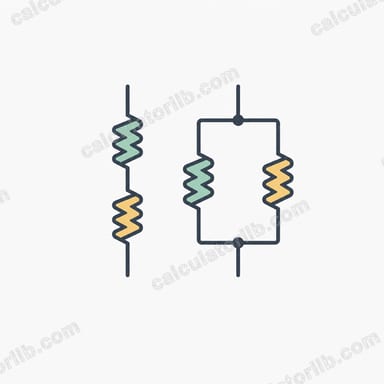
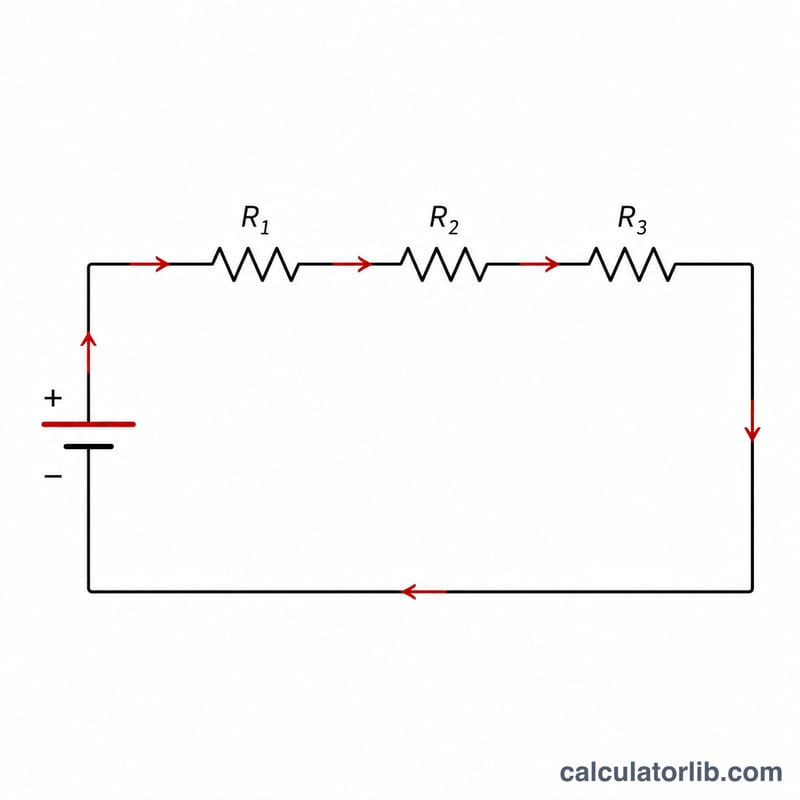
The Resistors in Series Calculator adds up the resistance values of two or more resistors connected end to end in a single line (a series circuit) and returns the total, or equivalent, resistance in ohms (Ω). In a series arrangement the same current flows through every component, so the individual resistances simply stack up to oppose that current. This tool saves you from manual addition and is handy for electronics hobbyists, students and engineers checking a design before building it.
How to use it
There is a single input field labelled Resistors in Series (Ω). Type each resistor value in ohms, separated by commas — for example 100, 47.5, 220. Decimal values are fully supported, so you can enter fractional ohms or precise measured values. Press calculate and the combined resistance appears instantly.
- Enter as many resistors as your circuit contains.
- Use commas to separate values; spaces around them are ignored.
- Only positive values are counted — zero, blank or invalid entries are skipped automatically.
The formula explained
The calculation uses the standard series resistance rule:
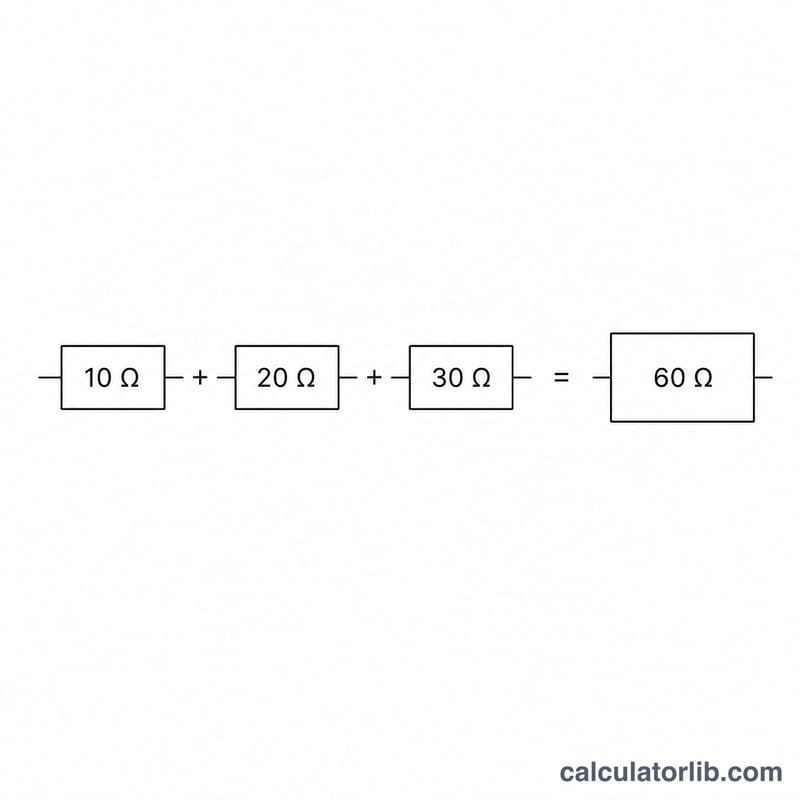
$$R_{\text{series}} = R_1 + R_2 + \cdots + R_n$$
The tool parses your comma-separated list, converts each entry to a number, discards anything that is not greater than zero, and then sums the remaining values. The result is the total ohms your series chain presents to the circuit.
Worked example
Suppose you enter 100, 47.5, 220:
- \(R_1 = 100\ \Omega\)
- \(R_2 = 47.5\ \Omega\)
- \(R_3 = 220\ \Omega\)
Adding them: $$100 + 47.5 + 220 = 367.5\ \Omega$$ That 367.5 Ω is the equivalent resistance — a single 367.5 Ω resistor would behave the same as those three in series.
FAQ
Why is total resistance always larger in series? Each resistor adds another obstacle to the same current path, so resistances simply add together and the total is always greater than the largest single resistor.
Can I mix whole numbers and decimals? Yes. Values like 1000, 4.7, 0.5 are all accepted and summed accurately.
What if I type a letter or leave an empty value? Non-numeric and zero or negative entries are automatically ignored, so only valid positive resistances contribute to the total. This prevents typos from corrupting your result.