
What Is the Inductors in Series Calculator?
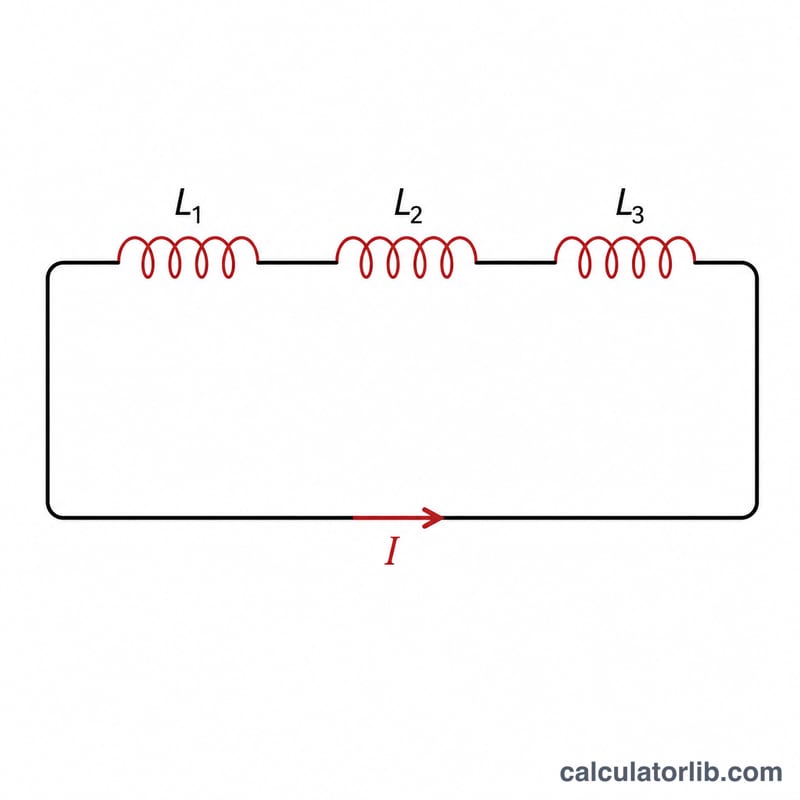
When inductors are connected end to end in a single path so the same current flows through each one, they are said to be in series. This calculator adds up the inductance of every component to give the equivalent total inductance of the chain. It works for any standard, non-coupled inductors and is useful for circuit design, filter networks, and electronics coursework.
How to Use It
Enter the inductance of each inductor in henries (H). You can leave unused fields blank — they will simply count as zero. The calculator returns the total in henries, millihenries (mH), and microhenries (µH) so you can match whatever unit your schematic uses.
The Formula Explained
For inductors in series the equivalent inductance is the simple sum of the individual values:
$$L_{\text{total}} = L_1 + L_2 + \ldots + L_n$$
This is analogous to resistors in series. It assumes there is no mutual inductance (magnetic coupling) between the coils. If the inductors are magnetically coupled, an extra \(\pm 2M\) term per coupled pair would be needed.
Worked Example
Suppose you connect a 10 mH (0.01 H) inductor, a 20 mH (0.02 H) inductor, and a 5 mH (0.005 H) inductor in series. The total is $$0.01 + 0.02 + 0.005 = 0.035 \text{ H},$$ which equals 35 mH or 35,000 µH.
FAQ
Does series always increase total inductance? Yes — for uncoupled inductors the total is always larger than the biggest single inductor, just like resistors in series.
What about mutual inductance? This calculator assumes no magnetic coupling. Tightly wound coils on the same core can couple and change the result.
What units should I enter? Enter all values in henries. To convert: \(1 \text{ mH} = 0.001 \text{ H}\) and \(1 \text{ µH} = 0.000001 \text{ H}\).