
What this converter does
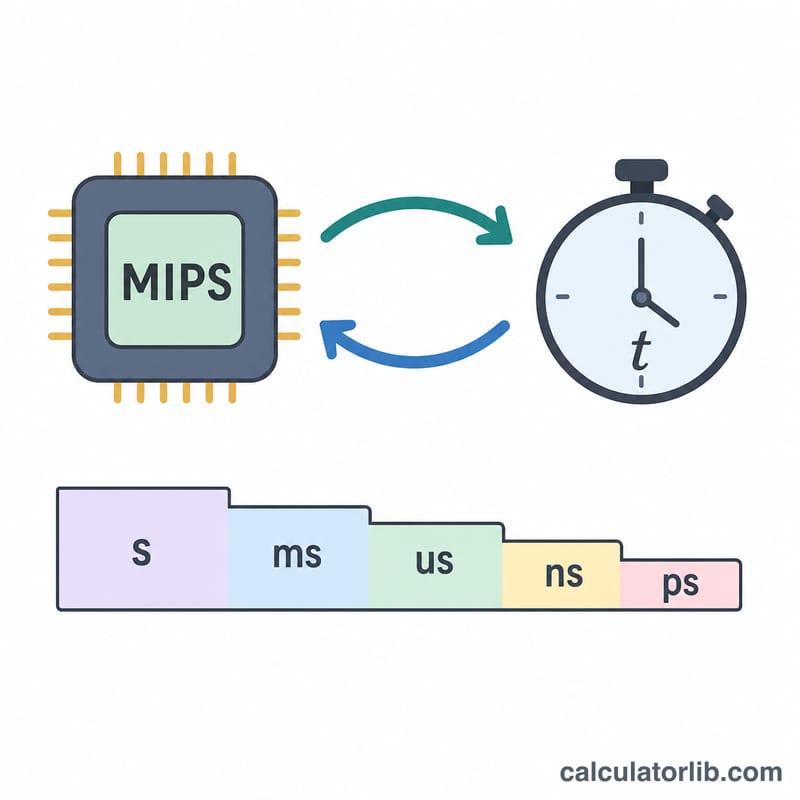
MIPS (Million Instructions Per Second) is a classic measure of processor throughput: how many millions of instructions a CPU completes every second. This tool converts a MIPS rating into the equivalent average time needed to execute a single instruction, and converts in the reverse direction as well. It is a universal computer-architecture metric and applies everywhere, with no region-specific rules.
How to use it
Pick a conversion direction. For MIPS to time, enter the MIPS value and read the average per-instruction time shown in seconds, milliseconds, microseconds, nanoseconds and picoseconds. For time to MIPS, enter the average instruction execution time, choose its unit, and the calculator returns the MIPS rating along with the same time expressed in every unit.
The formula explained
If a CPU runs at M MIPS, it completes \(M \times 10^{6}\) instructions every second. The average time per instruction is simply the reciprocal of that rate:
$$t = \frac{1}{M \times 10^{6}}\ \text{seconds}$$Rearranging gives the inverse relationship
$$\text{MIPS} = \frac{1}{t \times 10^{6}}$$where \(t\) is in seconds. Because the values span many orders of magnitude, the result is shown in five SI scales so you can read whichever is most convenient.
Worked example
Take a 50 MIPS processor. Per-instruction time =
$$\frac{1}{50 \times 10^{6}} = \frac{1}{5 \times 10^{7}} = 2 \times 10^{-8}\ \text{s}$$which is 0.00002 ms, 0.02 us, 20 ns, or 20000 ps. Running it backwards, an average instruction time of 20 ns gives
$$\text{MIPS} = \frac{1}{20 \times 10^{-9} \times 10^{6}} = \frac{1}{0.02} = 50\ \text{MIPS}$$FAQ
Why must values be positive? A MIPS of 0 means the CPU never finishes an instruction (infinite time), and an execution time of 0 implies infinite MIPS. Both produce a division by zero, so the calculator rejects zero and negative inputs.
Does MIPS account for instruction complexity? No. MIPS counts instructions regardless of the work each does, so it should not be used to compare different instruction-set architectures directly.
How is MIPS related to clock speed? \(\text{MIPS} = \dfrac{\text{clock frequency (Hz)}}{\text{CPI} \times 10^{6}}\), where CPI is the average cycles per instruction. This converter works purely from the throughput figure, so it stays architecture-independent.