
What This Calculator Does
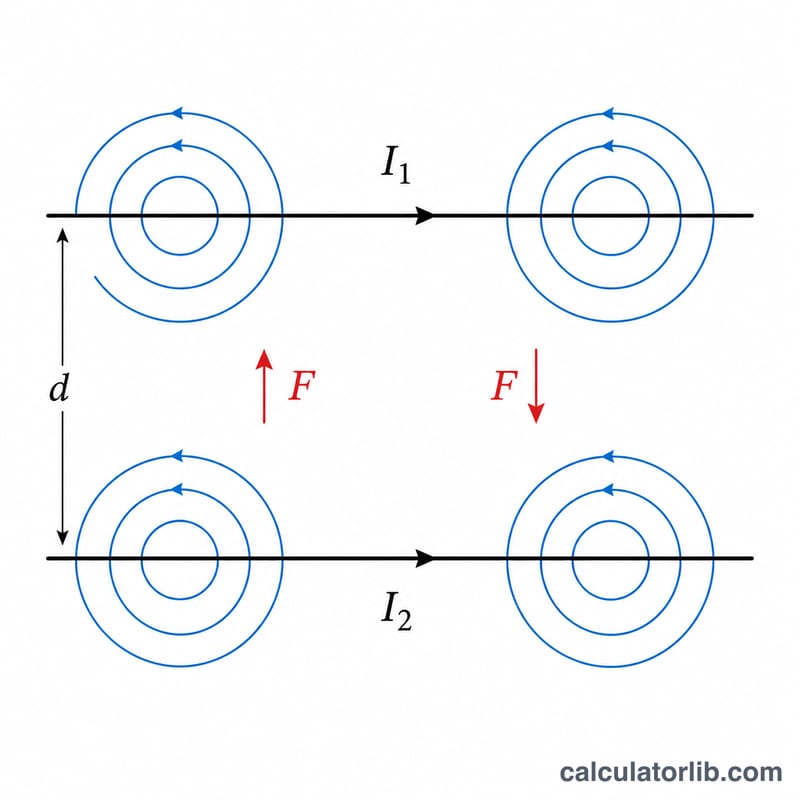
Two long, straight, parallel wires carrying electric current exert a magnetic force on each other. This calculator computes the force per unit length and the total force between them from the currents (I₁, I₂), their separation distance (d), and the wire length (L). Currents in the same direction attract; currents in opposite directions repel. This is a universal physics relationship and applies anywhere.
How to Use It
Enter the current in each wire in amperes, the center-to-center separation distance in meters, and the length of wire over which you want the total force, also in meters. The calculator returns the force per meter (N/m) and the total force (N).
The Formula Explained
The force per unit length is given by Ampère's force law:
$$\frac{F}{L} = \frac{\mu_0 \, \text{I}_1 \, \text{I}_2}{2\pi \, \text{d}}$$
where \(\mu_0 = 4\pi \times 10^{-7}\ \text{T}\cdot\text{m/A}\) is the permeability of free space (\(\approx 1.2566 \times 10^{-6}\)). Multiplying by L gives the total force. The relationship was historically used to define the ampere.
Worked Example
Two wires each carry 10 A and are separated by 0.1 m, with a length of 1 m. Then $$\frac{F}{L} = \frac{4\pi \times 10^{-7} \times 10 \times 10}{2\pi \times 0.1} = \frac{1.2566 \times 10^{-6} \times 100}{0.6283} = \frac{1.2566 \times 10^{-4}}{0.6283} \approx 2.0 \times 10^{-4}\ \text{N/m}.$$ Over 1 m, the total force is also \(\approx 2.0 \times 10^{-4}\ \text{N}\).
FAQ
Do the wires attract or repel? Parallel currents in the same direction attract each other; antiparallel currents repel. This calculator returns the magnitude.
What units should I use? Amperes for current and meters for distance and length, giving force in newtons.
Is this valid for any geometry? The formula assumes long, straight, parallel wires whose length is much greater than their separation, in free space (vacuum or air).