What this calculator does
Soft drinks pack a surprising amount of sugar, but nutrition labels usually show carbohydrate only for a small "reference amount" such as per 100 ml. This tool scales that figure up to the actual size of the bottle or can you are drinking, giving you the total grams of sugar in the whole container. It then translates the number into an easy-to-picture count of sugar sticks (the small 3 g packets you find in cafes), so you can instantly see how sweet your drink really is.
How to use it
Enter three values from the bottle or label: the container volume you are actually consuming (ml), the reference amount the label refers to (usually 100 ml), and the carbohydrate per reference amount (g). Press calculate to see total sugar in grams and the equivalent number of sugar sticks.
The formula
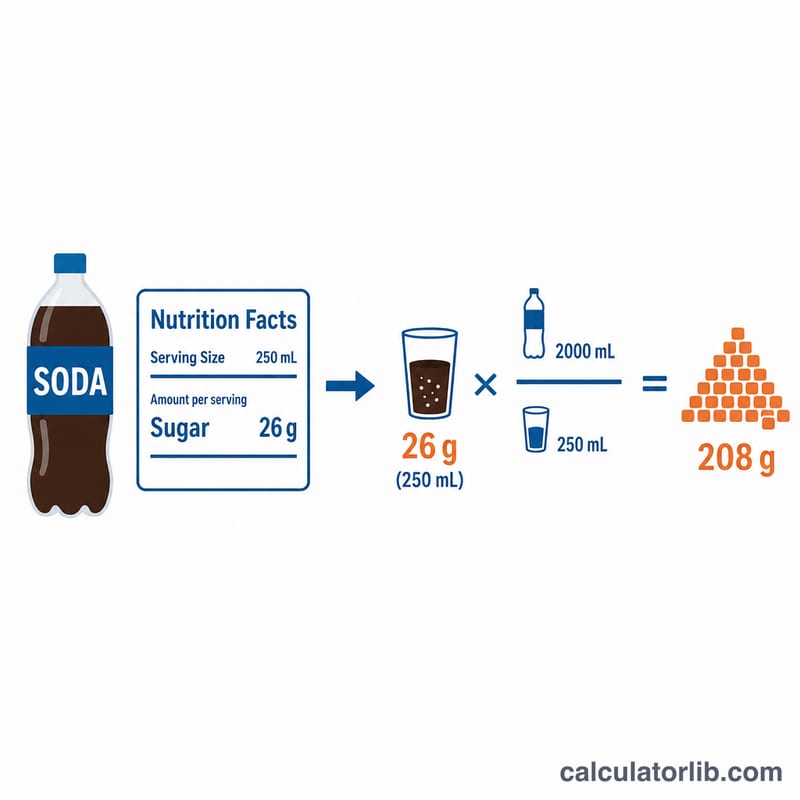
The calculation is a simple proportion. First the label value is scaled to the full container:
$$\text{sugarGrams} = \text{carbPerUnit} \times \frac{\text{containerVolume}}{\text{unitAmount}}$$
Then the total is converted to sugar sticks using an assumed 3 g per stick:
$$\text{sugarSticks} = \frac{\text{sugarGrams}}{3}$$
In typical sweetened soft drinks essentially all carbohydrate is sugar, so the label "carbohydrate" figure is treated as "sugar".
Worked example
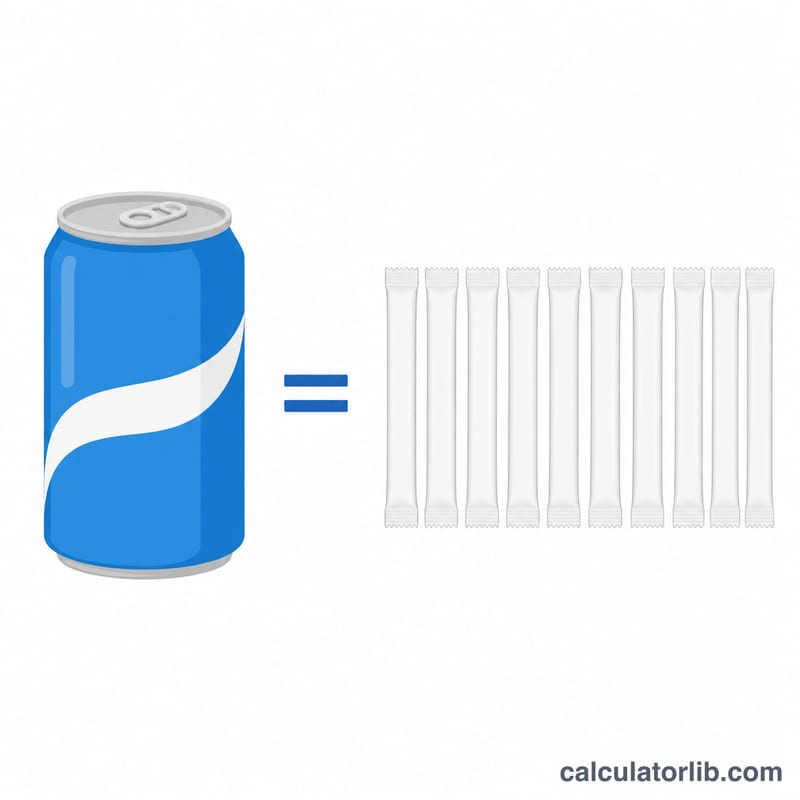
A 500 ml bottle lists 13.5 g of carbohydrate per 100 ml. Scaling up: $$13.5 \times \frac{500}{100} = 13.5 \times 5 = \textbf{67.5 g}$$ of sugar. As sugar sticks: \(67.5 \div 3 = \textbf{22.5}\) sticks. That single bottle contains the equivalent of more than twenty sugar packets.
Interpreting Your Result
The calculator estimates the grams of sugar in a container by scaling the label's carbohydrate value: \(\text{Sugar (g)} = \text{Carb per ref (g)} \times \frac{ \text{Container (ml)}}{ \text{Reference (ml)}}\). It then shows that amount as a number of 3 g sugar sticks (grams ÷ 3).
To put the number in context, the World Health Organization (WHO) guideline on sugars intake recommends that free sugars make up less than 10% of total energy intake for adults and children. It also suggests, as a conditional recommendation, a further reduction to below 5% of energy. On a 2000 kcal diet, these correspond to roughly 50 g and 25 g of free sugars per day. Individual energy needs vary, so these are reference figures, not personal targets.
- 25 g per day ≈ 8 sticks of 3 g (25 ÷ 3 ≈ 8.3).
- 50 g per day ≈ 17 sticks of 3 g (50 ÷ 3 ≈ 16.7).
You can compare your result with these two benchmarks to see how much of a day's reference amount one container would use. Free sugars include added sugars as well as sugars naturally present in honey, syrups and fruit juices.
Limitation: this tool uses the carbohydrate figure as a stand-in for sugar. If the drink contains fiber, starch or sugar alcohols (polyols), total carbohydrate can overstate the sugar content. Where the label lists "of which sugars", use that value instead. This is general information only and not medical or dietary advice.
Sugar in Common Container Sizes
The table applies the formula to common container sizes at two assumed label values: 10.6 g carbohydrate per 100 ml, and 13.5 g per 100 ml (the value used in the worked example). Sticks are grams ÷ 3, rounded to one decimal place. The values are illustrative and do not describe any specific brand.
| Container | Sugar at 10.6 g/100 ml | Sticks (3 g) | Sugar at 13.5 g/100 ml | Sticks (3 g) |
|---|---|---|---|---|
| 250 ml | 26.5 g | 8.8 | 33.75 g | 11.3 |
| 330 ml | 34.98 g | 11.7 | 44.55 g | 14.9 |
| 500 ml | 53 g | 17.7 | 67.5 g | 22.5 |
| 1 L (1000 ml) | 106 g | 35.3 | 135 g | 45.0 |
| 1.5 L (1500 ml) | 159 g | 53.0 | 202.5 g | 67.5 |
Example substitution (500 ml at 10.6 g per 100 ml): \(10.6 \times \frac{500}{100} = 53\) g, and \(53 \div 3 \approx 17.7\) sticks.
Remember that large bottles often contain several servings, so the whole-container total is not necessarily a single portion.
FAQ
Why use carbohydrate instead of sugar? Most regular soft drinks contain no fiber or starch, so the carbohydrate value and the sugar value are essentially the same. For drinks with added fiber or sugar alcohols this method will overestimate the true sugar.
Why 3 g per sugar stick? A standard café sugar stick or packet weighs about 3 g, which makes a handy mental reference. The constant is fixed in this calculator.
What if the reference amount is zero? The division would be undefined, so the reference amount must be greater than zero for a valid result.