
What Is the Added Sugar Intake Calculator?
This tool estimates the maximum amount of added sugar you should consume each day, based on your total calorie intake. It follows the American Heart Association (AHA) guideline that no more than 10% of your daily calories should come from added sugar. Added sugar refers to sugars and syrups added during processing or preparation — not the natural sugars found in whole fruit, vegetables, or plain milk.
How to Use It
Enter your typical daily calorie intake (for example 2,000 kcal) and the percentage limit you want to apply. The default 10% reflects the AHA recommendation, but you can lower it for a stricter target. The calculator returns your daily added sugar ceiling in grams, the calories those grams represent, and a rough conversion to teaspoons.
The Formula Explained
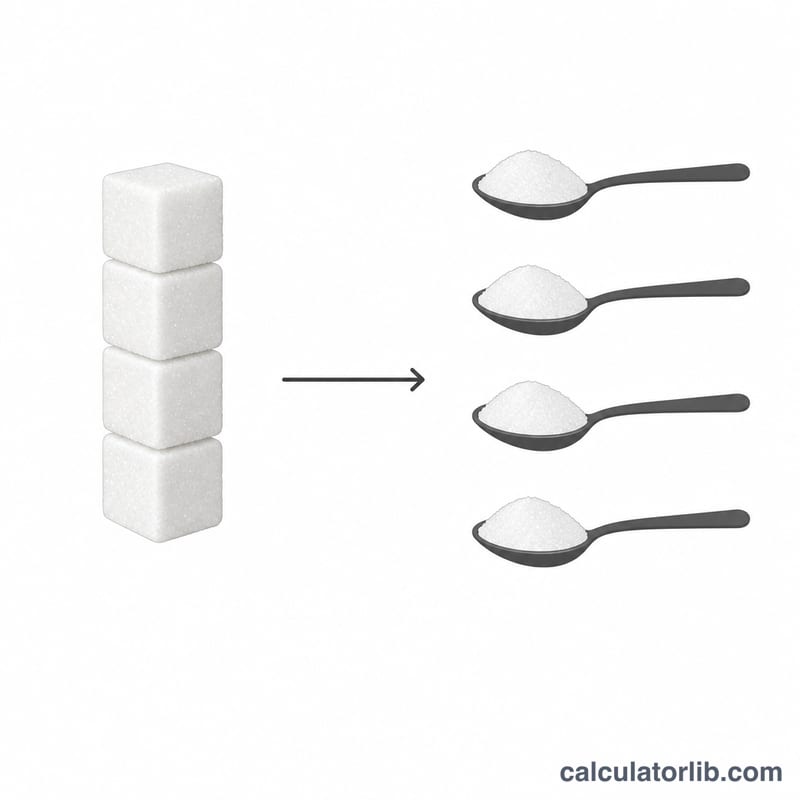
Each gram of sugar provides about 4 calories. First, the calories allowed from added sugar are found by multiplying total calories by the percent limit: \(\text{Calories} \times (\text{Percent} \div 100)\). Dividing that by 4 converts calories to grams. One teaspoon of granulated sugar weighs roughly 4.2 grams, so grams \(\div\) 4.2 gives an approximate teaspoon count.
$$\text{Max Sugar (g)} = \frac{\text{Calories} \times (\text{Percent} / 100)}{4}$$$$\text{tsp} = \frac{\text{grams}}{4.2}$$
Worked Example
For a 2,000-calorie diet at the 10% limit: $$2{,}000 \times 0.10 = 200 \text{ calories from added sugar}.$$ Dividing by 4 gives 50 grams of added sugar per day, which is about $$50 \div 4.2 \approx 11.9 \text{ teaspoons}.$$
Recommended Added Sugar Limits
Added sugars are sugars and syrups added to foods and beverages during processing or preparation — they exclude the naturally occurring sugars found in whole fruit, vegetables and plain dairy. Major health authorities set their guidance in two ways: as a percentage of total daily calories, or as an absolute amount in grams (or teaspoons). Because added sugar provides about 4 calories per gram, a percentage-of-calories limit can be converted directly into grams, which is what this calculator does.
| Authority / Group | Recommended limit | Approx. grams/day | Approx. teaspoons/day |
|---|---|---|---|
| AHA — Adult women | No more than ~100 calories from added sugar | 25 g | 6 tsp |
| AHA — Adult men | No more than ~150 calories from added sugar | 36 g | 9 tsp |
| AHA — Children (ages 2–18) | Less than 100 calories from added sugar | <25 g | <6 tsp |
| WHO — Strong recommendation | Less than 10% of total energy | <50 g (on a 2,000-kcal diet) | <12 tsp |
| WHO — Conditional (ideal) | Less than 5% of total energy | <25 g (on a 2,000-kcal diet) | <6 tsp |
| FDA — Daily Value (food labels) | Reference for % Daily Value | 50 g | ~12 tsp |
American Heart Association (AHA): The AHA recommends that most women consume no more than about 25 grams (6 teaspoons) of added sugar per day and most men no more than about 36 grams (9 teaspoons) per day. For children and teens ages 2 to 18, the AHA advises less than 25 grams (6 teaspoons) of added sugar daily, and no added sugar at all for children under age 2. (Source: American Heart Association, “Added Sugars” guidance.)
World Health Organization (WHO): WHO issues a strong recommendation to reduce free sugars to less than 10% of total energy intake throughout life, and suggests a further reduction to below 5% for additional health benefits. On a 2,000-calorie diet, 10% of energy equals about 50 grams of added sugar, while 5% equals about 25 grams. (Source: WHO Guideline on Sugars Intake for Adults and Children, 2015.)
U.S. Food and Drug Administration (FDA): The FDA sets the Daily Value (DV) for added sugars at 50 grams per day, based on a 2,000-calorie reference diet. This figure is what the “% Daily Value” for added sugars on the Nutrition Facts label is calculated against. (Source: FDA Nutrition Facts label regulations.)
Note: This is general information, not personalized nutrition advice. Individual needs vary with age, calorie intake and health conditions — consult a qualified health professional for guidance specific to you.
FAQ
Is 10% the right target? The AHA suggests an even tighter ideal limit of about 25 g/day for women and 36 g/day for men. The 10%-of-calories rule is a general dietary guideline.
Does this include natural sugar? No. It applies only to added sugars listed on nutrition labels, not naturally occurring sugars in fruit or dairy.
How many grams is 4 calories? Sugar provides 4 calories per gram, which is why we divide the sugar-calorie budget by 4 to get grams.